
Crepey skin is incredibly common, and incredibly frustrating. You may first notice it under your eyes, where the skin suddenly looks thinner, darker, or more shadowed. Or maybe it’s your arms, neck, or another area that just… doesn’t look as smooth as it used to.
Why does it happen? A lot of it comes down to changes in the skin itself. We lose collagen and elastin as we age, years of sun exposure catches up with us, and our skin naturally becomes thinner and drier. All of these factors can contribute to that finely wrinkled, almost papery texture we call crepey.
The good news? There are things we can do about it. But first: we’re big believers in understanding why your skin looks the way it does before throwing products and procedures at it. Sometimes better skincare is where we need to start. Other times, we need to stimulate collagen at a deeper level.
Usually the right approach depends on the area we’re treating, the condition of your skin, and what you’re hoping to improve. So let’s talk about how to get rid of crepey skin safely and effectively, what actually helps, and which treatment options we recommend.
How to Get Rid of Crepey Skin: Is It Possible?
At Emerge Aesthetics, we firmly believe that honesty is the best policy. So to answer the question upfront: there isn’t one magic treatment for crepey skin. (And if someone says that there is, they’re probably selling a trendy product online.) What works depends on why the skin looks crepey in the first place, where you’re seeing it, your skin quality, and how much change you’re hoping to see.
This is why we don’t love throwing one treatment at every skin concern. Crepiness can involve dryness and surface texture for one person, but reflect deeper changes in collagen and elastin for another. Sometimes skincare can make a noticeable difference, while other times, patients need a more proactive approach to deeper skin rejuvenation. (And most of the time… we tend to combine both approaches.)
Here’s more on what crepey skin is and why it tends to show up:
What Is Crepey Skin?
Crepey skin is thin, finely wrinkled skin that looks a little like crepe paper. It’s usually softer and more fragile than it used to be, and you tend to see that texture across a larger area rather than in one distinct crease.
That’s what makes it different from your typical fine lines and wrinkles. Expression lines around the eyes or mouth are influenced by repeated muscle movement, exactly what we covered in our article on getting rid of and preventing forehead wrinkles. Crepey skin has more to do with changes in quality and structure of the skin itself, including the loss of collagen and elastin.
And what about loose skin? They’re related, but they’re not exactly the same thing. Loose skin is more about laxity and a loss of support. Think: loose belly skin after weight loss or pregnancy. Crepiness, on the other hand, describes a thin, finely wrinkled texture. You can absolutely have both, which is why identifying what we’re actually treating matters.
What Does Crepey Skin Look Like?
For a lot of people, crepey skin becomes noticeable before they can name what it is. And where does it generally show up first? Under the eyes. The skin there is already some of the thinnest on your body, so early changes can show up as bags, darkness, shadows, or a finely wrinkled texture. You may also notice skin that visibly looks thinner, feels more delicate, and doesn’t bounce back as well when it moves.
That said, the under eyes aren’t the only place people notice crepiness. It can also show up just as easily on the neck, chest, forearms, and backs of the hands, especially after years of sun exposure. (This will come back up, trust us.)
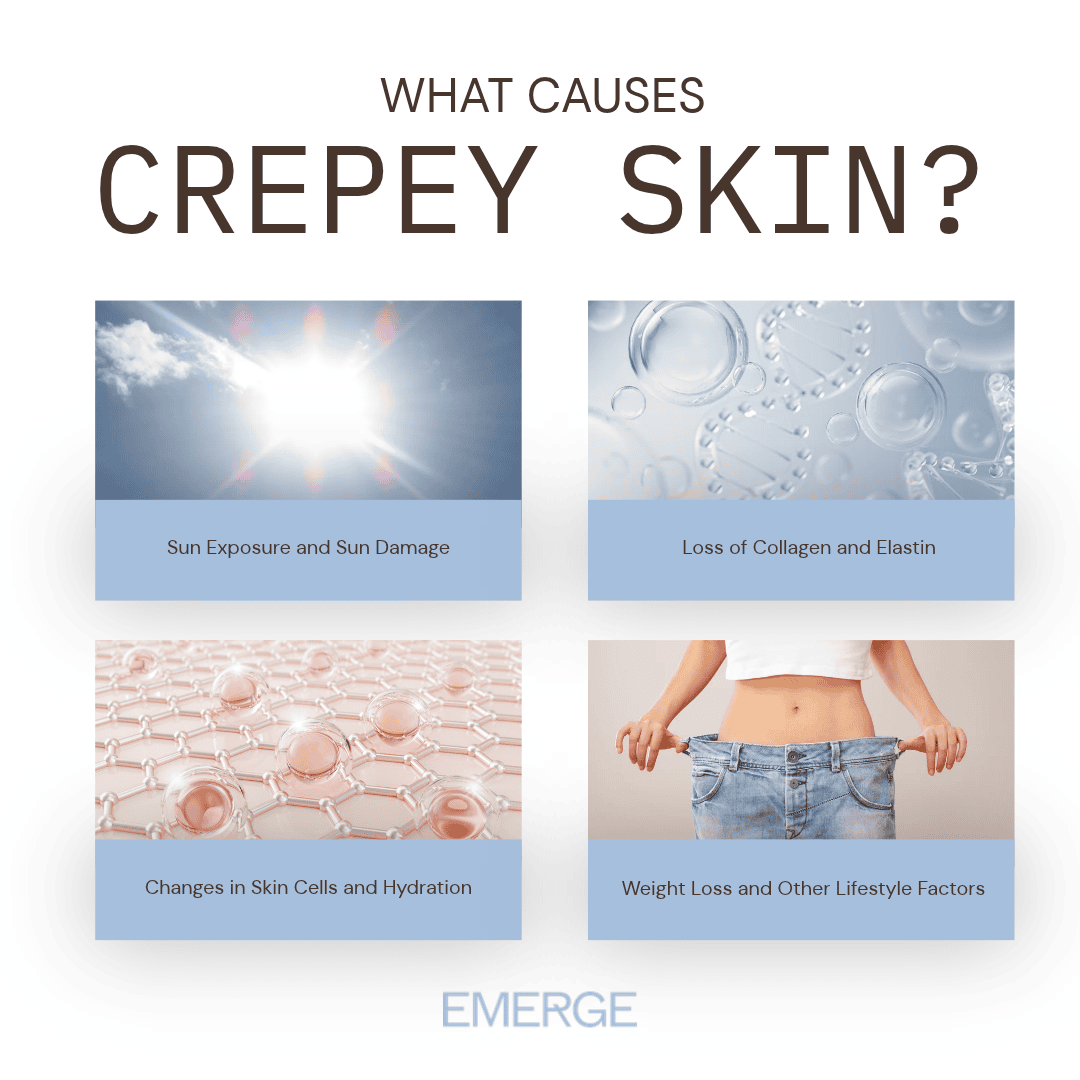
What Causes Crepey Skin?
Usually, there isn’t one culprit. Aging changes the skin naturally, but sun damage, hydration, lifestyle, and changes in your weight can all influence how noticeable crepey skin becomes.
Here’s what you need to know:
Sun Exposure and Sun Damage
UV radiation doesn’t just give you a nice bronzy glow and nose freckles; it also damages collagen and elastin, two proteins your skin relies on for structure and resiliency. More importantly, UV damage isn’t solely the result of the “big” moments people think of, like suntanning with baby oil or burning a little too much on a beach day. The little bits of exposure that you get day after day count, too.
UV rays trigger unstable molecules, free radicals, which can damage proteins, DNA, and healthy skin. At the same time, exposure increases the activity of enzymes called matrix metalloproteinases, breaking down the extracellular matrix (including collagen and elastin).
We can do a lot to improve skin quality, but we also need to protect the collagen we already have.
Loss of Collagen and Elastin
Think of collagen as part of the scaffolding that gives your skin structure. Elastin helps it stretch and then return to its original shape.
As we age, we naturally begin producing less collagen. To be specific, by the time you turn 25, you begin losing up to 1.5% collagen per year. As your skin loses that underlying support, it becomes thinner and doesn’t bounce back the way it used to. That’s when fine lines, crepiness, and other signs of aging can become more obvious.
Changes in Skin Cells and Hydration
Dry skin makes everything worse. Crepiness included.
Healthy skin cells (keratinocytes) hold water, making them plump and smooth. If these cells become dehydrated, they become shrunken, shriveled, and brittle. Think of this process like you would a sponge: bouncy when it’s wet, stiff and scratchy when it’s dry.
Your skin barrier plays a role here, too. When your barrier isn’t holding onto moisture well, more water escapes through the surface of the skin in a process called transepidermal water loss (TEWL). With less moisture, the skin doesn’t feel as supple, and fine lines and tiny folds in the surface become easier to see.
Weight Loss and Other Lifestyle Factors
Weight loss can make crepey skin more noticeable, especially when you lose a significant amount of volume and the skin doesn’t contract at the same time. In that situation, you may be seeing both crepiness and laxity. (We talk more about that distinction in our article on how to tighten tummy skin after pregnancy!)
Smoking is another consideration with crepey skin, as it can accelerate skin aging and affect collagen production. Beyond this, sleep, nutrition, alcohol intake, and your overall skin health can play a role in how your skin looks and recovers over time.
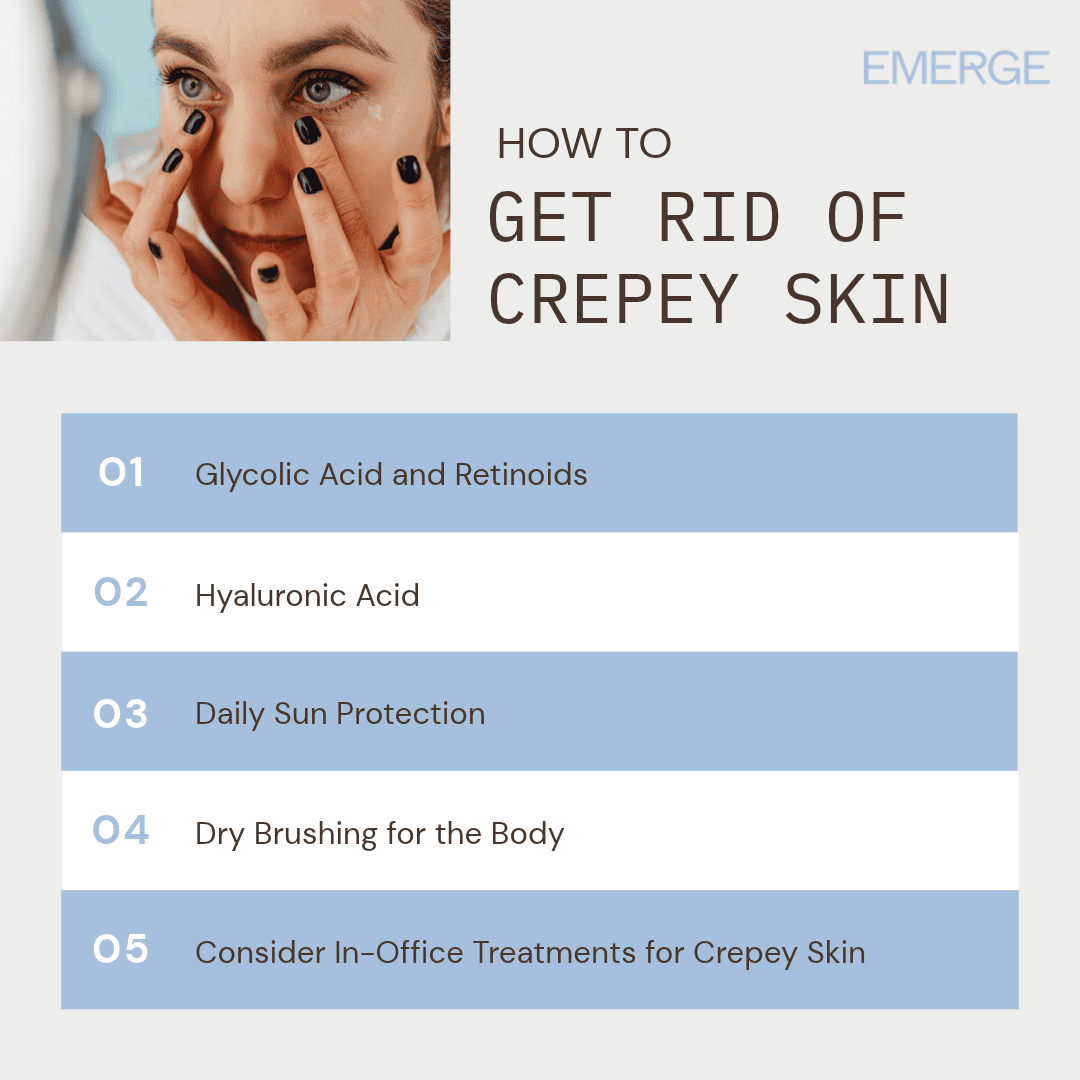
How Do You Get Rid of Crepey Skin? Skincare and Non-Surgical Treatments
This is where we want people to keep their expectations realistic. We can improve crepey skin. We can make it smoother, healthier, firmer, and less noticeable. But we don’t promise that one product or procedure will completely erase the concern.
At Emerge Aesthetics, our double-board-certified Emergency Medicine physician, Dr. Kling, takes a multimodal approach to skin concerns, addressing the different layers of skin quality rather than relying on a single, universal approach.
Here’s how this can look in practice:
Glycolic Acid and Retinoids
At Emerge, skincare is the foundation of everything we do. In fact, we believe that getting rejuvenative treatments without healthy skin quality is like building a house without laying the foundation.
That said, when it comes to crepiness, Dr. Kling is a big fan of glycolic acid wash. Glycolic acid is one of the alpha-hydroxy-acids (AHAs), and it exfoliates the surface of the skin while encouraging healthy skin cell turnover. Research even shows that it can promote apoptosis in skin cells, boosting collagen and elastin synthesis and improving skin cells.
Retinoids are another favorite of ours at Emerge because they increase skin cell turnover, stimulate collagen and elastin production, and help regulate melanin. Here’s the thing, though: when first starting retinoids, you may notice it gets worse before it gets better. Stick with it and start slowly; it often pays off.
Hyaluronic Acid
Hyaluronic acid is another key ingredient for improving skin elasticity, helping hydrate and support the skin barrier. It works by attracting and holding onto water (1,000 times its weight, to be exact), which helps the skin look plumper, smoother, and more supple.
Why does that matter for crepey skin? When skin is dry and dehydrated, fine lines and that thin, papery texture tend to look more noticeable. Adding hydration back into the skin can soften their appearance and improve the way the surface looks and feels.
Just keep expectations realistic. Hyaluronic acid won’t replace lost collagen, but it can give the skin the hydration it needs while treatments like retinoids, lasers, and microneedling address other structural changes.
Daily Sun Protection
Wearing sunscreen is an absolute non-negotiable when you want to prevent crepey skin. We’ve said it 100 times, and we’ll say it 100 more! It’s one of the simplest things you can do, yet also one of the most important.
Will sunscreen reverse the crepey skin you already have? No. But if you’re spending money on skincare and treatments while continuing to accumulate sun damage, you’re essentially working against yourself.
We recommend a broad-spectrum SPF 30 or higher every day, not just when you plan to spend hours outdoors. And hear us when we say that medical-grade skincare will always outperform generic products. Why? Because these are formulas that use higher actives, are clinically tested, and often target deeper layers of the skin. Our top picks are Skinceuticals Daily Brightening UV Defense Sunscreen and Alastin Hydratint Pro Mineral Broad Spectrum Sunscreen.
But if you want the entire lineup, head to the Emerge Skincare Shop, where you can find all of Dr. Kling’s most recommended options.
Pro Tip: Combine your SPF with other sun-protective tools, like hats when you go for afternoon walks, gloves when you’re driving, and long-sleeves at the beach. (It sounds dramatic, but you’ll really appreciate this later.)
Dry Brushing for the Body
For crepey skin on the body, especially the buttocks, Dr. Kling is a big fan of dry brushing. Dry brushing physically exfoliates the skin, which can help the surface feel smoother and improve the appearance of dry, rough texture. Keep the pressure gentle; we’re trying to exfoliate the skin, not attack it.
Beyond this, it can also boost blood flow and prep the skin to better absorb hydrating ingredients. It’s simple, inexpensive, and easy to make part of your regular routine. Use it for crepey skin on arms, the buttocks, the thighs, or even the stomach.
Consider In-Office Treatments for Crepey Skin
For more significant texture and sun damage, non-surgical lasers are some of Dr. Kling’s top recommendations.
Fractionated CO2 laser resurfacing with SmartXide Pro resurfaces damaged skin while triggering the healing response that stimulates new collagen production. AVAVA gives us another way to stimulate collagen with less disruption to the skin’s surface. It’s a non-ablative laser that uses Focal Point Technology™ to deliver ring-shaped microbeams into the dermis, while ComfortCool™ technology cools the surface during treatment.
Emerge is currently the only verified med spa in Bergen County offering AVAVA, and one of just two practices in the greater New Jersey area with the technology. In other words, book your treatments at Emerge Aesthetics; there’s a reason this treatment is so popular.
Another recommendation? Microneedling, which can help remodel texture and stimulate collagen. And when the problem involves more structural support, Dr. Kling may also recommend a biostimulator, such as Sculptra or Radiesse.
The point of having more treatment options isn’t to do more. It’s to choose the right tool for the layer we’re trying to treat. That’s why Dr. Kling will look at your skin quality, anatomy, and goals before ever recommending anything. Your skin deserves precision; not guesswork.
Treating Crepey Skin with Emerge Aesthetics
So, how do you get rid of crepey skin? You start with skincare, especially a glycolic acid wash and a retinoid, protect that work with daily SPF 30, and layer in treatments like laser resurfacing, AVAVA, microneedling, and biostimulators as your skin needs them. It’s not about doing more; it’s about doing it right, over time. Skin health is an investment, and consistency is what pays it off.
Emerge Aesthetics is a physician-owned and operated med spa in Bergen County, New Jersey, where Dr. Kling personally performs every procedure. We proudly serve Glen Rock, Ridgewood, Wyckoff, Franklin Lakes, Saddle River, Upper Saddle River, Ho-Ho-Kus, Paramus, and New York City. Ready to build a plan for your skin? Book a consultation for crepey skin treatment with us, browse our medical-grade skincare shop, follow along on Instagram, and keep reading on the Emerge blog.
This content is for educational purposes only and is not medical advice. Individual results vary, and a consultation determines candidacy. Please consult Dr. Kling regarding any medications, medical conditions, pregnancy, or nursing before beginning new products or treatments.
Rochelle Kling MD.