
Whether through lifestyle changes, physician guidance, or even bariatric surgery, losing weight is an incredible accomplishment. Loose abdominal skin after weight loss, on the other hand, can feel like an unexpected hurdle.
The truth is, weight loss changes far more than the number on the scale. As fat volume decreases, skin that has been stretched over time doesn’t always retract to match the new body shape. Instead, you’re left with extra skin that affects how clothing fits, causes discomfort, contributes to skin irritation, and impacts your confidence.
Let us be the ones to say: you deserve to feel as beautiful and healthy on the outside as you do on the inside. That’s why below, we’re discussing how to address loose abdominal skin. We’ll explore why it happens, whether you can improve it naturally, and the most effective non-surgical treatments for making a noticeable difference.
We’ll also spotlight one treatment that’s changing the landscape of medical aesthetics and skin-tightening treatments. (Hint: it’s the minimally invasive, non-surgical AVAVA Laser System.)
Loose Abdominal Skin After Weight Loss: Causes and Treatments
Your skin is a living organ, designed to stretch, heal, and adapt throughout your lifetime. During periods of weight gain, however, the skin expands to accommodate increased fat volume. Elastin and collagen support this process by strengthening the skin and enabling it to bounce back. But collagen and elastin aren’t limitless.
If those fibers become damaged or stretched beyond their ability to naturally rebound, the skin may not fully contract as it once did. That means after losing a significant amount of weight, you’ll likely notice loose or sagging skin.
Of course, there are plenty of individual factors that influence this—loose skin after weight loss doesn’t look the same for everybody. However, it IS a universal experience. People worldwide are left looking in the mirror, assuming that the only solution is to schedule body-contouring surgeries.
Cancel the call to your local plastic surgeon; we have good news. There are plenty of non-surgical, minimally invasive ways to reduce excess abdominal skin after major weight loss.
And at Emerge Aesthetics, we believe education is a significant part of treatment. So let’s discuss why loose skin develops after weight loss. Then we’ll discuss the lifestyle changes, regenerative treatments, and non-surgical body contouring procedures that can bring you closer to your goal.
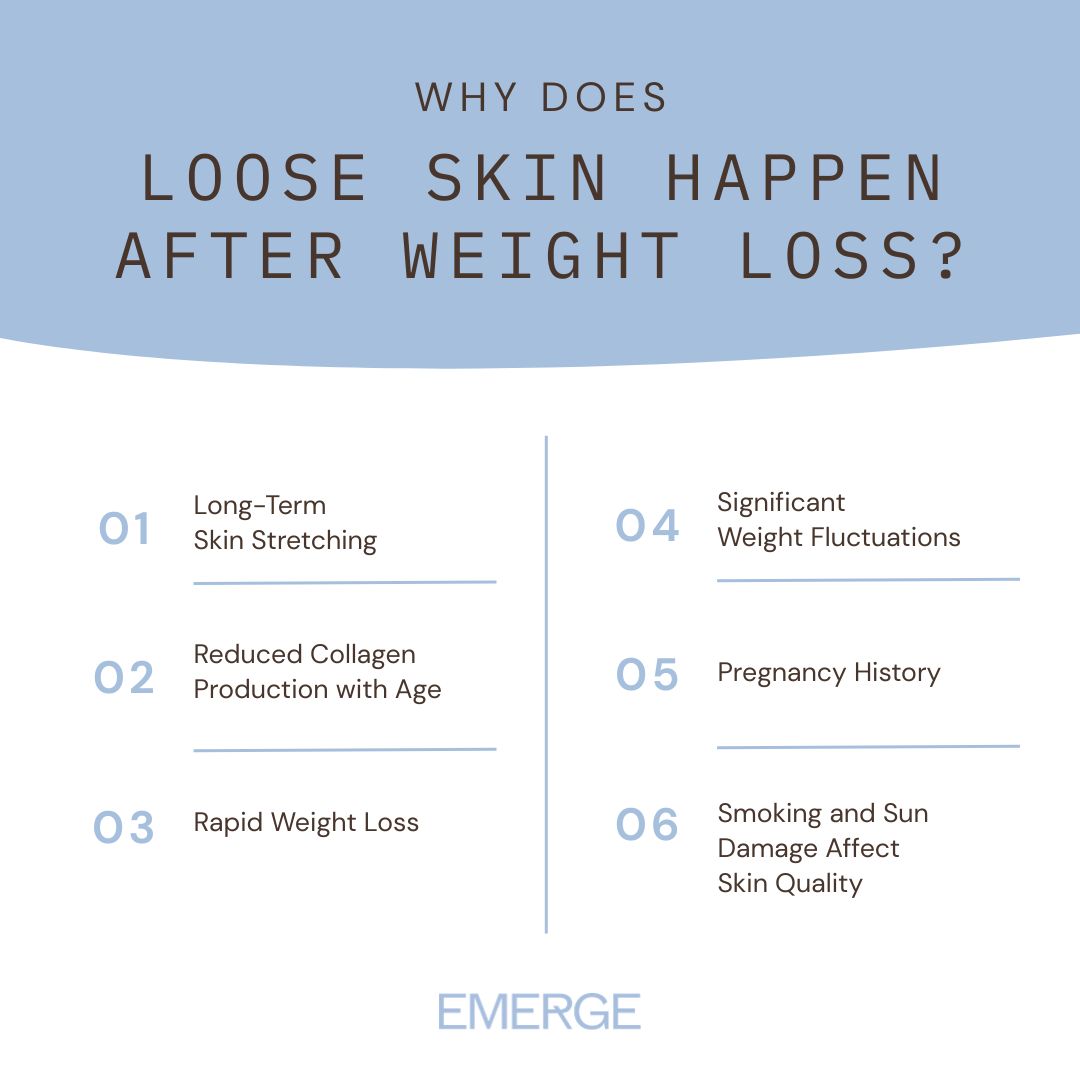
Why Does Loose Skin Happen After Weight Loss?
Long-Term Skin Stretching
Think of elastin and collagen like a rubber band. The longer and farther you stretch it, the less it’ll be able to return to its original shape.
Your skin functions the same way. When the skin remains stretched for long periods, collagen and elastin fibers gradually lose their structure. Then, once fat volume gradually disappears, the skin often can’t “snap back” as effectively, often leaving behind mild-to-moderate skin laxity.
Reduced Collagen Production with Age
We naturally lose up to 1-1.5% of collagen per year after the age of 25. Now, add sun damage, a high-sugar diet, lack of hydration, genetics, and chronic stress on top of that. You’re looking at a handful of factors that increase oxidative stress and trigger enzymes that destroy collagen fibers. (More on this below!)
While your skin may have snapped back after weight loss when you were 22, it doesn’t have that ability as you get older. Now, that’s not to say that age guarantees you’ll develop loose skin! However, it does influence how effectively your skin can remodel after significant weight loss.
Rapid Weight Loss
The faster you lose, the more difficult it is for your body to keep up. But again, this is nuanced.
When you gradually lose weight, the dermis typically has time to shrink and remodel itself. Think: 1–2 pounds per week. However, rapid drops and more significant fat volume reduction, for lack of better words, shock the body. The skin doesn’t have the time it needs to adapt biologically, leaving behind disorganized collagen fibers and increased skin laxity.
Significant Weight Fluctuations
A lot of the time, people assume that gaining weight—not losing it—is what affects the skin. However, this isn’t exactly the case! Repeated cycles of weight gain followed by weight loss stress collagen and elastin fibers.
It’s the same cycle as we explored above. When you lose weight, the dermis shrinks to adjust to your body shape. When you gain weight, collagen and elastin stretch to accommodate additional volume. If this happens repeatedly over a short period of time, structural proteins become permanently weakened.
Pregnancy History
Pregnancy, while a beautiful, life-changing journey, puts significant demands on the abdominal wall and overlying skin. More specifically, the underlying tissues are under constant mechanical tension, pushing collagen and elastin fibers to their limits.
And for many women, pregnancy-related stretching combined with post-pregnancy weight loss naturally leads to long-term skin laxity. But stretching isn’t the only thing that impacts how severe laxity is—so does abdominal separation (diastasis recti), hormone fluctuations, and genetics.
Interested in learning more? We wrote an entire guide on this, titled “How To Tighten Loose Abdominal Skin After Pregnancy.”
Smoking and Sun Damage Affect Skin Quality
Collagen production doesn’t just decline with age. Remember those lifestyle factors we discussed earlier that disrupt collagen? It’s time to expand on that a bit. Here are a few different things that can degrade collagen and elastin fibers, leading to loose abdominal skin:
- Smoking: Increases Matrix Metalloproteinase (MMP) levels, the enzymes that break down structural proteins
- Sun Damage: Breaks down structural proteins and triggers photoaging—an abnormal fiber production in the dermis
- Refined Sugar Consumption: Can promote glycation, a process where sugar molecules stiffen tissue, trigger inflammation, and damage collagen
- Chronic Stress: Can increase cortisol levels, which then activate MMPs to break down existing collagen
Lifestyle factors don’t just contribute to visible signs of aging. They can also damage structural proteins responsible for your skin’s strength, elasticity, and ability to rebound after stretching.
Does Loose Skin After Weight Loss Go Away?
Loose skin after weight loss can go away! However, this process doesn’t follow a universal, one-size-fits-all approach.
For example, mild loose skin can improve over time—especialy if you’re younger, maintain a consistent, medical-grade skincare routine, and invest in preventative, medical aesthetic treatments. (Remember: prevention is always easier than correction.) Plus, just as we mentioned earlier, gradual weight loss often allows the skin enough time to shrink.
However, moderate-to-severe loose skin is different.
Once collagen and elastin fibers have been damaged, the body can’t effectively rebuild them on its own. It requires the combination of healthy lifestyle habits, collagen-stimulating regenerative procedures, and science-backed skin-tightening treatments—like the AVAVA laser.
We discussed this in depth in our guide, “Can You Get Rid of Loose Skin Without Surgery?” You don’t need a body lift, thigh lift, plastic surgery, or other, more invasive surgical procedures. You need a double-board-certified Emergency Medicine physician who brings surgical expertise to non-surgical aesthetics. (Of course, we’re talking about Dr. Kling.)
Dr. Kling approaches skin laxity through a biology- and skin-first lens: loose skin after weight loss isn’t just empty space. It’s the result of collagen breakdown, thinning skin, reduced elasticity, and weakened support. While surgery removes excess skin, it can’t improve skin quality.
Medical aesthetic skin-tightening treatments, on the other hand, can. Through a tailored multimodal approach, Dr. Kling helps clients improve skin laxity, enhance skin quality, and, most importantly, strengthen the skin itself.
We’re not just “doing treatments” over here at Emerge. Instead, we’re educating, restoring, and rebuilding. Schedule your appointment at Emerge Aesthetics, proudly serving patients from Glen Rock, Ridgewood, Wyckoff, Franklin Lakes, Saddle River, Upper Saddle River, Ho-Ho-Kus, Paramus, and New York City. Let’s begin creating a plan for addressing your loose abdominal skin.
How Much Weight Loss Causes Loose Skin in the Abdominal Area?
Every body is different. (Literally, everyone’s bodies work differently.) Knowing this, there’s no single number for how much weight loss can cause loose abdominal skin.
Some patients lose 20 to 30 pounds with very little visible loose skin, while others notice skin laxity after smaller weight changes. Genetics, age, pregnancy history, or previous weight gain all influence how the skin snaps back.
The likelihood increases considerably after losing more weight, such as 50 to 75+ pounds. Our patients who come in following bariatric surgery or similar procedures are often those managing more severe skin laxity.
At Emerge, our goal with advanced skin-tightening treatments isn’t to help you lose weight or cut back inches. It’s to help your skin reflect the healthier body you’ve worked so hard to achieve.
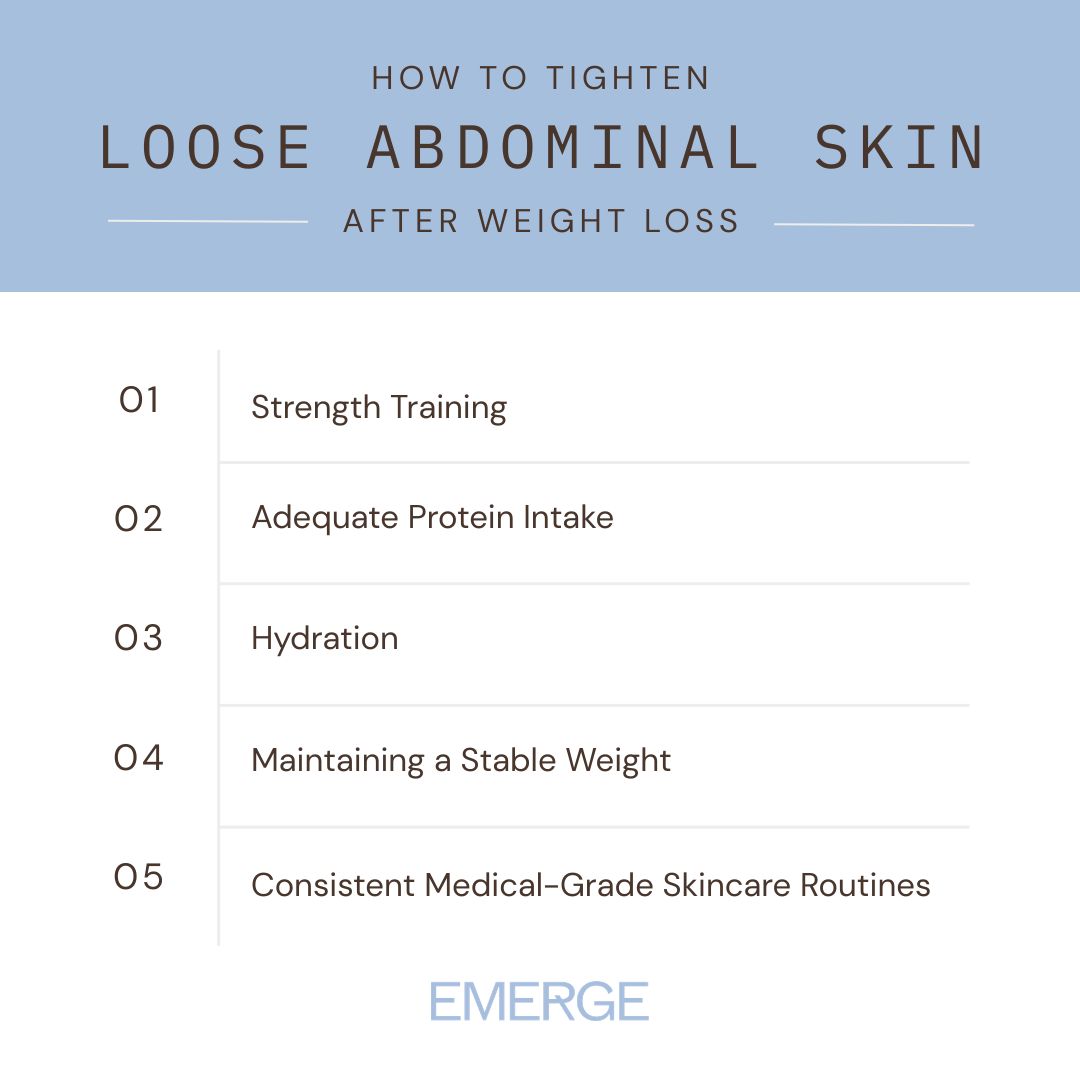
How to Tighten Loose Abdominal Skin After Weight Loss
If you’ve experienced significant weight loss, you may be asking one important question: “Can I tighten loose abdominal skin without surgery?” Fortunately, the answer is yes! However, it’s important to maintain realistic expectations.
Healthy habits won’t magically erase large amounts of excess skin. They can, however, improve skin quality, support collagen production, and maximize the results of regenerative medical aesthetic treatments. Think of them as the foundation.
Here’s what to incorporate into an intentional routine:
Strength Training
One of the most effective ways to improve your overall body contour is by building lean muscle. We’re not removing excess skin here, though—we’re simply increasing muscle definition beneath the skin. In fact, strength training has been shown to add natural volume, increase circulation, activate fibroblasts to support collagen and elastin production, and improve posture.
When combined with non-surgical skin-tightening treatments, strength training can provide a solid foundation for enhancing your overall results.
In the New Jersey area and don’t know how to get started? Check out our Sweat, Sip, and Glow event with Forme House NJ to get a little inspiration. (And stay updated with our socials so you know when our next event is!)
Adequate Protein Intake
Collagen is a protein, and your body needs adequate amounts of dietary protein to support tissue repair and collagen production. Following major weight loss, it’s especially important to consume enough high-quality protein. Doing so maintains muscle mass while supporting healthy skin remodeling.
Protein consumption alone won’t tighten loose skin. However, it CAN provide many of the building blocks your body needs to repair and regenerate tissue. Combined with strength training and regenerative, non-surgical treatments? It’s an incredibly helpful way to support your body.
Hydration
Proper hydration plays a major role in skin elasticity and cellular health. Think of your skin as a sponge. When it’s dehydrated, sagging becomes more noticeable… and so do fine lines and wrinkles (but that’s a topic for a different post!). Hydrated skin simply functions more efficiently. It helps the body transport nutrients, protects the skin barrier, and improves overall texture.
When combined with collagen-stimulating treatments and medical-grade skincare, both internal and external hydration become one part of a comprehensive, long-term strategy.
Maintaining a Stable Weight
We all go through weight fluctuations, especially as women! Fluid retention, hormonal shifts, digestion, inflammation, stress, medical conditions—these factors all play a role in maintaining a stable weight. However, the more you’re able to keep your weight steady, the less likely you’ll have to deal with skin laxity.
This is easier said than done, so be gentle with yourself. However, we’ll say it again: preventing a problem is always easier than correcting it. Focus on supporting your body now, so you don’t have to worry about loose abdominal skin later.
Consistent Medical-Grade Skincare Routines
High-quality skincare is the foundation of skin quality. That’s why, if you’re a client at Emerge, you know the point we hammer home ALL the time: we’d rather you invest in good skincare than Botox. (Yes, really.)
And when we say “good,” what we really mean is medical-grade.
Medical-grade skincare outshines generic products every time. Why? Because they’re formulated with higher concentrations of active ingredients, use advanced delivery systems to penetrate more deeply, and are clinically backed by multiple scientific studies.
TL;DR: Not all skincare is created equal. Skip the guesswork by shopping Dr. Kling’s curated collection of skincare products! Also, don’t miss your chance to join the Emerge RX Club to receive customized formulations, professional guidance, a progressive approach, and a membership model. Oh, and did we mention that when you buy Alastin skincare through Emerge, you earn aspire points? AKA, points you can put towards future treatments!
Pay yourself forward and trust Emerge to guide your skincare regimen where it needs to go.
Abdominal Loose Skin Treatments After Weight Loss
Lifestyle changes and topical products have a limit. While they do contribute to an advanced multimodal approach, they won’t move the needle like non-surgical, regenerative medical aesthetics will.
At Emerge Aesthetics, treatment plans are never one-size-fits-all. Dr. Kling assesses every layer contributing to your concern before recommending an appropriate solution. The best results always come from a strategic, gradual, multimodal approach, which all of these treatments can help you achieve:
AVAVA Laser System
The AVAVA laser system has completely changed the way physicians treat skin laxity. Using proprietary Focal Point Technology™, this system delivers controlled laser energy beneath the skin’s surface, activating the body’s natural regenerative response to support long-term collagen production.
More specifically, this precise delivery stimulates fibroblasts to produce collagen and elastin, gradually improving skin firmness. And unlike treatments that simply heat the skin for surface ablation, AVAVA’s regenerative approach stimulates a healing response that strengthens the skin from within.
But the benefits don’t end there. AVAVA is FDA-approved, safe for all skin types and tones, and results in a shorter recovery time than other skin-tightening procedures.
Interested in learning how the AVAVA laser system can improve your loose abdominal skin? Visit Emerge Aesthetics, the only verified med spa in Bergen County offering AVAVA and one of just two practices in the greater New Jersey area with this technology. (NJ residents… If you’re not as excited as Dr. Kling is, you need to be.)
This isn’t marketing—it’s medicine. Just look at the results of AVAVA after one session.
Collagen Biostimulators
Collagen biostimulators can be a valuable approach to encouraging collagen production in loose skin. More specifically, options such as Sculptra and Radiesse can add volume and help rebuild the skin’s foundation. It’s an intentional way to address a lack of collagen and elastin fibers, helping to improve your skin’s overall quality and tightness.
However, we have to be clear about this. If you’re only thinking about injectables for targeting moderate skin laxity, you’re missing the bigger picture.
Collagen biostimulators work particularly well in combination with AVAVA, creating a balanced approach to firming and rebuilding. But injectables alone won’t tighten skin. Don’t get us wrong, they certainly serve their purpose! (Otherwise, we wouldn’t talk about how much we love them.) But it’s important to keep realistic expectations when treating loose abdominal skin.
Targeted Medical Grade Skincare
Skin quality comes before everything, and targeted medical-grade skincare supports this. Not only does it strengthen the skin’s foundation, but it also helps regenerative medical aesthetic treatments work as effectively as possible.
When targeting loose abdominal skin, considering add these products to your vanity:
- Retinoids: As powerful vitamin A derivatives, retinoids stimulate collagen production and increase skin cell turnover. This improves elasticity, prevents MMPs, and thickens the epidermis. Read our guide, “Retinol vs. Retinoid,” to learn more!
- Skinceuticals Advanced RGN-6: Inspired by laser regeneration science, this product is powered by 6 synergistic actives to help firm, smooth, and rejuvenate your skin.
- Peptides: Peptides act as messengers to skin cells, boosting the production of collagen and elastin, improving tissue repair, increasing cell turnover, and strengthening the moisture barrier. Read “Benefits of Peptides in Skincare for Healthy, Youthful Skin” to dive deeper!
- Alastin C-Radical Defense Antioxidant Serum: Acting as a powerhouse nutrient, vitamin C stimulates collagen synthesis and protects existing collagen from environmental damage.
- Alastin TransFORM Body Treatment: Using TriHex Technology, this product supports the production of collagen, elastin, and hyaluronic acid, helping you achieve firmer, more toned skin.
Medical-grade skincare, while powerful, won’t deliver the skin-tightening benefits that AVAVA can. However, using them as part of a multimodal treatment gives your skin the best opportunity to tighten, firm, lift, and perform better during treatment.
You don’t have to just “live” with loose abdominal skin—schedule your appointment at Emerge Aesthetics today!
Losing weight IS something to be proud of! And that excitement shouldn’t be overshadowed by crepey, loose, or sagging skin. But here’s the good news: you don’t have to undergo complex plastic surgeries or body contouring procedures to see real results. A balanced approach to lifestyle changes, consistent skincare routines, and regenerative, non-surgical medical aesthetics can significantly improve loose abdominal skin.
But the medical aesthetic physician you visit matters. Dr. Kling, Emerge Aesthetic’s double-board certified Emergency Medicine physician, doesn’t just improve appearances. She approaches skin rejuvenation from every layer, prioritizing your anatomy and preserving the qualities that make you… you! Schedule your appointment with Emerge Aesthetics today—the medspa that doesn’t want to change your appearance—just enhance it.
Already booked your appointment? Check out the Emerge blog while you wait! Here, we cover all things skincare, medical aesthetics, and minimally invasive procedures in a simple, reader-friendly way. Also, don’t forget to follow the Emerge Aesthetics Instagram. We offer deals, discounts, and updates you won’t find anywhere else.