
If you’ve ever caught yourself raising your eyebrows in the mirror to check whether those forehead lines are still there, you’re not alone. Forehead wrinkles are one of the most common—and visible—signs of aging. But here’s the thing: we don’t always notice them when they first appear. We notice them when they won’t go away.
Forehead wrinkles aren’t just the result of one factor. Instead, they’re a combination of repetitive facial expressions, genetics, lifestyle factors, and a natural loss of collagen and elastin. But yet, brands still promote cure-all serums, social media influencers still rave about overnight fixes (looking at you, face taping!), and many people are left wondering what actually works.
In reality, treating fine lines and wrinkles isn’t about finding one miracle product. It’s about understanding the anatomy behind aging and creating a strategy that addresses the underlying causes, not just what you see on the surface.
Below, we’ll tell you how to actually get rid of forehead wrinkles—and prevent new ones from showing up. We’ll cover the causes, the timeline, and the treatments that actually move the needle. Because your skin doesn’t deserve guesswork, it deserves a science-backed multimodal approach.
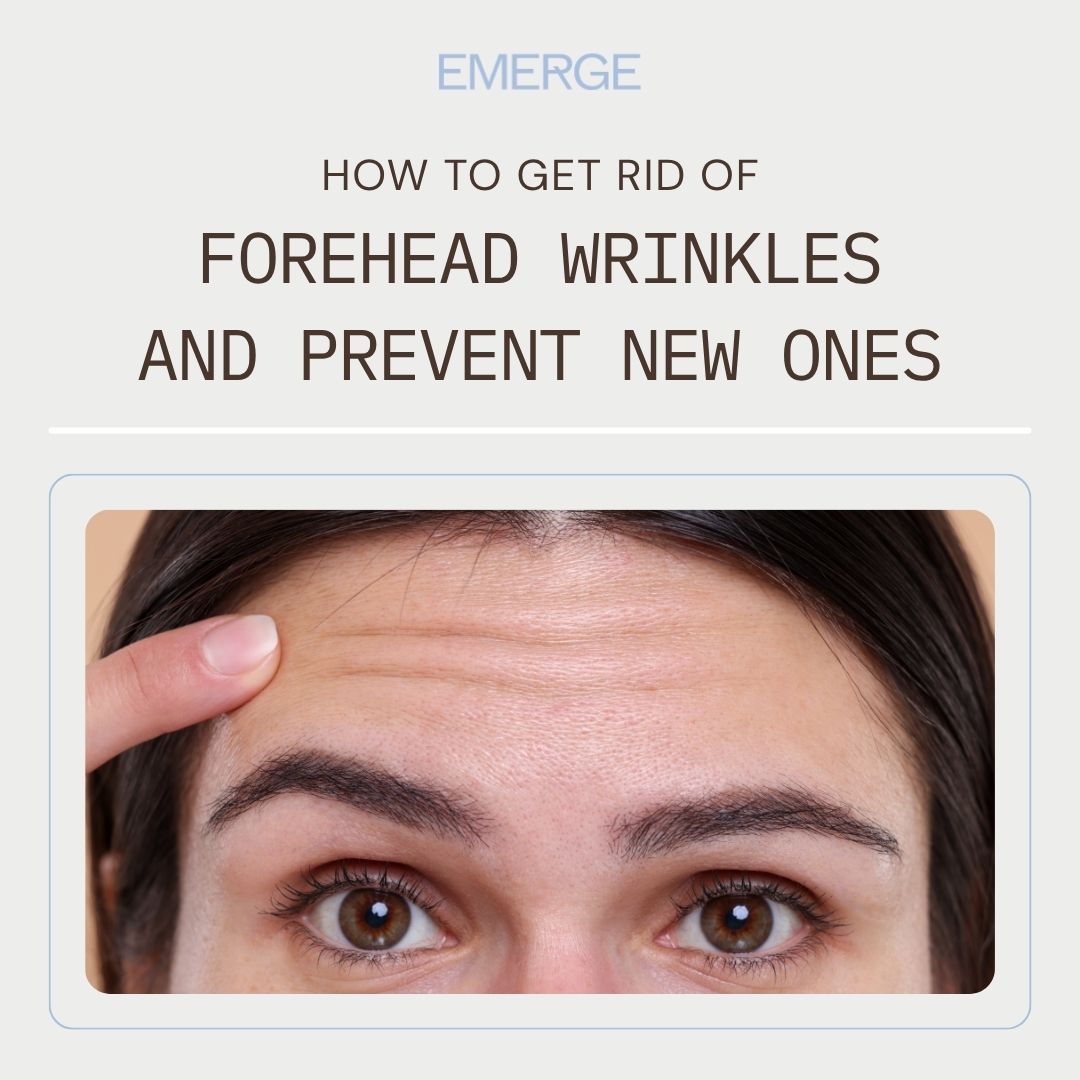
How to Get Rid of Forehead Wrinkles and Prevent New Ones
First, let’s make something clear: forehead wrinkles are natural. They’re an entirely normal part of the aging process. And, as much as we wish we could, we can’t stop aging. We can, however, prevent, delay, or proactively manage how aging shows up on the skin.
There ARE several approaches that can soften the appearance of forehead wrinkles while simultaneously slowing future wrinkle formation. The problem is, when most people talk about this topic, they leave out one important detail: forehead wrinkles aren’t a one-dimensional problem—and they rarely respond to a one-dimensional solution.
If you really want to address fine lines, you have to get to the root of the problem. And, here’s a secret: it’s not just what you see on the top layer of your skin. Effective wrinkle reduction is usually a blend of a clinically supportive skincare routine, intentional lifestyle adjustments, and professional medical aesthetic treatments.
And it doesn’t have to be nearly as intimidating as it sounds. Below, we’ll start by explaining what causes forehead wrinkles and when they typically appear. After, we’ll discuss medical-grade skincare ingredients to incorporate into your routine and professional treatments to add to your lineup.
What Causes Forehead Wrinkles?
Repeated Facial Expressions
Squinting, raising your eyebrows, furrowing your brow, widening your eyes, even tilting your head up—these all cause the frontalis muscle (the only muscle responsible for elevating the eyebrows) to contract. That consistent movement inevitably pulls on the skin, slowly breaking down structural proteins such as collagen, elastin, and keratin.
These repetitive movements are what cause dynamic wrinkles (temporary expression lines) to become static wrinkles (deeper, structural creases). And because there’s now a lack of elasticity, your skin doesn’t bounce back like it once did.
Interested in learning more? We talk all about wrinkle development in our guide, “How Long Does Botox Take to Work?”
Sun Exposure and UV Damage
UV exposure can account for up to 80% of visible signs of aging. And at that point, forehead wrinkles just become one of the many other skin concerns caused by sun damage. (More on that in our post “Loose Neck Skin at 50.”) Ultimately, when you leave your skin unprotected, ultraviolet (UV) rays penetrate it, triggering a spike in free radicals.
These unstable molecules inevitably trigger the release of enzymes called matrix metalloproteinases (MMPs), which essentially degrade structural proteins. Not only does this damage existing healthy skin cells, but it also prevents the skin from repairing itself later. This is what people refer to when they say “photoaging”—the premature skin aging caused by chronic UV exposure.
Collagen and Elastin Loss
By the time we turn 25, we lose 1-1.5% of collagen and elastin a year. Collagen is what keeps your face plump and firm, whereas elastin provides that bounce-back ability. When you’re younger, your skin essentially snaps back into place with little physical disruption. But as you age, your skin’s supportive matrix weakens, and those lines don’t disappear nearly as fast—or at all.
This is a natural, normal process of aging. Aging IS normal! But ultimately, collagen and elastin don’t replenish themselves at the same rate forever. Once that underlying support begins to decline, the skin becomes less able to repair, rebuild, and bounce back on its own.
Interested in learning more about this process? We cover it in depth in our guide, “How to Stimulate Collagen in Face for Firmer, Smoother Skin.”
Smoking and Pollution Exposure
Smoking and exposure to pollution both trigger oxidative stress, an imbalance between unstable molecules and the body’s antioxidant defenses. While both contribute to collagen and elastin breakdown, they do so through different pathways.
Smoking introduces free radicals that trigger enzymes that break down the skin’s support structures. Yep, same thing we mentioned earlier. Airborne pollutants, on the other hand, generate Reactive Oxygen Species (ROS), which alter cellular DNA, trigger structural breakdown, and increase the activity of enzymes that degrade collagen and elastin.
Don’t panic just yet—there are ways to prevent and protect your skin. We’ll cover that below.
Dehydration
Think of your skin as a sponge. When you dunk that sponge in water, it’s firm, elastic, and plump. Leave the sponge out to dry, and suddenly it’s rough, textured, and unable to bounce back the way it once did. Your skin relies on hydration—both internally and externally—to stay flexible, resilient, and plump.
Now, will dehydration alone lead to forehead wrinkles? No, of course not! As we said earlier, forehead wrinkles are rarely the result of one single factor. However, if you’re not hydrated, the skin creases and holds shape while the cells lose volume. Not only can this contribute to more permanent fine lines, but it can also lead to crepiness, transepidermal water loss (TEWL), and a compromised skin barrier.
Poor Skin Barrier Function
Your skin barrier is your body’s first line of defense for keeping the good things in and the bad things out. This is why at Emerge Aesthetics, we emphasize the importance of skin quality. If your skin barrier is compromised, it can lead to moisture loss, inflammation, irritation, and sensitivity.
And that doesn’t just show up through breakouts and dryness—it also impacts forehead wrinkles. When the skin barrier is compromised, the skin struggles to retain moisture and becomes more susceptible to external irritants. Over time, this can make fine lines more noticeable and accelerate the appearance of visible signs of aging.
Genetics and Skin Type
There are plenty of external factors that can cause forehead wrinkles—as you just read above! However, genetics and your unique skin type are the baseline for skin aging, essentially serving as the blueprint for processes such as collagen and elastin production, muscle strength, and cellular repair. While they work hand in hand, they function differently.
Genetics can impact how you age. Ultimately, your DNA determines how quickly you produce (and degrade) structural proteins, how strong your frontalis muscle is, and how effectively your skin can protect itself against environmental stressors.
Your skin type, on the other hand, determines how well your dermis retains moisture, handles daily movement, and produces oil. For example, those with a stronger natural barrier often find their skin is plumper, smoother, and more elastic. On the other hand, those with dry skin are more likely to deal with crepiness, skin laxity, and superficial fine lines.
When Do Forehead Wrinkles Appear?
Forehead wrinkles generally begin to appear in the mid-to-late 20s. Remember, by 25, your collagen and elastin production slowly begin to decrease. Combined with repetitive facial expressions, a lack of quality skincare products, and cumulative environmental damage, those early fine lines can gradually become more noticeable over time.
However, the dynamic wrinkles you notice in your 20s slowly begin to turn into static wrinkles in your 30s and 40s. This is why at Emerge, we always emphasize that prevention is easier than correction. When you get ahead of visible signs of aging, you’re not playing catch-up. Instead, you’re preserving the skin quality you’ve already been investing in for years.
Can You Get Rid of Forehead Wrinkles?
You can absolutely get rid of forehead wrinkles—but it takes strategy. When we’re swimming in a sea of brands, influencer recommendations, and trendy buzzwords, it can be hard to separate strategy from shortcuts.
To soften existing forehead wrinkles and prevent new ones from forming, you have to address aging at every level: the skin, the structure, and cellular function. That includes:
- Prioritizing medical-grade skincare (Check out Dr. Kling’s curated collection of physician-grade skincare!)
- Investing in professional regenerative aesthetic treatments
- Supporting your body through physical movement
- Getting quality rest
- Increasing internal hydration (keep your emotional support water bottle full!)
- Focusing on a high-protein diet
- Cutting out processed foods (especially sugar)
And, most importantly, staying consistent! Just like any area of your life—the gym, at work, in school, with your diet—you won’t truly see results unless you’re consistent.
But let’s start with the basics: skincare. To achieve the best results from professional medical aesthetic treatments and intentional lifestyle changes, you have to maintain your skin quality. Here are a handful of ingredients that have the highest aesthetic ROI:
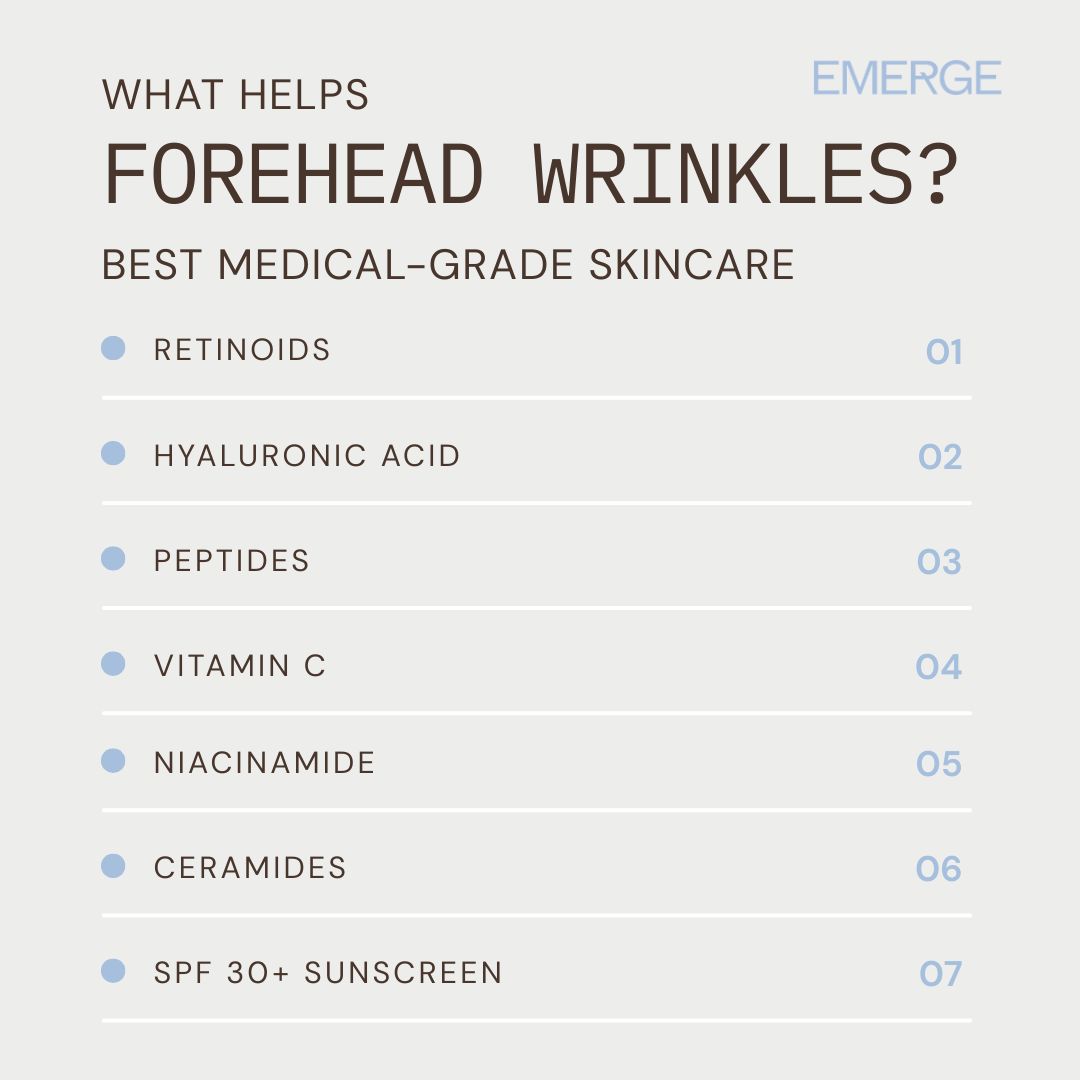
What Helps Forehead Wrinkles? Best Medical-Grade Skincare
Retinoids
Retinoid, a vitamin A derivative that directly influences cellular behavior, is the gold standard in anti-aging skincare. Instead of just sitting on the skin’s surface, it reaches the dermis to essentially reprogram how your skin functions.
And this isn’t just a helpful beauty boost. Retinoids stimulate collagen production, accelerate cell turnover, regulate oil production, even out pigmentation, and restore skin elasticity. However, there ARE differences in retinol, retinals, and retinoids. Confusing, we know, but we break it all down in our post: “Retinol vs. Retinoid: Which Is Best for Your Skin?”
By accelerating cell turnover and stimulating collagen production, retinoids help soften the appearance of forehead wrinkles while supporting the skin’s structure, which helps keep those lines from deepening over time.
Don’t have a retinoid prescription? Join the Emerge RX Club, Dr. Kling’s specialized membership program! Through this, you receive customized formulations, professional guidance, and a progressive approach based on your unique treatment plan.
Hyaluronic Acid
Hyaluronic acid is a humectant that can hold up to 1,000 times its weight in water. The effects extend far beyond your typical nighttime lotion, though. Hyaluronic acid replenishes moisture levels, hydrates cells, strengthens the barrier, soothes inflammation, and improves elasticity.
For forehead wrinkles, that hydration translates to smoother, more resilient-looking skin. When skin cells are adequately hydrated, fine lines appear far less noticeable, and the skin is better equipped to maintain its structure.
But don’t just grab the first product you see on the shelf—medical-grade matters. More specifically, the Alastin HA (Hyaluronic Acid) Immerse Serum uses Proprietary Octapeptide-45, helping the skin’s ability to naturally increase its own high-molecular hyaluronic acid production.
Peptides
Peptides are a short chain of amino acids, the building blocks of proteins like collagen and elastin, and act as cellular messengers. They essentially signal the skin to increase collagen production and to prioritize the repair process. Like we discussed in our guide, “Benefits of Peptides in Skincare,” there are a few different types of peptides, including:
- Carrier Peptides: Delivers minerals to skin cells for better absorption, boosting collagen and reducing inflammation
- Enzyme-Inhibitor Peptides: Blocks negative enzymes that break down structural proteins to maintain firmness and slow signs of aging
- Neurotransmitter-Inhibitor Peptides: Blocks neurotransmitters from cells to soften expression lines
- Signal Peptides: Increases production of collagen and elastin to plump and firm skin
When applied topically, peptides can penetrate the skin on the forehead to stimulate collagen synthesis, relax muscle contractions, and repair the skin barrier. Just like we said before, though, the product you use does matter. Grab something like Skinceuticals P-TIOX, a peptide-powered serum inspired by the effects of anti-wrinkle neurotoxin injections.
Vitamin C
Vitamin C is an unsung hero of skincare. And if you’re not using it in your morning routine yet, you need to be. Vitamin C is a potent antioxidant that brightens complexion, stimulates collagen production, and protects the barrier from environmental pollutants. Not only does this product help neutralize free radicals, but it also acts as a cofactor in collagen synthesis.
For forehead wrinkles, this seriously matters. Collagen is one of the primary structural proteins that help keep skin firm, smooth, and resilient. The more effectively you protect and support collagen production, the better equipped your skin is to resist visible signs of aging.
Looking for a product to start with? Check out Alastin C-Radical Defense Antioxidant Serum, formulated with a proprietary encapsulated form of vitamin C and 15 proven antioxidants.
Niacinamide
Niacinamide is a water-soluble form of vitamin B3 that helps build proteins in the skin, retain moisture, and protect against environmental damage. It’s one of the most versatile active ingredients, protecting the barrier while simultaneously reducing inflammation, fading dark spots, and boosting collagen and elastin production.
And the best part? It’s extremely gentle, working well with almost every skin type and pairing well with other skincare ingredients. For topical forehead application, niacinamide helps boost ceramide production to decrease moisture loss while promoting collagen synthesis to restore resiliency.
You can read all about the benefits in our post, “Does Niacinamide Help with Acne Scars?”
Ceramides
Ceramides are naturally occurring lipids that make up around 50% of the skin’s epidermis. This waterproof barrier is ultimately responsible for retaining moisture, defending the skin against environmental damage, and preventing chronic inflammation. If you want an effective anti-aging routine, you have to protect and support your epidermis.
As for reducing forehead wrinkles, ceramides essentially act as the “mortar” to skin quality. They strengthen the barrier between cells, helping the skin maintain the hydration and resilience needed to keep fine lines from appearing more pronounced.
Don’t know much about adding ceramides to your daily routine? Get a head start with Skinceuticals Triple Lipid Restore. This anti-aging cream contains optimal, patented lipids, fatty acids, and natural cholesterol to nourish skin, restore the barrier, and support natural self-repair.
SPF 30+ Sunscreen
If you’re not applying sunscreen multiple times throughout the day, everything else you do won’t matter. It sounds dramatic, but it’s seriously that important. SPF is, by far, the most powerful anti-aging tool you can use.
UV rays break down the structural proteins in the skin, trigger melanin production, degrade the protective barrier, and ultimately lead to significant structural loss. Enter: premature aging, wrinkles, dark spots, cell damage, and, worst case, an increased risk of skin cancer.
By applying a high-quality SPF, you’re effectively preventing and slowing the progression of forehead wrinkles. Think of it as an invisible sun visor. With consistent application, you can retain skin elasticity, prevent premature aging, maintain smoothness, and prioritize skin quality.
A lot of SPFs on the shelf don’t hold a candle to medical-grade products, though. Start using Alastin Hydratint Pro Mineral Broad Spectrum Sunscreen, formulated with powerful antioxidants that protect skin against pollution, blue light, and IR rays. You can also listen to Dr. Kling talk about the importance of a tinted SPF here!
How to Get Rid of Wrinkles on Forehead
Use Sunscreen Daily
Use broad-spectrum sunscreen daily. Use it when it’s sunny, cloudy, rainy, snowy, when you’re flying or in the car, if you’re sitting inside near a window—you get the gist. This is a non-negotiable for anyone trying to prevent forehead wrinkles. Medical-grade formulas help prevent UV-induced breakdown of structural proteins, which can contribute to skin laxity and fine lines.
You may love your glowy sunkissed skin now, but you won’t love the forehead wrinkles you experience later.
Apply Retinoid Consistently
In order for retinoids to work, you have to stay consistent with application. Just like with anything else, you won’t see results from a once-a-week application. Retinoids work by fundamentally altering cellular behavior, which requires ongoing maintenance. Not only does this help build tolerance, but it also allows the cumulative effects of collagen stimulation and cellular turnover to compound over time.
Also, if you haven’t heard this already: the purging phase (AKA retinoid uglies) is normal. Don’t stop it as soon as your face begins to break out! Generally, this is a sign that the product is doing its job.
Prioritize Sleep and Stress Management
If you’re not getting enough sleep or are spending your days stressed, your skin will be the first to show it. Quality sleep allows your skin to essentially go through its refresh cycle. This is when the body ramps up collagen production, boosts blood flow, and balances hormones. In fact, research shows that people who sleep better experienced 30% greater barrier recovery.
Stress functions the same way. Chronic stress triggers the release of hormones like cortisol that increase inflammation, stimulate oil production, and weaken the barrier. Not only can this result in collagen breakdown and cellular damage, but it can also lead to breakouts, chronic skin condition flare-ups, and slowed healing.
Avoid Over-Exfoliating
Exfoliating washes? Fantastic for the skin. Using these products every day? A fast track to increased signs of aging. If you’re exfoliating too much, you can strip the skin’s protective lipid barrier. Cue: moisture loss, chronic inflammation, and a breakdown of elastin and collagen fibers. Stick to exfoliating 1–3 times per week at most. This can help shed dead skin cells and improve radiance without compromising the barrier in the process.
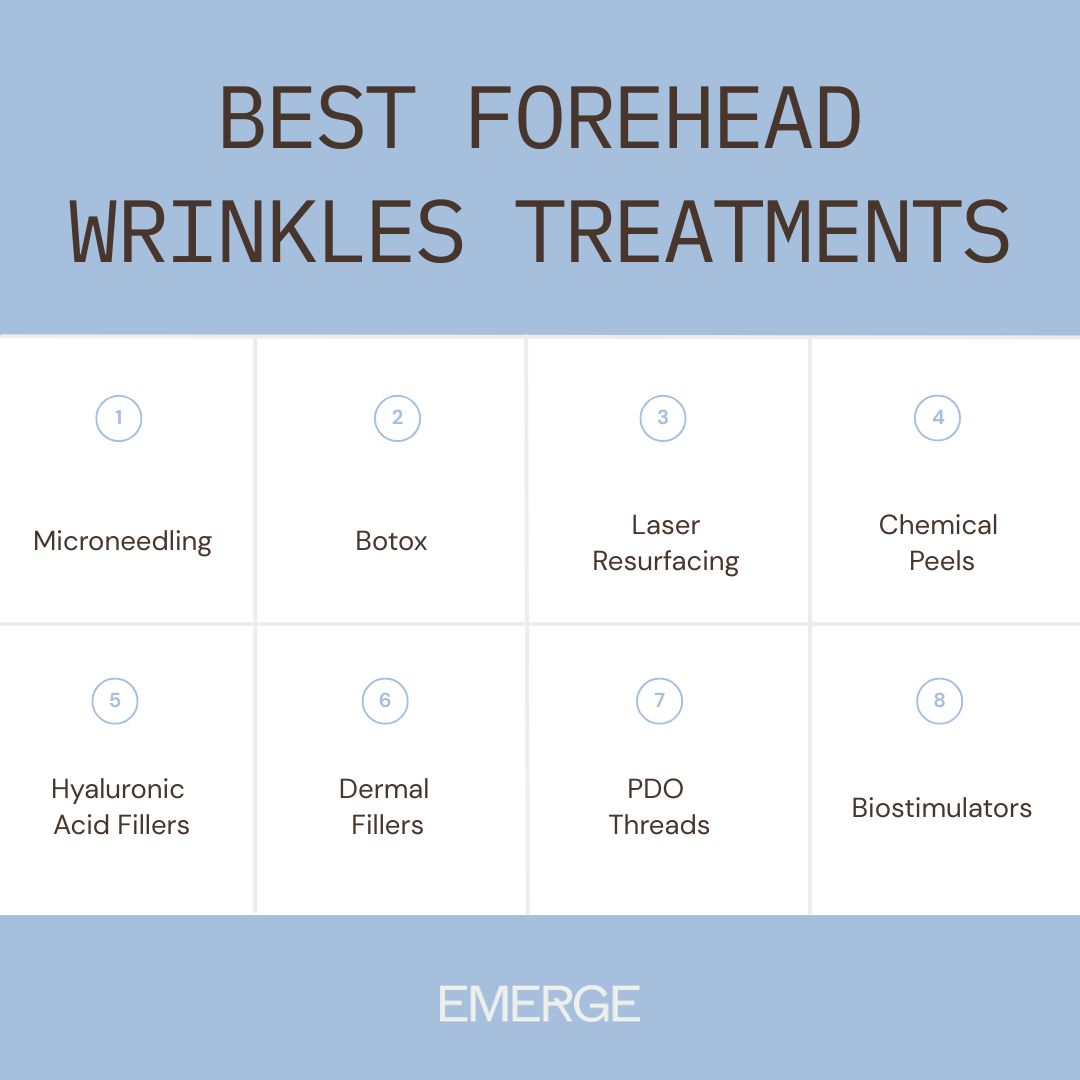
Best Forehead Wrinkles Treatments
Here’s the truth: topical products can only go so far, especially when you’re trying to target structural changes that occur beneath the skin’s surface. Skin quality is undebatably essential—it’s what allows professional treatments to perform at their best.
However, even the most effective skincare routine can’t replace lost collagen, tighten lax tissue, or address muscle-driven wrinkles on its own. The best treatment plan ultimately depends on what’s causing wrinkles, whether it’s muscle movement, collagen loss, sun damage, or a combination of factors.
This is why a multimodal approach often delivers the most comprehensive results.
Microneedling
Microneedling creates controlled micro-injuries in the skin, triggering the body’s natural wound healing response. As a result of this healing process, the body stimulates fibroblasts to produce collagen and elastin in treatment areas. This means tightened skin, improved texture, reduced signs of aging, and minimized fine lines.
Add platelet-rich plasma (PRP) to microneedling, and these growth factors penetrate the skin more deeply to improve collagen quality, support deeper skin remodeling, and make results even more noticeable. This treatment is particularly effective for clients experiencing early-to-moderate forehead lines.
Check out this video on our Instagram to see what microneedling with PRP looks like in real time!
Botox
Botox, an FDA-approved neuromodulator, works by temporarily relaxing the muscles responsible for repetitive facial movements. For clients experiencing dynamic wrinkles, Botox can be an extremely effective way to soften existing lines while simultaneously preventing new ones.
Think of every time you make a facial expression that lifts, moves, or adjusts the brows. Botox temporarily blocks the release of acetylcholine, a chemical messenger that triggers muscle contractions, keeping the overlying skin smooth and flat. You aren’t frozen—you can still make expressions. Instead, the forehead wrinkles made during these expressions aren’t as deep.
Learn more about the effectiveness of Botox and other treatment options in our post, “Is Daxxify Better Than Botox?”
Laser Resurfacing
Laser resurfacing is making serious waves in the medical aesthetic community—and for good reason. When we talk about lasers, though, there are two types people often think of: CO2 ablative lasers and the AVAVA laser system. Both are effective, and both can make a noticeable improvement in forehead wrinkles.
A fractionated CO2 laser is a skin resurfacing treatment that uses a gas mixture to produce focused light energy to remove microscopic layers of damage. It creates controlled micro-injuries, stimulating collagen and elastin production for firmer, more radiant skin. You can learn all about this in our guide, “The Fractional CO2 Laser Treatment for Skin Transformation.”
The AVAVA laser system is the newest addition to the skin-tightening treatment lineup. Using a cone-shaped non-ablative laser, AVAVA delivers high-energy laser beams directly into the dermis. By creating coagulation zones beneath the skin, these micro-targeted thermal zones stimulate collagen production and reduce damage to the surrounding tissue.
And here’s the thing: you can combine the AVAVA laser with the CO2 laser to compound benefits. They’re that good.
Chemical Peels
There are at-home peels, and there are chemical peels—and the difference extends far beyond strength alone. Professional chemical peels use carefully selected acids to accelerate cellular turnover and remove damaged surface cells.
While they won’t address muscle movement, they can improve skin texture, reducing superficial fine lines and creating an overall smoother appearance. Think of them as a helpful tool in your overall broader anti-aging strategy.
Hyaluronic Acid Fillers
We talked earlier about topical hyaluronic acid, but you can also take it a step further with hyaluronic acid (HA) fillers. HA fillers provide instant volume and hydration while also smoothing fine lines and decreasing folds. There are a few kinds of HA fillers, including:
- Belotero: Ideal for fine lines and delicate areas
- SkinVive: Improves hydration and elasticity
- Restylane Family: Ideal for lip enhancement, cheek contouring, and wrinkle reduction
For forehead wrinkles, HA-based treatments are most beneficial when skin dehydration, volume loss, or structural changes contribute to the appearance of lines. While they won’t address every type of forehead wrinkle, they’re excellent for creating smoother, more hydrated-looking skin.
Dermal Fillers
Some forehead wrinkles persist even when the face is completely at rest. Enter: dermal fillers. These treatments can help restore lost volume beneath the skin while providing structural support to creased areas. By improving support within the tissue, fillers can soften deeper static wrinkles and create a smoother appearance.
That said, treatment in the forehead requires careful anatomical consideration, which is why who your provider is matters. Dr. Kling, Emerge’s double-board certified Emergency Medicine physician, considers each client’s unique tissue, physiology, and biology, ensuring every injection is safe and effective.
PDO Threads
PDO threads stimulate the body’s natural healing response while providing temporary structural support beneath the skin. As the threads gradually dissolve, they stimulate new collagen production, improving firmness and skin quality.
For forehead wrinkles, PDO threads offer a valuable approach when skin laxity and collagen contribute to wrinkle formation. Not only do they provide an immediate lifting effect, but they also stimulate collagen production over time.
It’s a lot less intimidating than it sounds. Just read our guide, “What Is PDO Thread Lift? Benefits, Results, and Longevity” to learn more!
Biostimulators
Unlike traditional fillers, biostimulators work by encouraging the body to produce its own collagen over time. Products like Sculptra and Radiesse help rebuild the skin’s underlying support structure, making them particularly valuable for age-related collagen loss.
Because forehead wrinkles are often linked to declining collagen and elastin, biostimulators can provide gradual, long-term improvements in skin firmness, thickness, and overall quality. And that’s all without making you look frozen.
Getting rid of forehead wrinkles isn’t about finding one magic solution—it requires a multimodal approach that addresses every layer of aging.
Gone are the days of scheduling plastic surgery or relying on trendy products to fix aesthetic concerns. With medical-grade skincare, intentional lifestyle changes, and professional regenerative treatments, patients have more options than ever to proactively manage and prevent forehead wrinkles while also supporting long-term skin health.
At Emerge Aesthetics, Dr. Kling doesn’t lead with guesswork—she leads with precision, compassion, and patient anatomy. Each patient’s goal and skin structure is unique, and she recognizes this while formulating each tailored treatment plan. Schedule your appointment at Emerge in Bergen County to begin targeting forehead wrinkles today!
Waiting for your appointment? Read over the Emerge blog to learn more about quality skincare and professional treatments! Also, don’t forget to follow the Emerge Instagram, where you’ll find all of our latest deals, discounts, and updates.