
Are two lasers better than one? At Emerge Aesthetics, patients often ask us if it would be beneficial to use two lasers vs. just one. This usually comes up after people have undergone a resurfacing treatment with great results and are wondering if more could be done with another device to enhance their results.
The short answer is yes! Using two lasers can be beneficial if your goals warrant it. The CO2 laser and the AVAVA laser are two very different tools, and in a personalized skin rejuvenation plan they complement each other well.
One works on the surface for texture, fine lines and wrinkles, and acne scars. The other works below the surface to build collagen and elastin and improve tone, with minimal downtime and safety across all skin types.
I’m Dr. Rochelle Kling, a double board-certified Emergency Medicine physician and the founder of Emerge Aesthetics, and I personally perform both treatments at our practice in Glen Rock, NJ. At Emerge, I use the SmartXide Pro CO2 laser and the AVAVA laser, which can be used together.
I started combining these treatments when I had patients with very deep acne scarring. I would resurface their scars beautifully with the CO2 laser, only to hit a plateau when it came to tone and skin quality. I also found myself wishing I had a safe resurfacing treatment for patients whose skin tone was too deep to safely address with the CO2. Enter AVAVA.
This post walks through the benefits, who it is right for, and what to consider before combining them. As always, results vary from person to person, and a consultation determines whether any plan is right for you.
Benefits of Combining CO2 Laser with Avava for Real Skin Rejuvenation
When you combine these two lasers, you treat more than one layer of skin and more than one concern inside a single, personalized treatment plan. The CO2 laser handles the surface. AVAVA reaches deeper. Together they cover more ground than either does alone.
Treat Surface Texture and Deeper Collagen at the Same Time
The CO2 laser is ablative, meaning that it uses heat energy to resurface or vaporize the top layers of the skin. It works very well for concerns like fine lines and wrinkles and scarring (such as acne scars), and it works great for improving overall skin texture. However, it can only do so much when it comes to collagen and deeper concerns.
AVAVA, on the other hand, uses non-ablative technology to address concerns below the surface of the skin, stimulating more collagen and elastin. Since the top layer of skin remains intact, there is minimal downtime. AVAVA can help improve many different concerns, including skin tone and pigment, as well as more structural concerns. This laser is also cleared for all skin types, which makes it a strong option for patients who want to address collagen with resurfacing technology but whose skin tone may be too deep to resurface safely with CO2.
By using the CO2 to address surface concerns and AVAVA to address concerns below the surface, we are treating many different levels within the skin, which can mean more dramatic results. To help visualize this, think of remodeling your home. The CO2 is like the paint and plaster, addressing the surface. But to make sure your remodel is up to par, you need to make sure your framing (the dermis) is sound underneath!
Address Multiple Concerns in One Plan
Maybe you are struggling with fine lines and wrinkles and the beginning signs of sagging (skin laxity). Or maybe it’s deep acne scarring, hyperpigmentation, and uneven skin tone. By combining lasers, I can often treat your concerns together under one personalized treatment plan.
The CO2 laser excels at texture and resurfacing. AVAVA is strong on tone, pigment, and deep collagen stimulation.
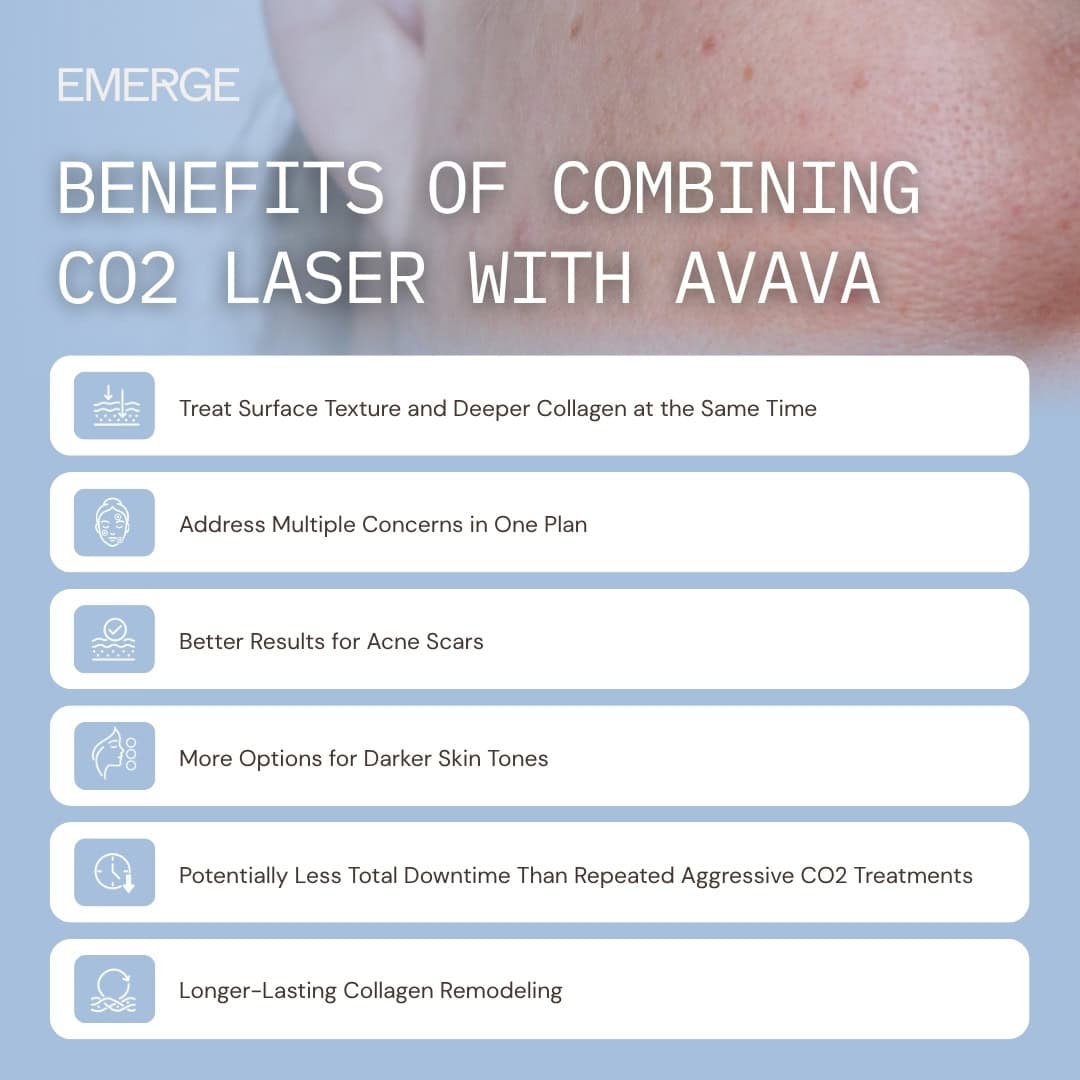
Better Results for Acne Scars
While ablative carbon dioxide (CO2) laser treatment has long been considered the gold-standard treatment option for the correction of your acne scars, it is associated with longer downtime and an increased risk of treatment-related side effects. With the introduction of newer non-ablative fractional photo-remodeling techniques, clinicians have an additional tool with which to combat acne scarring.
At Emerge Aesthetics, I use AVAVA’s patented Focal Point Technology, which offers minimal downtime and is cleared for all skin types. Results from a multicenter clinical trial of AVAVA’s Focal Point Technology for the treatment of acne scars showed:
- 78% of study subjects were graded improved, with 0% worsened.
- 90.2% of study subjects showed an improvement of at least 15 points on a blinded scar evaluation.
I’ve written previously about scars and treatment options in my guide on laser for acne scars. One option that gives the best results in many patients is a combination of lasers: one to resurface the top of the skin (the CO2 laser) and one to work on remodeling the collagen underneath (the AVAVA laser, formerly known as Miria).
The results from using the two lasers in combination for skin rejuvenation or to help with scarring are really something to see. Results are variable from patient to patient, and not everyone will be a candidate. Call our office to set up a consultation.
More Options for Darker Skin Tones
In the past, patients with darker skin tones have often not been candidates for many of the resurfacing lasers, as they ran the risk of hyperpigmentation (darkening of the treated areas). AVAVA changes the options because it is cleared for use in all skin types, Fitzpatrick I through VI.
Potentially Less Total Downtime Than Repeated Aggressive CO2 Treatments
Fractional resurfacing with the CO2 laser can result in several days of redness and crusting, with redness beyond 3 months in a small percentage of patients. Certainly, each individual’s biology and anatomy determine their healing.
Treating too aggressively with CO2 can lead to longer downtimes. A less aggressive CO2 treatment to help with texture, in combination with AVAVA to help remodel the collagen deeper, can result in less overall downtime than repeated, more aggressive CO2 treatments.
Longer-Lasting Collagen Remodeling
Scars, wrinkles, fine lines, and discoloration exist at all depths. Using a resurfacer for the top and a laser that remodels the collagen below means we are treating at all levels.
The CO2 laser results last from collagen remodeling, which occurs over the ensuing 3-6 months (with many patients telling us that they like their results best at 3-4 months). AVAVA will stimulate collagen and elastin over a similar time course. So there’s remodeling being signaled on all levels, with longer-lasting effects.
How Can CO2 Laser and Avava Work Together
The two lasers work together because they rely on different mechanisms to reach different depths.
How the CO2 Laser Works
Here at Emerge Aesthetics, we use the fractional CO2 laser known as the SmartXide Pro. The laser energy is focused on the skin in a pixelated fashion (rather than like a solid line), so only a portion (say 20%-40%) of the skin is treated, with intervening untreated areas that help with healing time.
The treatment is ablative, which means that it vaporizes (removes) portions of skin, treats the deeper portions of the skin with heat (coagulating the collagen), and signals your body to make new collagen, elastic fibers, and new top layers of skin.
How AVAVA Works
Emerge Aesthetics is the only verified med spa in Bergen County and one of two practices in greater NJ to offer the AVAVA laser (previously Miria). This is a non-ablative laser, which means that it leaves the top of the skin intact and gets energy deep into your skin. It does so in a precise, safe manner thanks to its proprietary technology.
AVAVA uses a beam shaped in a cone, its patented Focal Point Technology. The shape of the beam allows the physician to know exactly where the energy will heat the skin. Focal Point Technology lets AVAVA focus its energy pinpoint-style at any depth in the skin while more than doubling the dose of therapeutic energy currently possible. Its tip is chilled in order to protect and calm the top layers of skin (the epidermis).
Thanks to AVAVA’s ability to protect the top layers of your skin and its precise control over where it deposits its energy, AVAVA can minimize unwanted side effects and treat all skin tones.
Why Combining Them Can Work Better Than One Alone
As I said above, we see problems (whether they be from aging or scars) at all levels of the skin. Combining lasers that work best in certain areas means more comprehensive treatment and can mean better results.
There’s never one magic treatment. The best results come when we address every layer of the skin. “Dramatic results happen gradually when you follow the plan.”
Learn more by calling Emerge Aesthetics, my medical practice for aesthetic care in Glen Rock, NJ, where I bring surgical training to nonsurgical procedures.
CO2 Laser vs AVAVA at a Glance
| Fractional CO2 Laser (SmartXide) | AVAVA (formerly Miria) | |
| How it works | Ablative resurfacing; removes microscopic columns of the skin’s surface and heats surrounding tissue to trigger the body’s wound healing response | Non-ablative; does not remove any skin. Sends conical-shaped beams into the dermis via Focal Point Technology |
| What it treats | Skin texture, fine lines and wrinkles, acne scars, sun damage | Deeper collagen and elastin, uneven skin tone, hyperpigmentation, acne scars |
| Downtime | Some redness and crusting for a few days; varies with how intense the treatment is | Minimal; most patients get back to daily activities almost immediately |
| Skin types | Most commonly performed on lighter skin; increased risk of hyperpigmentation in deeper skin tones | Cleared for acne scarring in all skin types (Fitzpatrick I through VI) |
| Sessions | Usually 1-3, spaced out | A short series spaced several weeks apart |
For a closer look at the resurfacing side of the plan, see our full fractional co2 laser treatment page.
Who Might Consider Combining CO2 Laser With Avava
Some people may benefit from a combination of fractional CO2 resurfacing with AVAVA laser treatment. Those are:
- Those who have more than one issue to be addressed with laser treatment, such as uneven skin tone plus rough skin texture
- Those who have moderate to severe acne scarring that has not responded adequately to one laser or the other, or stopped improving before goal results were reached
- Those who want a more intense result than could be obtained with one laser alone
- Those with darker skin tones who cannot safely have CO2 laser but can use an all skin types laser to stimulate collagen formation and address certain concerns
Those who might consider this type of combination treatment should also consider whether they can:
- Take time off work or hide the redness associated with CO2 laser resurfacing (AVAVA has very minimal additional downtime to worry about)
- Avoid having any active acne or skin infections where they are being treated
- Wait until they are not pregnant or nursing
- Check with their doctor before coming in if they have certain medical conditions or take medications that affect the skin’s response to injury and its sensitivity to the sun
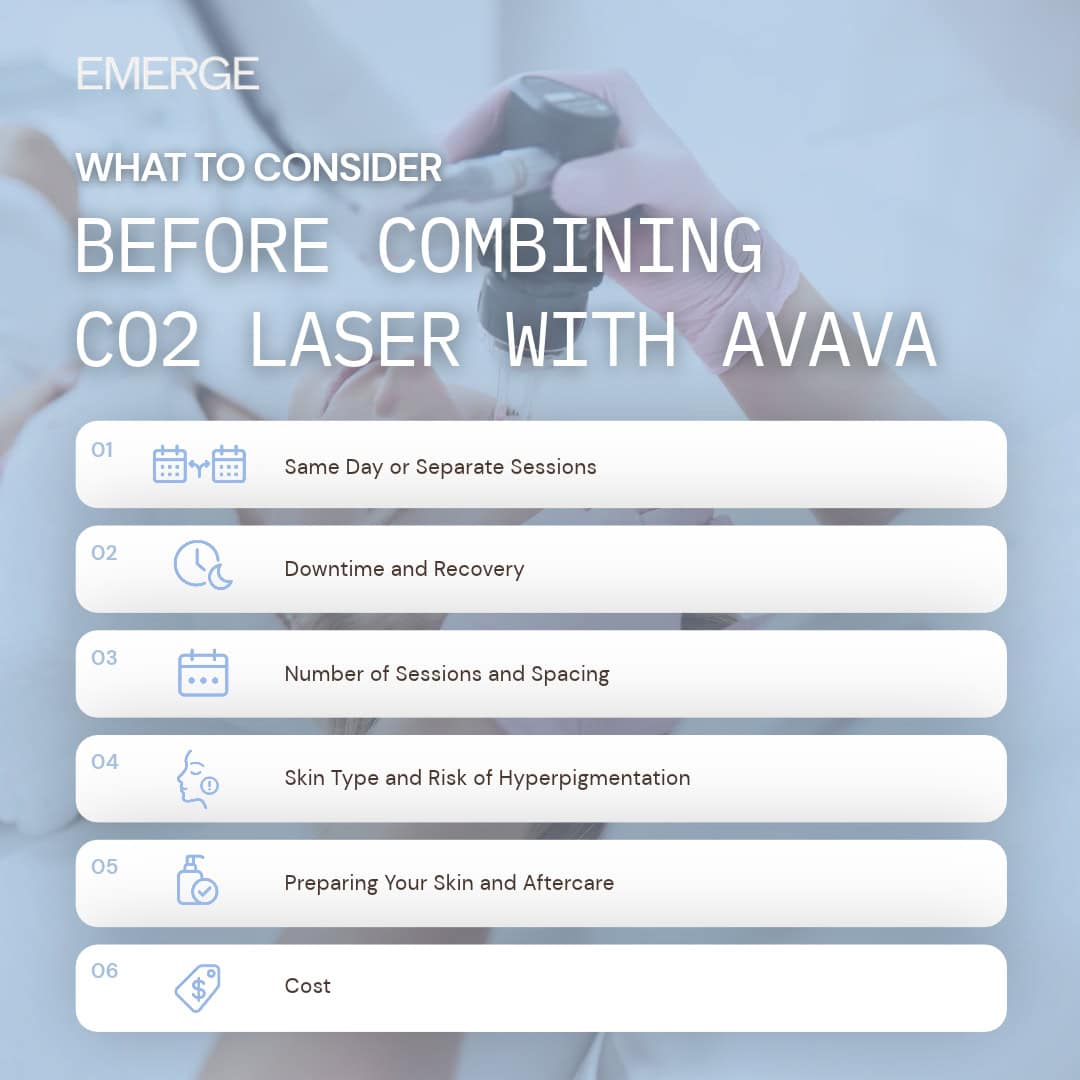
What Should You Consider Before Combining CO2 Laser With Avava
A good plan is built on details. Here is how I think through the big ones.
Same Day or Separate Sessions
Sometimes it’s best to do treatments on the same day. Sometimes it’s best to space them out and do them on separate days to give the skin time to heal.
In wound healing, there are different phases that overlap one another, one being a proliferative phase that starts a few days after injury. That’s the collagen-making phase. It’s best not to interrupt those activities with another procedure, because it could delay healing.
Ultimately, I customize treatment to what I think will be the most helpful for each patient. There is no one protocol that I follow religiously for everyone. Factors I consider include your skin type (deeper skin tones have a higher risk of dark spots after overly aggressive resurfacing procedures), what we are trying to treat, how aggressive I want to be with each laser, and how much downtime you can tolerate. We protect results with diligent medical-grade aftercare and sun protection.
Downtime and Recovery
Downtime for fractional CO2 laser resurfacing can vary from five to fourteen days, depending on how aggressive the treatment is. Be sure to be counseled appropriately. I still tell most patients to plan on about five to seven days. AVAVA adds very little on top.
For a closer look at each stage, read my week-by-week guide to the laser skin resurfacing healing process.
Number of Sessions and Spacing
There is no universal number. Most people need between one and three CO2 sessions, with recovery anywhere from five to fourteen days depending on intensity. AVAVA is typically a short series spaced several weeks apart. I sequence the sessions so each one has room to do its job.
Skin Type and Risk of Hyperpigmentation
This is where skin type steers everything. Deeper skin tones carry more risk of hyperpigmentation with aggressive resurfacing, which is exactly why AVAVA is such a valuable partner in my plans. AVAVA is cleared for acne scarring in all Fitzpatrick skin types I through VI, addressing a critical gap in treatment accessibility and safety for patients with skin of color. A measured plan protects the skin barrier and lowers that risk.
Preparing Your Skin and Aftercare
At Emerge, our mantra is, “Consistency is the best anti-aging treatment,” and “prevention is always easier than correction.” With that said, I wish all of my patients would invest in medical-grade skincare before investing in Botox. Quality skincare is the basis of great skin.
The main pillars in skincare are retinoids, SPF, and vitamin C. Vitamin C is an underappreciated investment and one I wish patients would start on much sooner. There are certain items I want my patients using on their skin ahead of a laser treatment (not another random acid or scrub). Two favorites can be found at our Emerge Skincare Shop: Alastin C-RADICAL Defense Antioxidant Serum and SkinCeuticals Triple Lipid Restore 2:4:2.
Medical-grade skincare products have much stronger ingredients that penetrate deeper into the skin, and they are tested to make sure they actually do what they claim, unlike many generic brands. Buy Alastin products in the Emerge RX Club to earn Aspire Rewards points to use toward treatments.
Cost
Each person’s skin is unique, and so is their treatment plan, so it is difficult to quote costs without first addressing your concerns and developing a personalized treatment plan. I always go over pricing with you during your consultation.
What To Expect From a Combined Treatment Plan
Here is how a typical plan unfolds, from consultation to final results:
- During a consultation with me, we discuss your goals, evaluate your skin texture, skin tone, scarring, etc., determine the best options for your skin, and make sure you are a good candidate.
- Laser treatments are tailored to your skin, and the best results come from a gradual plan we build together over multiple visits.
- As you heal, you may notice a difference in tone and a smoother feel early on. Your end results continue to improve and look natural over the coming months, as collagen keeps remodeling for three to six months.
Curious how the treatments feel? I cover that in my post on does laser treatment hurt.
CO2 Laser and Avava FAQs
Can You Do CO2 Laser and Avava on the Same Day
In some instances, we layer both in the same visit. In others, we break it up into separate visits. It depends on what phase of wound healing your skin is in and the downtime you are able to take.
Is AVAVA Safe for Darker Skin Tones
Yes. AVAVA is FDA-cleared for all Fitzpatrick skin types I through VI. That means it’s safer in darker skin types, with a lower risk of the pigmentation issues that some older laser technology carries.
Which Is Better for Acne Scars, CO2 or AVAVA
It depends on your scars and your skin tone, which is why pairing them often wins.
Ultimately, the type of scarring you have and the downtime you can accommodate for healing will help decide whether CO2, AVAVA, or a combination of both would yield the best results for you.
How Long Do the Results Last
While collagen continues to remodel for three to six months after CO2 laser treatment, no results are permanent. Continued use of medical-grade products and returning for treatment can help keep you glowing and looking great. Remember, it is easier to maintain than to undo.
Ready to Build Your Personalized Skin Plan at Emerge in Glen Rock
Combining CO2 and AVAVA lasers resurfaces the outer layers and deeper levels of your skin to address wrinkles and fine lines, acne scarring, discoloration or hyperpigmentation, and skin texture and tone issues. To see if laser resurfacing is a treatment that is right for you, book a consultation. With AVAVA cleared for all skin types, more patients than ever can be considered for smoother, more youthful-looking skin.
Come see us at Emerge Aesthetics in Glen Rock, NJ. We are the only verified med spa in Bergen County and one of only two practices in the greater NJ area that have the AVAVA laser, and I am excited to bring it to my patients. It is filling a void for so many of my patients, especially those with skin of color, who are often not candidates for many of the rejuvenation treatments out there.
If you’d like to learn more about fractional laser treatments, schedule an appointment by giving our office a call at 201-383-5299, or check out our Instagram for updates and current promotions. For my current skincare recommendations, browse the Emerge Skincare Shop.
About Emerge Aesthetics
Emerge Aesthetics is a medspa and laser clinic led by a surgically trained physician who loves non-surgical options. Every treatment is performed by Dr. Rochelle Kling personally. Call today to schedule a consultation.
Dr. Rochelle Kling is a double board-certified Emergency Medicine physician and the founder of Emerge Aesthetics. Her extensive medical and surgical training gives her the expertise necessary to perform even the most complicated non-surgical procedures.
Emerge Aesthetics proudly serves patients from Glen Rock, Ridgewood, Wyckoff, Franklin Lakes, Saddle River, Upper Saddle River, Ho-Ho-Kus, Paramus, nearby New York City, and surrounding communities.
Disclaimer: This information is not intended as medical advice and does not create a physician/patient relationship. Those who are taking medication, pregnant or breastfeeding, or have a medical condition should first speak with Dr. Kling as well as their physician.
Rochelle Kling MD