
Anti-aging treatments aren’t what they used to be, and regenerative aesthetics is here to prove it.
Gone are the days when people felt they had to wait until their skin was “bad” to invest in a plan. Now, non-surgical, minimally invasive procedures, like PDO threads, are proving that strategy and consistency matter far more than chasing quick fixes—or even plastic surgery.
A PDO thread lift is one of the quickest, most popular ways to achieve a more youthful appearance. With less downtime and more natural-looking results, there’s a reason thread lifts are often referred to as the “lunchtime facelift.” They can lift and tighten, treat sagging skin, and, most importantly, they can stimulate collagen production for longer-lasting improvements in skin quality.
It’s no secret that people don’t really know how thread lifts work, which can make the treatment feel intimidating. So in this post, we’re explaining exactly what a PDO thread lift is. We’ll discuss how it works, how a board-certified physician approaches treatment planning, and what to expect from results.
Because at the end of the day, your skin deserves the best—and that starts with understanding your treatment options.
What Is PDO Thread Lift? And Why Is Everyone Talking About It?
When considering non-surgical cosmetic treatments, your search history probably looks a little like How Long Does Botox Take to Work? and What Is Microneedling with PRP? (Nope, not spying—we’ve just been doing this for a while.)
Both are incredible treatments—but they’re best as part of a comprehensive multimodal approach—one that includes PDO threads.
A PDO thread lift is a minimally invasive cosmetic procedure that uses dissolvable sutures to lift sagging skin and stimulate collagen production. Essentially, it offers the benefits of a traditional facelift without the visible scarring, long downtime, and potentially unnatural results. It sounds like anti-aging magic—but it’s just medicine. Evidence-based, regenerative, FDA-approved medicine.
Not only does a PDO thread lift provide instant, skin-lifting results, but it also stimulates collagen production over time. Here’s more on exactly how that process works:
How Does PDO Thread Lift Work?
Immediate Lift
When PDO threads are inserted under the skin, they act like support beams in a building. The threads gently reposition the tissue through mechanical suspension, providing instant structure to sagging skin.
More specifically, a PDO thread lift treats areas such as the cheeks, jawline, lower face, forehead, eyebrows, marionette lines, nasolabial folds, and neck. These are areas that naturally sag more quickly due to a decline in collagen, elastin, fat pads, and bone density. It’s natural. It’s normal. But that doesn’t mean it isn’t one of the first things we notice in our own appearance.
The lift from PDO threads is subtle. It doesn’t result in an overly-tightened, “overly-done” appearance—which is exactly what many clients want to avoid. Combine this with additional rejuvenative treatments, and you’ll start to see real, structural change—not just temporary improvements.
In other words? Over-filled faces are out; multimodality is in.
Collagen Stimulation
As threads dissolve, typically over several months, they trigger the body’s natural healing response. This is where the medicinal magic happens.
Directly after receiving the threads, your body goes into immediate defense mode. It perceives the threads as a “threat,” initiating a controlled inflammatory response to repair the area. During this process, fibroblasts—the cells responsible for stimulating collagen production—migrate to the site to produce healthy collagen fibers. This is only the beginning, though.
Over time, as the threads dissolve, the body initiates what’s called “neocollagenesis.” It’s a biological process in which the body creates new collagen and elastin, reducing signs of aging and improving skin laxity. This is the same process that other well-known and well-loved procedures follow, like dermal fillers, AVAVA laser therapy, and microneedling.
And this is why regenerative aesthetics is taking over. The goal isn’t simply to lift—it’s to improve how your skin behaves long-term.
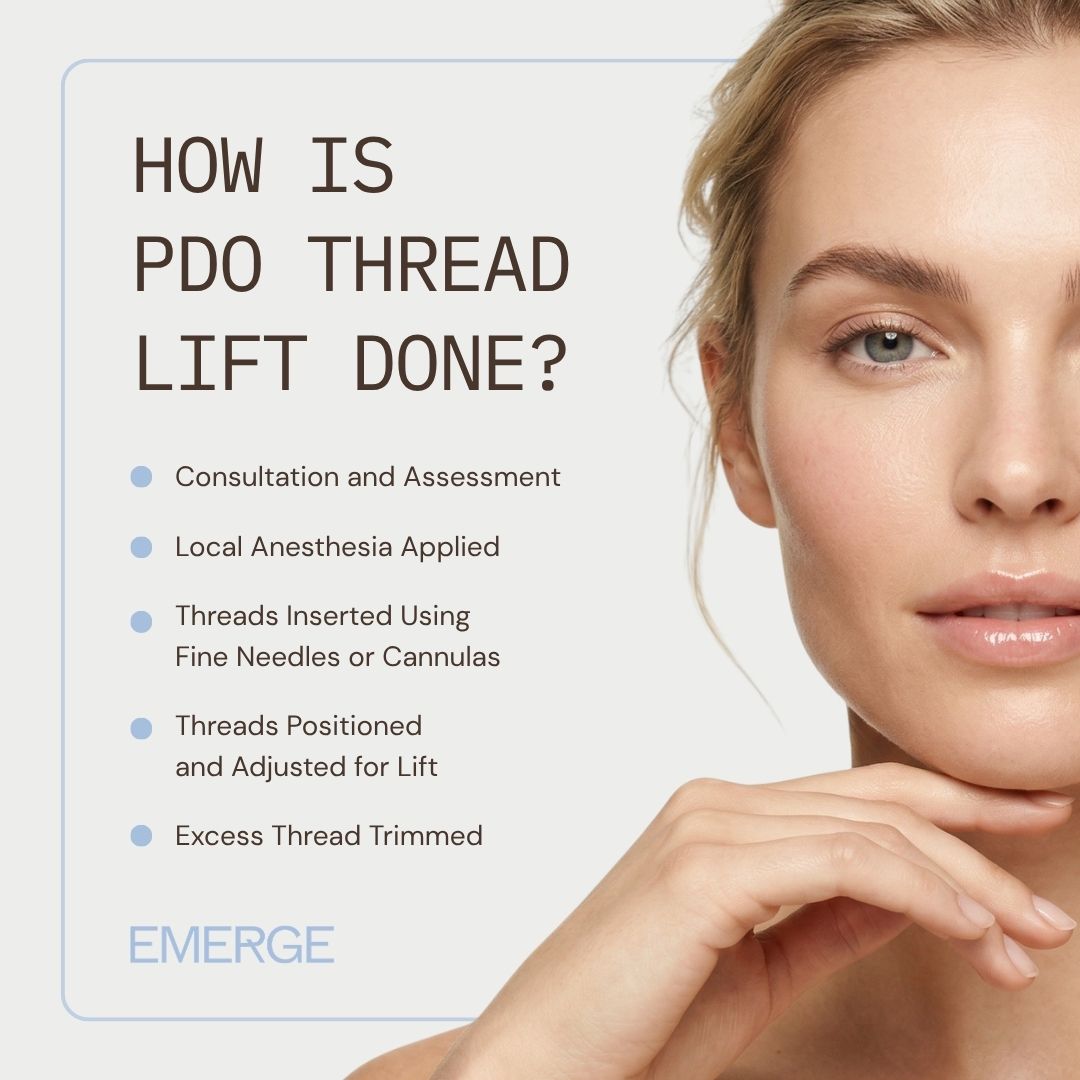
How Is PDO Thread Lift Done?
Consultation and Assessment
Ultimately, treatment efficacy isn’t just about the procedures you invest in—it’s the physician who’s performing them. As Dr. Kling has previously discussed, medspas are a very unregulated industry. That’s why many people walk in expecting one thing and leave with overfilled, unnatural results. It shouldn’t be happening—but it does.
At Emerge, we don’t just “do treatments.” We practice medicine through our Emerge Ethos—non-negotiables that define our practice, such as patient safety, integrity and honesty, and education and empowerment. When you come in for a PDO thread lift consultation, Dr. Kling will evaluate:
- Your facial structure
- Areas of volume loss
- Skin quality
- Your goals (and expectations)
Not everyone is a good candidate for threads. If that’s the case, we’ll be honest about that, and we’ll recommend a treatment that aligns with your anatomy without disrupting your skin and tissue. The goal isn’t just to receive treatment—it’s to receive the right treatment.
Local Anesthesia Applied
Don’t let the words “local anesthesia” intimidate you. It’s much different from general and twilight anesthesia, where patients are sedated or fully asleep. Local anesthesia is a medication that causes temporary loss of sensation in a targeted area. In other words, it will just feel numb and maybe slightly tingly.
Local anesthesia simply ensures that patients remain comfortable. And, ultimately, this is one of the many reasons that it’s such a popular alternative to more invasive procedures. It allows for effective treatment without the risks, downtime, or recovery associated with surgery.
Interested in a deeper dive? Read our guide, “Non-Surgical Face Lifts,” to learn more!
Threads Inserted Using Fine Needles or Cannulas
A physician will insert the threads beneath the skin using either a needle or a cannula, depending on the area and the technique. Here’s a quick breakdown of the differences:
- Needles are sharp and rigid, allowing for precise, direct placement. A physician will generally use a needle for smaller areas and localized skin rejuvenation, such as treating fine lines and wrinkles.
- A cannula is a blunt-tipped, flexible tube that pushes through the tissue rather than cutting into it. Physicians will use cannulas to treat larger treatment areas, providing subtle volume and lift.
Additionally, there are different types of thread: PDO mono threads (smooth) and PDO cog threads (lifting). Smooth threads build collagen, whereas lifting threads lift. More often than not, patients will receive both types during treatment—smooth threads provide support for the lifting threads.
Threads Positioned and Adjusted for Lift
Once inserted, the threads are carefully adjusted or “anchored” to create a natural-looking lift. This is where experience matters. Overcorrection or poor placement can lead to immediately noticeable irregularities, such as facial asymmetry, dimpling, or thread mitigation.
Because PDO threads are dissolvable, these results, fortunately, aren’t permanent. But that doesn’t mean they’re insignificant. A board-certified physician will properly manipulate and reposition the threads to complement a patient’s natural anatomy, prioritize facial balancing, and enhance the facial structure.
Excess Thread Trimmed
Physicians will insert PDO threads into the subcutaneous layer of the skin, directly below the dermis. After proper insertion and placement, the physician will trim any excess to allow the skin to settle.
Because patients receive local anesthesia, the process is seamless and quick. The physician will then trim excess thread close to the skin and massage the area afterward, ensuring the threads have properly anchored and become virtually invisible post-procedure.
How Long Does a PDO Thread Lift Last?
Generally, most patients can expect PDO thread results to last 12 to 18 months. However, the longevity of treatment ultimately varies based on a patient’s lifestyle, age, and skin condition. Additionally, the type of thread used can affect how long it lasts and how long it takes to dissolve.
While PDO threads commonly dissolve within 4–6 months, the treatment results don’t end there. As we mentioned earlier, the procedure triggers neocollagenesis—a long-term biological response. The body replaces the threads with structural collagen, creating a scaffold that reinforces the skin’s structure, enhances firmness, and promotes long-term improvements in elasticity.
Remember, though: you’ll always get the best results with a multimodal approach. More specifically, Dr. Kling recommends periodic maintenance treatments and additional minimally invasive procedures tailored to your goals and anatomy.
How Painful Is PDO Thread Lift?
One of the most common questions people ask is: Is a thread lift painful? We’ll never promise that a procedure will be pain-free—honesty is important. However, Dr. Kling takes every measure to ensure patient comfort. More specifically, because you receive numbing medication before thread insertion, most clients only feel pressure.
Post-treatment, you may experience side effects like tenderness, slight swelling, and occasional bruising. However, downtime is minimal, and side effects usually resolve in as little as a few days.
You can learn a little more about the process in our Threads FAQ on Instagram!
How Much Is PDO Thread Lift?
There’s a common myth regarding PDO thread lifts: that they’re expensive. On average, PDO threads cost between $700 to $4,500. That’s a significant range, but that’s normal! Ultimately, costs vary by location, medspa, physician, and treatment plan.
But here’s the thing… thread lifts are still more affordable than traditional surgical facelifts.
PDO thread lifts can be an excellent addition to a treatment plan for lifting, restructuring, and enhancing the skin.
When you approach skincare with a plan, that’s when you get the results you want. You don’t need a facelift or a trendy social media hack—you need regenerative aesthetics that’s designed to move the needle. (Pun not intended.) Not only can PDO threads improve sagging skin through subtle lifting and gradual collagen stimulation, but they also work excellently as part of a multimodal treatment plan.
Your face, body, and goals deserve expertise—not guesswork.
At Emerge Aesthetics, Dr. Kling is our double-board-certified Emergency Medicine physician who brings surgical expertise to non-surgical aesthetics. With a “Less is more” approach, she prioritizes subtle enhancements that encourage natural results. She’s not JUST your medspa physician—she’s a compassionate advocate for precision, patient safety, and strategic results.
Schedule your consultation with Emerge Aesthetics today! And if you still want to do a little compare-and-contrast for treatments, visit the Emerge blog. We break regenerative aesthetics down so you know exactly how treatments work—and what they work for. And, of course, follow the Emerge Instagram so you never miss out on deals, discounts, and updates.