
Loose skin on the stomach rarely shows up out of nowhere. It follows a change. Maybe a pregnancy, maybe weight loss, maybe the simple fact that skin has been stretching and rebounding for a few decades. Whatever brought you here, you have questions, and you deserve real answers.
Here’s the thing about tightening stomach skin: there’s no single fix that works for everyone. The right approach depends on how much loose skin you have, what your goals are, and whether you lean toward non-surgical or surgical options. Some people need gentle support. Others are working with more significant laxity after major weight changes. This guide walks you through the whole picture, so you can understand your options before you ever book a consultation.
At Emerge Aesthetics, our philosophy is simple. This is medicine, not marketing. Dr. Rochelle Kling, a double board-certified Emergency Medicine physician, brings surgical-level precision to non-surgical aesthetics. That perspective matters here, because tightening stomach skin is as much about understanding tissue and anatomy as it is about picking a treatment.
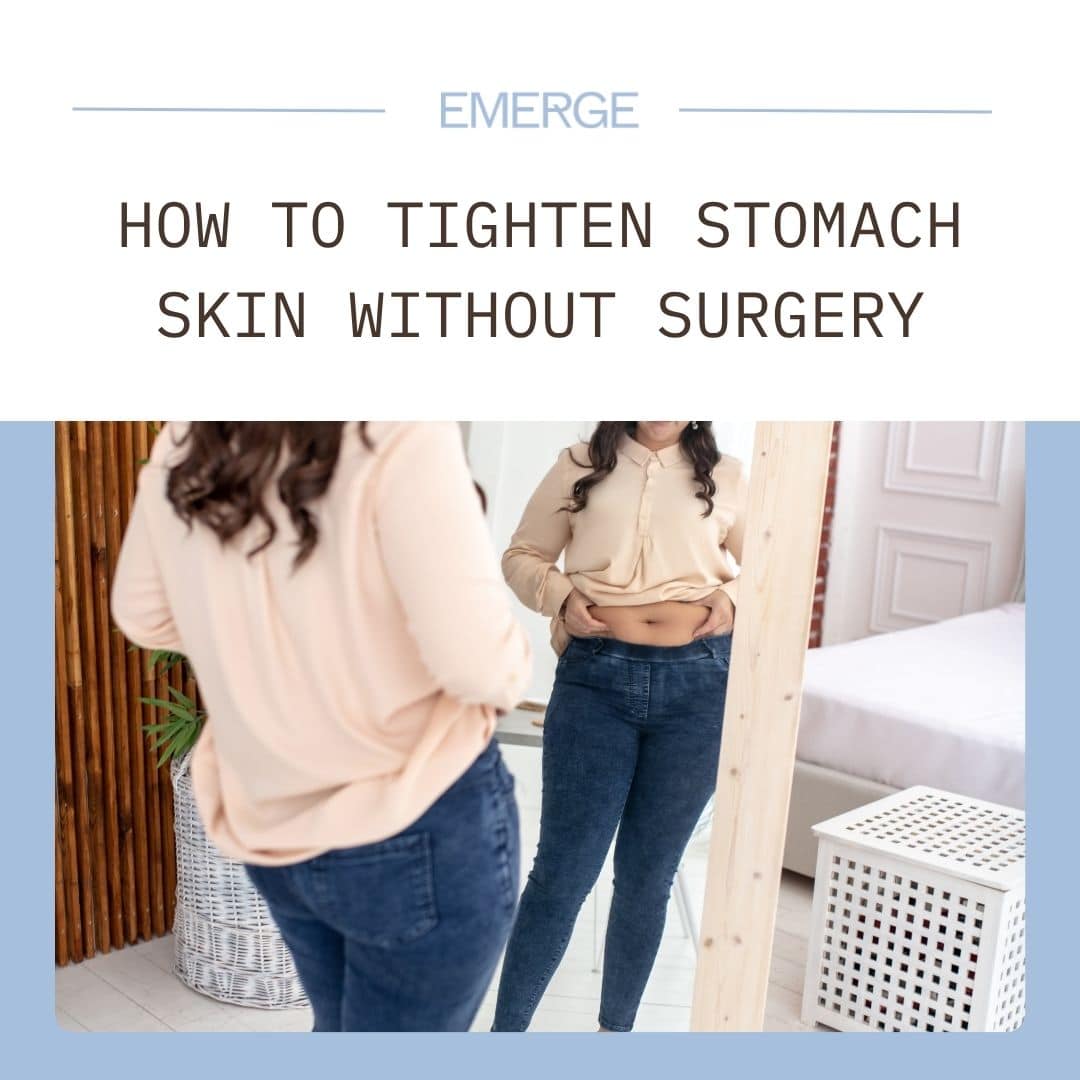
How to Tighten Stomach Skin: Understanding Your Real Options
When it comes to tightening stomach skin, the best approach depends on several factors working together. How much loose skin do you actually have? What are your goals? What is your overall health like? Have you had prior abdominal surgeries? Do you have rectus diastasis?
These questions matter because they shape everything. The ideal candidate is someone who is fit, lean, and minimal adipose tissue aka fat. A person with mild-to-moderate skin laxity has a very different path than someone facing significant loose skin after weight loss. Treatments may help improve skin firmness, but results vary depending on each person’s situation.
And here’s what not every physician will tell you: the best approaches are multi-modal.
Dr. Kling believes the best results come from a gradual, layered strategy, not one magic treatment. We combine energy-based devices, biostimulatory options, and medical-grade skincare over the long term, because that’s what actually moves the needle on skin quality. Prevention is always easier than correction, and consistency is the best treatment.
What Causes Loose Skin on Stomach?
So why does stomach skin lose its snap in the first place? To understand that, you have to understand what keeps skin firm to begin with.
Your skin has two structural proteins doing the heavy lifting: collagen and elastin. Collagen gives skin its strength and structure. Elastin gives it the ability to stretch and bounce back, like a rubber band that returns to shape.
When your skin stretches slowly, say during pregnancy or weight gain, these fibers stretch, too. Sometimes they recover. Sometimes they don’t, especially when the stretch is large or fast, or when time and age slow down how efficiently your skin cells rebuild.
Here’s the part people miss: as we age, the body naturally breaks down collagen and elastin faster than it produces them. Add in sun exposure, which also breaks down collagen and elastin over time, and you get skin that’s lost some of its ability to snap back.
Common causes of loose skin on the stomach include:
- Pregnancy: Which stretches the abdominal skin and underlying tissue over months, sometimes across multiple pregnancies.
- Significant Weight Loss: Where skin that expanded over years cannot always retract to fit a smaller frame.
- Natural Aging: As collagen and elastin production slows and skin stretches more easily.
- Sun Damage: Which breaks down collagen and elastin in the deeper layers of skin.
- Genetics: Since some people simply have skin that holds firmness longer than others.
- Rapid Weight Fluctuations: Which repeatedly stretch and shrink the skin.
Is It Possible to Tighten Loose Skin on Stomach?
In many cases, yes. However, the degree of improvement depends on your skin, anatomy, and how much laxity is present.
Mild-to-moderate loose skin may respond well to non-surgical treatments designed to stimulate collagen production and support gradual remodeling of the skin. More significant skin laxity, particularly when there’s a larger amount of excess skin, many require a different approach to achieve noticeable tightening.
Age can play a role, too, but it’s only one part of the picture. Skin quality, existing collagen and elastin, weight changes, muscle mass, overall health, and the underlying tissue all influence how the abdomen looks and how it may respond to treatment. This is why Dr. Kling evaluates each patient individually rather than recommending one universal treatment based on skin laxity alone.
It’s also important to set realistic expectations. Treatments that work by stimulating your body’s own regenerative processes typically create changes gradually as new collagen develops and the tissue remodels. Depending on your starting point and goals, Dr. Kling may recommend a multimodal treatment plan that addresses several contributing factors rather than relying on one single procedure.
Here’s where to start: a consultation at Emerge Aesthetics. This is the best way to determine what’s realistically achievable for your unique anatomy.
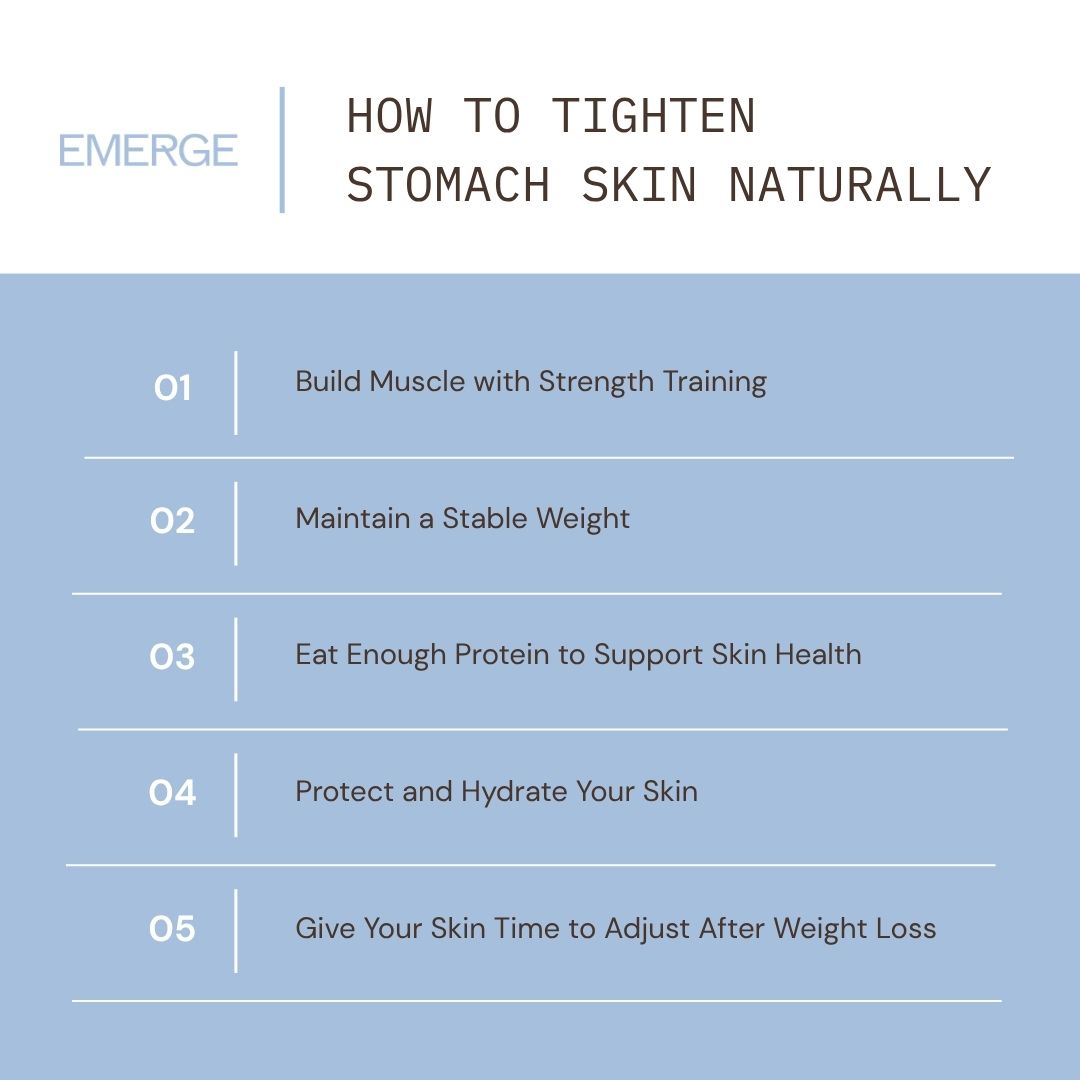
How to Tighten Stomach Skin Naturally
Before we get to in-office treatments, let’s talk about what you can do at home. A healthy lifestyle lays the groundwork for everything else, the same way skincare is the foundation of every plan Dr. Kling builds. These natural approaches may help improve the appearance of stomach skin, but let’s be honest up front: they have limits, which we’ll get to.
Build Muscle with Strength Training
One of the most underrated ways to improve the appearance of loose stomach skin is to build what sits underneath it.
When you strength train and build muscle, you improve your body composition. More muscle mass beneath the skin can help fill out the area and create a firmer, more toned appearance. Resistance training a few times a week does more for that look than endless cardio. It won’t remove excess skin, but it changes what the skin drapes over.
This is exactly why we held our Emerge x Forme House NJ event! Think: rooftop pilates, music, and exciting activities. (TL;DR: moving your body doesn’t have to feel like another thing to check off your to-do list.)
Maintain a Stable Weight
Losing weight is a huge achievement, and it’s one you should be proud of! However, it’s also important to know that yo-yo dieting, also known as crash dieting, is tough on skin. Every time your weight climbs and drops, your skin stretches and contracts, which strains those collagen and elastin fibers.
Keeping a stable weight gives your skin the best chance to adapt and stay firm over the long term. If you’re still actively losing weight, aim for a steady, gradual pace rather than dramatic swings.
Eat Enough Protein to Support Skin Health
Your skin relies on protein, and your body needs adequate protein to produce collagen and support healthy tissue. Eating enough protein helps provide the building blocks involved in skin repair and maintenance.
Nutrients like vitamin C also play an important role in normal collagen production (hence why Dr. Kling recommends all clients invest in a topical vitamin C serum!) Together, a balanced, nutrient-rich diet can support skin health while helping you maintain the muscle mass and body composition that contribute to a firmer appearance.
Protect and Hydrate Your Skin
Non-surgical body contouring is where most of our patients start, especially those with mild to moderate skin laxity. These treatments work by stimulating your own collagen and remodeling tissue, with far less recovery time than surgery. No general anesthesia, minimal disruption, and results that build gradually.
For those interested in the full picture, read our article: “How Does Body Contouring Work?” And don’t worry, we understand the hesitation around non-surgical procedures and their efficacy. That’s exactly why we wrote “Can You Get Rid of Loose Skin Without Surgery?”
Here are the non surgical treatments we use to tighten stomach skin.
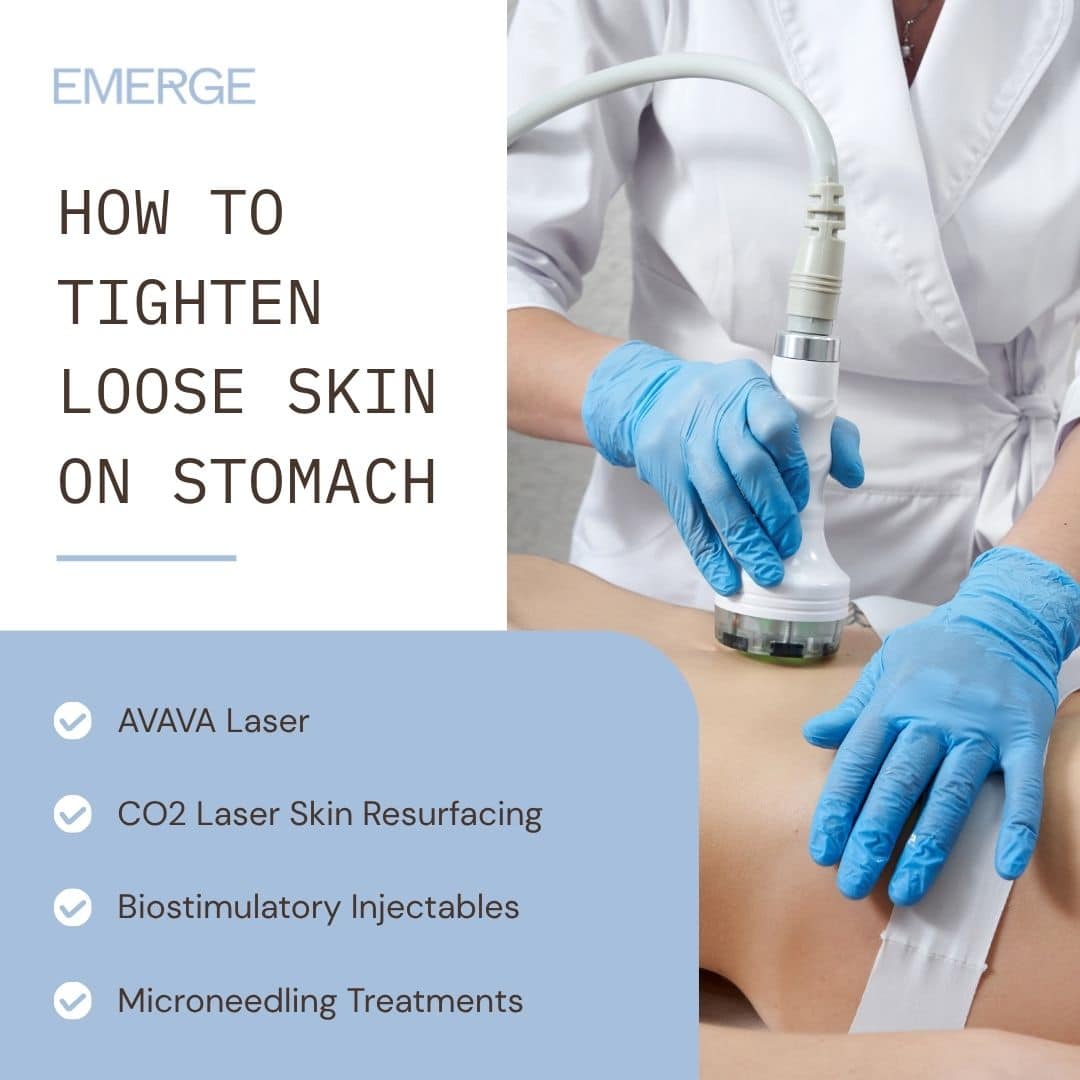
AVAVA Laser
The AVAVA laser is a non-ablative skin treatment designed to improve skin quality from the inside out. Using Focal Point Technology™ (FTP), AVAVA focuses ring-shaped microbeams deep into the dermis to trigger the production of collagen and elastin production from the inside out. At the same time, the system’s ComfortCool™ technology soothes the outer layer of the skin to minimize surface heat and discomfort.
At Emerge, this is our gold standard laser system. Not only does it minimize downtime, provide impressive results (sometimes after just one session), and protect the surrounding tissue, but it’s also safe and effective for all Fitzpatrick skin types (I through IV). For treating stomach skin laxity in particular, it helps stimulate collagen where it counts while keeping recovery gentle.
Emerge Aesthetics is the only verified med spa in Bergen County offering AVAVA, and one of just two practices in the greater New Jersey area with this technology. Schedule your appointment with Emerge to figure out your treatment plan with Dr. Kling today!
CO2 Laser Skin Resurfacing
Fractionated CO2 laser resurfacing, delivered on our SmartXide Pro, is a powerful collagen builder. It creates controlled micro-channels in the skin that trigger your body’s natural repair response, ramping up collagen production over the weeks and months that follow.
For stomach skin with texture concerns and mild to moderate laxity, CO2 resurfacing can help improve both firmness and skin quality. It does involve more downtime than some other non-surgical options, and recovery can vary depending on the depth of treatment and how your skin heals. Dr. Kling will walk you through exactly what to expect based on your skin, treatment plan, and goals.
Learn more about how this treatment works by reading our article: “The Fractional CO2 Laser Treatment for Skin Transformation.”
Biostimulatory Injectables
Biostimulatory injectables like Sculptra and Radiesse work differently from traditional filters. Instead of primarily adding volume, they stimulate your body’s own collagen production to gradually improve the quality and support of the skin. Sculptra uses poly-L-lactic acid (PLLA) to encourage new collagen formation over time, while Radiesse uses calcium hydroxylapatite (CaHA) to provide structural support while also stimulating collagen.
On the stomach, Dr. Kling may use biostimulatory injectables to address mild to moderate laxity and improve skin quality, often alongside other treatments that target different layers of the tissue. The goal isn’t simply to “fill” loose skin, but to create gradual improvement by supporting the skin’s underlying structure.
Microneedling Treatments
Microneedling treatments create controlled micro-injuries in the skin that switch on your natural healing and collagen response. We often pair it with PRP or PRF, using growth factors from your own blood to amplify the regenerative effect.
For stomach skin, microneedling can help improve texture and support firmness over a series of sessions. Like our other non-surgical tools, it works best as part of a strategy rather than a one-and-done, and it layers beautifully with laser and biostimulatory options over time.
Surgical Stomach Skin Tightening Procedures
For significant amounts of excess abdominal skin especially when associated with fat, and rectus diastasis (typically post pregnancy) then surgical skin removal is a better option to consider. In many cases this might be the best optionThis is most commonly associated with substantial weight loss or changes to the abdomen after pregnancy, when loose skin may extend beyond the degree of laxity typically addressed with non-surgical treatments.
A tummy tuck, for example, is often performed by a plastic surgeon to remove excess skin and, when appropriate, repair or tighten the underlying abdominal wall. Because it’s a surgical procedure, it typically involves general anesthesia and a more extensive recovery period than regenerative and non-surgical treatments. Even patients who have already undergone a mommy makeover could potentially benefit from improving the quality of the skin.
Emerge Aesthetics focuses on regenerative aesthetics and non-surgical approaches to improving skin quality, firmness, and overall tissue health. Dr. Kling, a physician who brings surgical expertise to non-surgical aesthetics, can evaluate the degree of laxity you’re experiencing and help you understand what kind of improvement may be realistic with treatments.
Building Your Plan to Tighten Stomach Skin in Bergen County
Loose stomach skin has a lot of causes, from pregnancy and significant weight loss to natural aging and sun damage, all of which affect the collagen and elastin that keep skin firm. The good news is you have real options. A healthy lifestyle, strength training to build muscle, stable weight, protein, and diligent skincare lay the foundation. From there, non surgical treatments like the AVAVA laser can help improve skin firmness over the long term.
Emerge Aesthetics is proud to serve Bergen County and surrounding areas, including Glen Rock, Ridgewood, Wyckoff, Franklin Lakes, Saddle River, Upper Saddle River, Ho-Ho-Kus, Paramus and New York City. Dr. Rochelle Kling, our double board-certified Emergency Medicine physician and surgically trained founder, personally performs every procedure and builds every plan around your unique anatomy and goals.
Ready to take the next step? Book a consultation to explore your body contouring options, and browse our medical-grade skincare shop to start supporting your skin at home. Ask us about the Emerge RX Club, where purchasing Alastin skincare earns Aspire points redeemable toward in-office treatments. And finally, follow us on Instagram for education and inspiration, and keep reading the blog for more physician-led guidance.
This blog is for educational purposes only and does not constitute medical advice. Results vary from person to person, and a consultation with Dr. Kling determines your candidacy for any treatment. If you have a medical condition or take medications, please consult your physician before beginning any new treatment. Products mentioned are not intended to diagnose, treat, cure, or prevent any disease.
Rochelle Kling MD