
If you’ve been researching the laser skin resurfacing healing process, you’re one of many. Known as an effective way to improve uneven texture, acne scars, skin damage, and fine lines, laser systems are redefining the medical aesthetic space. However, treatment is only one piece of the puzzle.
Understanding the healing process and how to protect your skin after treatment is just as important. While recovery isn’t one-size-fits-all, there are certain things you need to do (and not do) during recovery. And most importantly, it depends on the type of laser, the treated areas, the treatment depth, and your unique anatomy.
At Emerge Aesthetics, Dr. Kling, our double-board certified Emergency Medicine physician, brings surgical expertise to non-surgical aesthetics… and aftercare. That’s why below, we’re discussing what the laser resurfacing healing process looks like on a week-by-week basis. When you know what to expect, you can go into your appointment at Emerge Aesthetics confident, informed, and, most importantly, excited. Let’s dive in.
Laser Skin Resurfacing Healing Process: Week-by-Week Recovery
When you’re planning your laser resurfacing treatment, you often hear about treatment efficacy: it treats fine lines, improves skin texture, helps minimize the appearance of acne scars, and stimulates collagen production. After all, those benefits are the stars of the show! However, it’s just as important that you’re informed about the healing process.
Not because healing is lengthy, painful, or tedious. Instead, think of it like this: the better you care for your investment, the longer it lasts. (In other words, the more appropriately you care for your skin post-laser resurfacing, the better and longer-lasting your results will be.) That’s not marketing; it’s simple science.
As Dr. Kling tells every patient: patience is part of the plan. We aren’t chasing dramatic overnight results; collagen stimulation and skin resurfacing is a process. And healing is part of that process.
Below, we’ll touch on the two most common (and effective) lasers in modern medical aesthetics: Fractionated CO2 laser and AVAVA laser. We’ll talk about what each is, what they both do, and how long you can expect the healing process to last.
What Is Laser Skin Resurfacing?
Laser skin resurfacing is a treatment that uses focused light energy to improve the quality of your skin. Think texture, tone, and clarity. Generally, laser treatments use concentrated beams of light to target specific areas, stimulating collagen production and promoting new skin cell growth.
But we mentioned two different laser skin resurfacing techniques earlier: CO2 laser and AVAVA laser. What’s the difference? First, one laser is ablative and the other isn’t.
Fractionated CO2 lasers are ablative, meaning they create microscopic channels in the skin by removing tiny columns of damaged surface tissue while heating deeper layers. This dual action stimulates collagen production and encourages healthy new skin to replace older, damaged skin. It’s a highly effective non-surgical procedure for treating fine lines and wrinkles, acne scars, and sun damage.
AVAVA laser, on the other hand, is non-ablative. Rather than removing the skin’s surface, it delivers targeted laser energy beneath the skin to stimulate remodeling while leaving the outer layer intact. This approach is incredibly effective for improving skin laxity, fine lines, and overall skin quality with significantly less downtime than traditional laser treatments.
Ultimately, both AVAVA and CO2 lasers rely on the body’s natural healing process. However, they differ in downtime, treatment concerns, and aftercare.
Interested in learning more? (We hoped so.) Check out our guide on laser aftercare!
How Does Laser Skin Resurfacing Work?
Ultimately, there’s no universal “best’ laser skin resurfacing treatment. Both CO2 fractional laser and AVAVA laser have their unique benefits; it simply comes down to your specific skin concerns. Most importantly, Dr. Kling will never hand you a pamphlet of minimally invasive procedures and ask you to choose one. Instead, she’ll analyze your skin health, skin quality, anatomy, and skin goals, and help lead you to the laser system most appropriate for you.
Your skin doesn’t deserve guesswork; it deserves science, precision, and expertise. Here’s what you can expect based on each treatment:
Ablative Laser Resurfacing (CO2 Laser Resurfacing)
Fractionated CO2 laser resurfacing is an ablative treatment, meaning it removes microscopic columns of damaged skin while simultaneously heating the deeper layers of the dermis. The wavelengths are absorbed by water in the skin cells, causing vaporization of damaged tissue. Although it may sound aggressive, so long as you’re receiving treatment from a qualified physician, the healthy tissue remains intact.
This controlled injury activates the body’s natural wound-healing response, stimulating collagen and elastin production while encouraging fresh, healthy skin cells to replace damaged ones. As a result, fractionated CO2 laser treatment is particularly effective for improving deeper wrinkles, acne scars, sun damage, and uneven skin texture.
It’s important to note that CO2 laser treatments do result in longer downtime and recovery periods. However, in retrospect, many patients often note it’s worth it for safe, effective, and meaningful skin rejuvenation.
Non-Ablative Laser Treatments (AVAVA Laser System)
The AVAVA laser system is a non-ablative treatment that delivers precise laser energy beneath the epidermis to gently heat deeper tissues where collagen is produced. This thermal stimulation encourages the body’s natural healing response and collagen remodeling while leaving the outer layer of skin entirely intact.
Unlike traditional ablative lasers, AVAVA uses Focal Point Technology™ (FPT) that delivers targeted, cone-shaped laser energy to minimize tissue damage and reduce downtime. And the best part? AVAVA laser is generally safe for all skin tones and skin types, making it a valuable addition to a multimodal treatment plan for virtually every patient.
Emerge Aesthetics is the only verified med spa in Bergen County offering AVAVA and one of just two practices in the greater New Jersey area with this technology. Still on the fence? See how impressed Dr. Kling is with AVAVA results after one session.
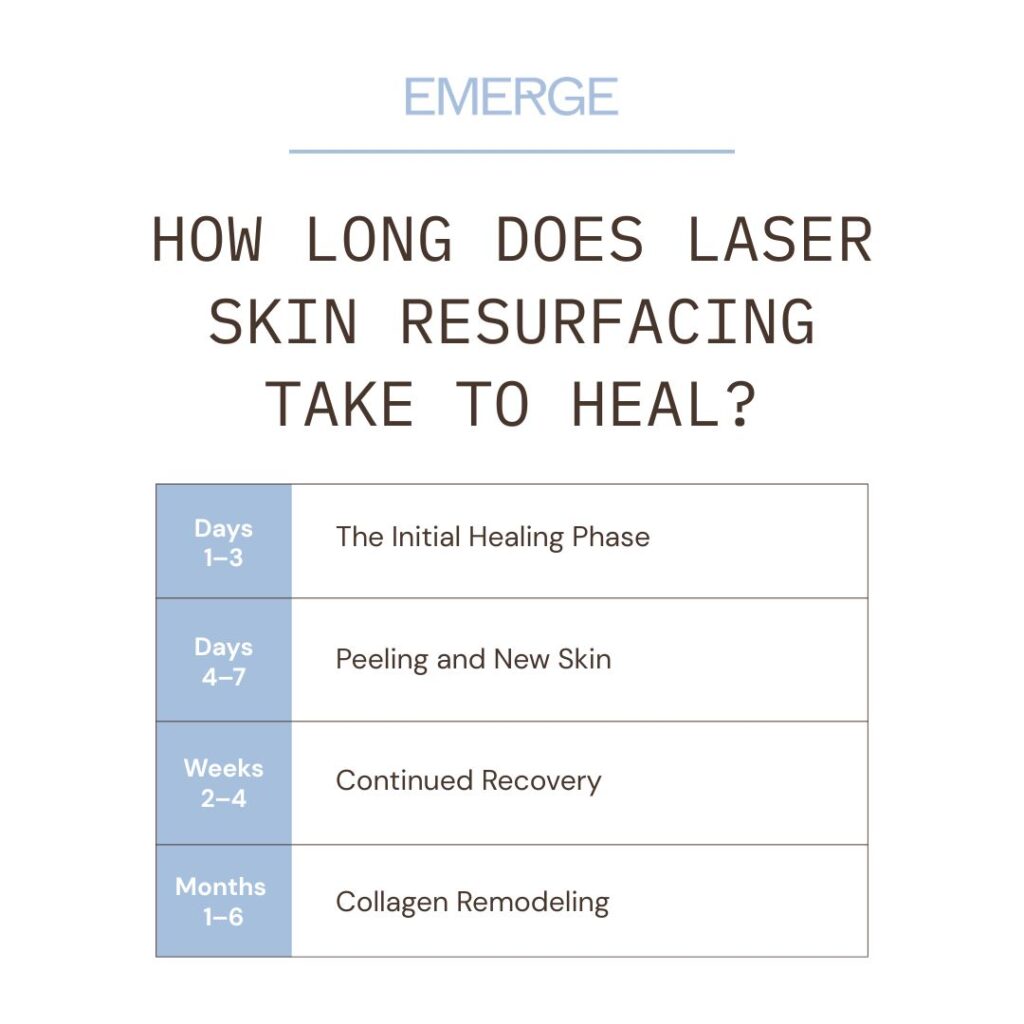
How Long Does Laser Skin Resurfacing Take to Heal?
Ultimately, it depends. Healing after laser skin resurfacing varies based on the type of laser used, the intensity of your treatment, the size of the treatment, and your body’s natural healing response.
In general, non-ablative treatments like AVAVA involve less downtime than ablative treatments like Fractionated CO2 laser. However, every patient’s recovery is unique.
Immediately after treatment, it’s normal to experience side effects like redness, swelling, warmth, and sensitivity as your skin begins its natural repair process. (We compare it to the feeling of a fresh sunburn!) During the first week, these symptoms gradually improve as new skin cells replace damaged tissue and collagen remodeling continues beneath the surface.
Below, we’ll break down what you can generally expect during the recovery timeline for both fractional CO2 laser and AVAVA laser treatments, so you can feel prepared for every stage of recovery.
Days 1–3: The Initial Healing Phase
In the first few days after CO2 laser resurfacing, you may notice side effects like warmth, gentle stinging, and slight swelling. The skin will most likely feel dry, tight, and sensitive. This is normal! By day 3, skin starts to dry out, lightly flake, and reduce in redness.
Following the first few days after receiving AVAVA, you may notice mild redness, swelling, and dryness. Many patients compare the feeling to a slight sunburn. By days 2 and 3, swelling begins to decrease and the skin may start to feel noticeably dry.
Days 4–7: Peeling and New Skin
By days 4–7 after receiving CO2 laser skin resurfacing, patients often notice shedding, flaking, and the first signs of improvement. More specifically, the dry layer begins to crack, peel, and flake on days 4 and 5, and new, fresh skin emerges by days 6 and 7. Although it’s been a full week, the skin is still highly sensitive. Avoid peeling, picking, itching, or scratching at the treated skin.
4–7 days after receiving AVAVA laser treatments, swelling tends to be nearly unnoticeable, the redness has faded, and the skin starts to look smoother and clearer. Because the technology leaves the outer layer of skin virtually untouched, you won’t experience that same peeling and flaking that you would with traditional ablative laser systems.
Weeks 2–4: Continued Recovery
By the time you reach weeks 2–4 post-CO2 laser treatment, peeling stops and the new, fresh skin slowly calms down. You may notice a light pink tone, occasional dryness, and mild sensitivity. However, these side effects should progressively calm down and can be easily concealed by this point with gentle makeup application.
2–4 weeks after receiving AVAVA laser treatment, redness, swelling, minor pinkness, and dryness have generally resolved. Some patients may continue to experience mild dryness as the skin continues to heal, but these effects become less noticeable over time. Beneath the surface, collagen remodeling is still in full swing, resulting in a brighter, smoother complexion.
Months 1–6: Collagen Remodeling
During months 1 through 6 of either AVAVA laser or CO2 laser recovery, your skin continues producing new collagen and remodeling existing collagen beneath the surface. While the initial healing is complete, you’ll notice gradual improvements in skin texture, firmness, fine lines, and overall skin quality as these regenerative processes continue.
By month 6, make sure you’ve scheduled your next appointment! While laser resurfacing is incredibly valuable for longer-lasting, more meaningful results, we’re always aging. Prevention is always easier than correction, and the best way to honor this? Staying on top of treatments throughout the year.
And this is where the multimodal philosophy shines. Laser is rarely a solo act. Paired thoughtfully over time with treatments like microneedling, biostimulatory options, and consistent medical-grade skincare, it becomes part of a bigger plan for long-term skin quality.
Laser Skin Resurfacing Aftercare Tips
Aftercare isn’t a suggestion. It’s part of the treatment. Here’s what Dr. Kling often recommends:
- Keep skin moist and protected. Use the exact ointment or occlusive your provider recommends in the first 48 hours, then move to gentle moisturizing as directed.
- Practice gentle cleansing. No scrubs, no active ingredients, no harsh cleansers. Lukewarm water and gentle cleansing only.
- Do not pick or peel. Let the treated skin shed on its own. Picking invites scarring and pigment changes.
- Prioritize sun protection. Strict sun avoidance and daily SPF are essential. Without the right skincare routine and protection from sun exposure, results can be compromised and side effects like hyperpigmentation may develop.
- Sleep with an extra pillow. Elevating your head can help manage swelling in the first few nights.
- Ask about cold sore prevention. If you’re prone to a cold sore, tell your provider beforehand. Laser treatments can trigger an outbreak and an antiviral may be recommended.
- Hold off on makeup and workouts until your provider clears you. Sweat and products on healing skin aren’t your friends.
Here’s what most people often forget: non-surgical, minimally invasive treatments are one part of a much larger puzzle. In order to see the best results for medical aesthetic procedures, taking care of your skin is non-negotiable. (In fact, Dr. Kling tells patients all the time that she’d rather them invest in high-quality skincare than in Botox!)
And, if we’re being totally transparent, nothing beats medical-grade skincare. Higher concentrations, professional formulations, and backed by clinical research can make a meaningful difference both during recovery and in your day-to-day skin health. Visit Dr. Kling’s curated list of medical-grade skincare and join the Emerge RX Club! (Pssttt… when you purchase Alastin skincare with Emerge, you earn aspire points! AKA, real points you can put toward real in-office treatments.)
Plan your laser skin resurfacing treatment by booking an appointment at Emerge Aesthetics.
When planning laser skin resurfacing treatment, it’s important to get excited! This is the first step in a larger multimodal approach that leads to better, smoother, and healthier skin. However, what you do after you leave the office is just as important as the treatment itself. Take care of the investment into your skin health; it always pays off.
At Emerge Aesthetics, Dr. Kling brings surgical expertise to non-surgical aesthetics. She analyzes each patient’s unique biology, skin health, skin history, and specific goals to provide science-led, gradual results that prioritize long-term skin health and natural-looking rejuvenation. Proudly treating patients throughout Glen Rock, Ridgewood, Wyckoff, Franklin Lakes, Saddle River, Upper Saddle River, Ho-Ho-Kus, Paramus, and New York City, book your appointment with Emerge Aesthetics today to take your first step toward a happier, more rejuvenated you.
In the meantime, scroll through the Emerge blog to learn all about quality skincare, medical aesthetics, treatment options, and more! Also, don’t forget to follow the Emerge Aesthetics Instagram; you don’t want to miss out on all the deals, discounts, updates, and events we’ve got in store.
This blog is for educational purposes and is not medical advice. Laser resurfacing results vary by individual, and a consultation determines candidacy. Always follow your provider’s aftercare instructions and speak with a qualified physician about your specific situation, especially regarding medications or any medical condition.
Rochelle Kling MD