
When people receive Botox injections, they tend to have one immediate question: how long does Botox take to work? Unlike dermal fillers or similar cosmetic treatments that offer instant lift, Botox doesn’t take effect immediately. However, it’s consistently ranked as the number one most popular non-surgical cosmetic procedure for a reason.
Shadows, fine lines and wrinkles, hollow areas, softened jawlines—these are all signs of aging. They’re normal. Aging is normal. However, Botox is an effective, FDA-approved cosmetic treatment that targets the muscles causingthese signs of aging. And its results follow a predictable, science-backed timeline.
Most people know that Botox works—there are decades of research behind it. What they don’t know is how it works or how long it takes for results to appear. So, let’s talk about it! In this post, we’re breaking down exactly what Botox is, how it works, and how long it takes to work. We’re also covering the different treatments it’s used for and how you can optimize results.
Botox treatments aren’t marketing or magic. They’re medicine.
How Long Does Botox Take to Work? Timeline and What to Expect
If your Google history is full of search results like how long does Botox take to work?, you’re in the right place. Here’s the short answer: most people generally begin seeing results within a few days. However, the timeline varies depending on treatment area, dosage, and individual biology.
Botox treatments also aren’t a permanent solution—and they shouldn’t be your only strategy. They’re injectables that provide temporary results that rely on consistency and multimodal treatment plans—two things we emphasize at Emerge Aesthetics. Botox can improve dynamic wrinkles, but it can’t visibly reduce signs of natural aging like other regenerative treatments can.
But before we get too far into the details, let’s talk about what Botox is. Then we’ll cover its different cosmetic and medical uses, how it works beneath the skin, and what typical result timelines look like.
What Is Botox?
Botox is an injectable form of botulinum toxin A, a purified toxin derived from Clostridium botulinum, that temporarily blocks nerve signals to muscles. While that may sound intimidating, this injectable treatment has been FDA-approved for decades and is safely used worldwide. Even the side effects, like swelling and bruising, are generally mild and temporary.
Cosmetically, Botox relaxes facial muscles responsible for dynamic wrinkles. Think: crow’s feet, frown lines, and forehead lines. Medically, Botox treats muscle overactivity, excessive sweating, and even chronic migraines.
For most people, Botox injections are a versatile, well-studied, effective regenerative treatment that enhances your appearance—not alters it.
What Is in Botox?
Botox contains a highly purified form of botulinum neurotoxin type A produced by Clostridium botulinum. After being injected, the toxin blocks acetylcholine, the chemical messenger that tells muscles to contract. This treatment doesn’t permanently paralyze muscles. Instead, it temporarily weakens them, relaxing facial muscles to reduce visible signs of aging.
However, if you’re considering treatment, only licensed, FDA-approved formulations should be used. Receiving injections from non-medical providers increases the risk of side effects and complications. In fact, you can listen to Dr. Kling talk about the danger of inexperienced practitioners here! (Seriously, it’s important. And it’s not talked about NEARLY enough.)
What Is Botox Used For?
Cosmetic Uses
Cosmetically, Botox works by temporarily smoothing wrinkles and blocking nerve signals that cause muscles to repeatedly contract and relax. Common reasons for using Botox injections include:
- Reducing Facial Wrinkles: Botox can target dynamic wrinkles caused by repetitive muscle movement. This includes forehead wrinkles, glabellar lines (the vertical wrinkles between the eyebrows), and crow’s feet.
- Sculpt the Lower Face: Botox works particularly well for defining the jawline and sculpting the lower face. (This is actually one of Dr. Kling’s favorite techniques!)
- Non-Surgical Neck Lifts: Neck bands (platysmal bands) can occur just as easily as facial wrinkles. Botox relaxes the muscles from the jaw to the collarbone, reducing that natural downward pull.
- Enhancing Lip Shape: Fillers offer a plumping effect. Botox offers naturally enhanced lip shapes with a “lip flip,” which you can see an example of here!
- Lifting the Brows: Often called a “Botox brow lift,” this treatment relaxes the muscles that pull the eyebrows down. Visit our Instagram for an example of a client who received a Botox brow lift!
Botox injections, generally, don’t travel far from the treated areas. They’re not supposed to. Instead, they diffuse 1–3 cm from the injection site, resulting in precise, targeted, effective improvements. This means a relaxed, refreshed appearance without looking overdone—or altering your natural expression.
Medical Uses
Most people don’t know that the effectiveness of Botox extends beyond cosmetic treatments. In fact, Botox injections for medical purposes are extremely common—and equally as beneficial. Botox treatments are FDA-approved for:
- Neurological Disorders: Neck spasms, uncontrollable blinking, and upper or lower limb spasticity can all be effectively treated with Botox.
- Chronic Migraines: For clients who suffer from 15 or more headaches per month, Botox prevents the release of chemicals involved in pain transmission. Not only does this reduce intensity, but it also reduces headache frequency.
- Incontinence: Botox is a common, highly effective treatment for both bladder and bowel incontinence or urgency. It reduces involuntary spasms and increases storage capacity.
- Excessive Sweating: To treat hyperhidrosis, Botox temporarily blocks chemical signals responsible that stimulate sweat glands. It’s only FDA-approved for underarm treatment—not for palms, feet, or foreheads.
- Jaw Tension Management: Clenching, teeth grinding, and muscle spasms all contribute to tension headaches and limited jaw mobility. Botox treatments relax the masseter (jaw) muscles, preventing them from forcefully contracting.
Result timelines may be similar to those of cosmetic treatments, but results vary depending on the condition and dosage.
Related: How to Get Rid of Forehead Wrinkles and Prevent New Ones
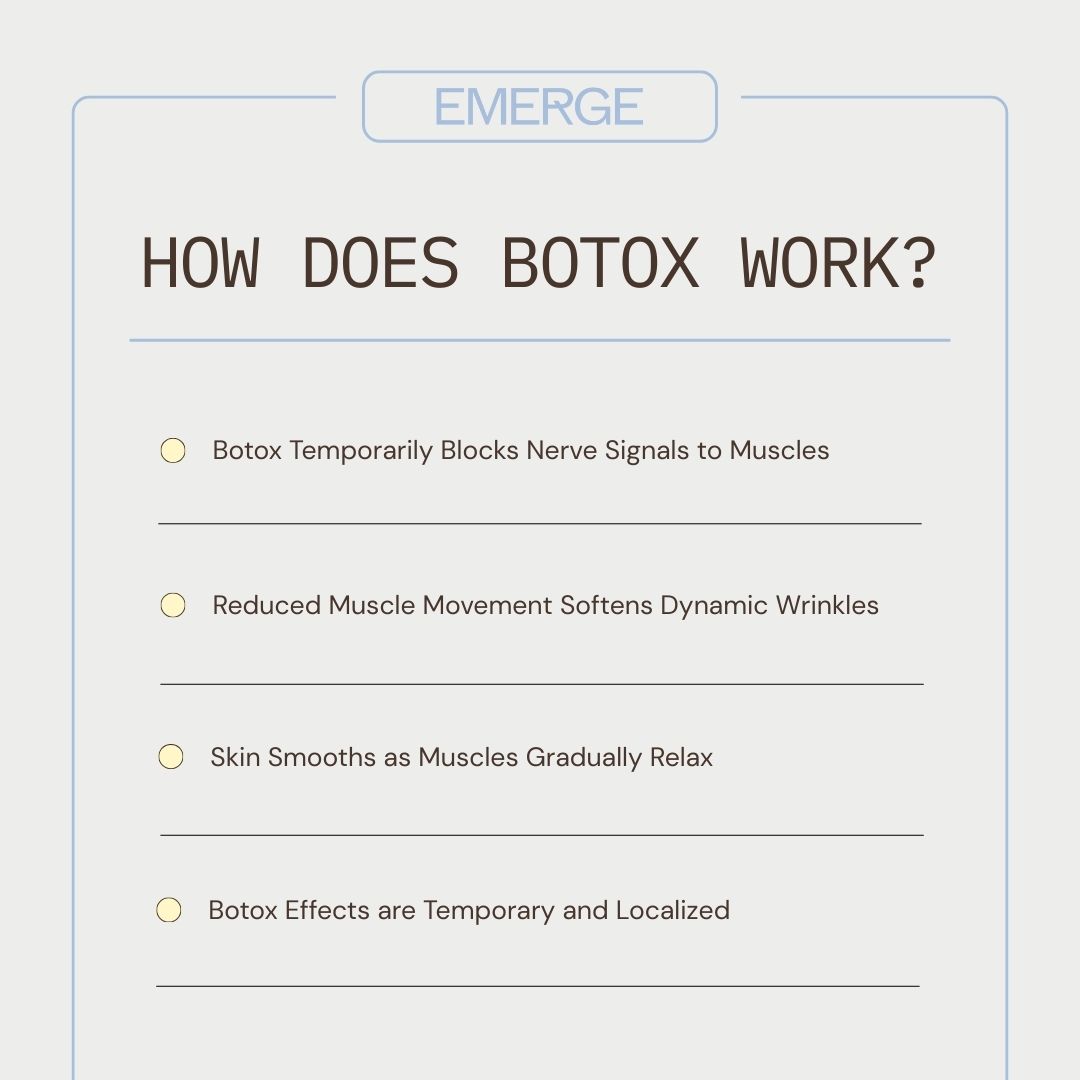
How Does Botox Work?
Botox Temporarily Blocks Nerve Signals to Muscles
After injection, Botox delivers a purified form of botulinum toxin type A to the targeted facial muscles. More specifically, it acts at the neuromuscular junction—the “relay station” for voluntary movement. The nerve sends a message, the junction passes it along, and the muscle responds by contracting. Botox interrupts that message right at the relay point.
When this happens, Botox blocks the release of acetylcholine, the chemical messenger that tells muscles to relax. Without that classic “relay station” system, muscles can’t contract as they normally would. This doesn’t “freeze” the face—it temporarily relaxes muscles and softens out expressions.
Reduced Muscle Movement Softens Dynamic Wrinkles
We’ve used the term “dynamic wrinkles” throughout this post, but what are they? And how are they different from static wrinkles?
Dynamic wrinkles are those that appear temporarily due to facial expressions—frowning, smiling, scowling, raising eyebrows, wrinkling the nose. Static wrinkles are permanent lines due to aging, collagen loss, or sun damage. Botox treats continuous muscle contraction, not pre-existing collagen or elastin loss.
As Botox reduces muscle contraction, facial movements become less intense. You can still make expressions, move your face, and react normally. The skin just doesn’t contract fully, stopping the skin above the muscle from creasing.
Skin Smooths as Muscles Gradually Relax
The skin doesn’t change in appearance because Botox fills fine lines and wrinkles. Instead, the underlying muscles are no longer able to pull or tighten—meaning skin can’t either. As muscle activity decreases over the following days, skin has the opportunity to “settle.” This results in a smoother, more relaxed appearance.
Remember: with the right physician, your face shouldn’t look “stuck in place,” essentially. Instead, you should look like you—just a refreshed, rejuvenated version.
At Emerge, we also use MicroTox, an effective treatment when skinquality is a concern rather than muscle movement. Learn more about how MicroTox works on our Instagram, and let us know if you want to learn even more!
Botox Effects Are Temporary and Localized
Botox injections don’t travel outside of the treatment area. If they do, you went to the wrong physician. (Your friendly reminder to book with Emerge Aesthetics for safe, ethical, and expert-level precision!) Because they bind directlyto the nerve endings at the injection site, they prevent localized muscle contraction—not full face contraction.
Botox isn’t a permanent solution—it isn’t designed to be. Over time, usually 3–4 months, the body repairs the nerve endings, and muscle activity slowly returns. This is why, if anti-aging regenerative treatments are part of your multimodal approach, consistency is key. The more consistent you are, the slower the visible aging process. And, most importantly, the higher your confidence.
Prevention is always easier than correction. And fortunately, Botox is (one of!) the most highly effective procedures for preventing deep-set wrinkles from forming.
How Long Does It Take for Botox to Work?
Botox does take a few days to work. It’s not like Hyaluronic Acid (HA) fillers, which provide instant volume and hydration. Neurotoxin injections have to bind to nerve endings, break down proteins, and relax muscles over several days. If you want to learn more about fillers, visit our guide, “What Is Sculptra and How It’s Different from HA Filler.”
For now, here’s a general overview of how long it takes Botox results to appear:
Typical Botox Results Timeline
- First 24–72 Hours: Botox is already getting to work within the first 24 hours. It isn’t producing noticeable results just yet, but it is beginning to bind nerve endings. This is when you’ll notice side effects like swelling, bruising, or redness.
- 3–5 Days: Around day 3, many patients experience a reduction in side effects and a slight “tight” feeling. This is normal; it’s a sign that Botox is doing its job. Around days 4 and 5, you may begin noticing subtle changes and reduced movement.
- 7–14 Days: One to two weeks post-treatment, Botox results become much more visible. Dynamic wrinkles look smoother, skin feels firmer, and facial muscles don’t contract as strongly.
Remember, this is the timeline results typically follow—but they can vary by person. Metabolism, muscle strength, lifestyle, dosage, and treatment area all play a role in how quickly Botox takes effect.
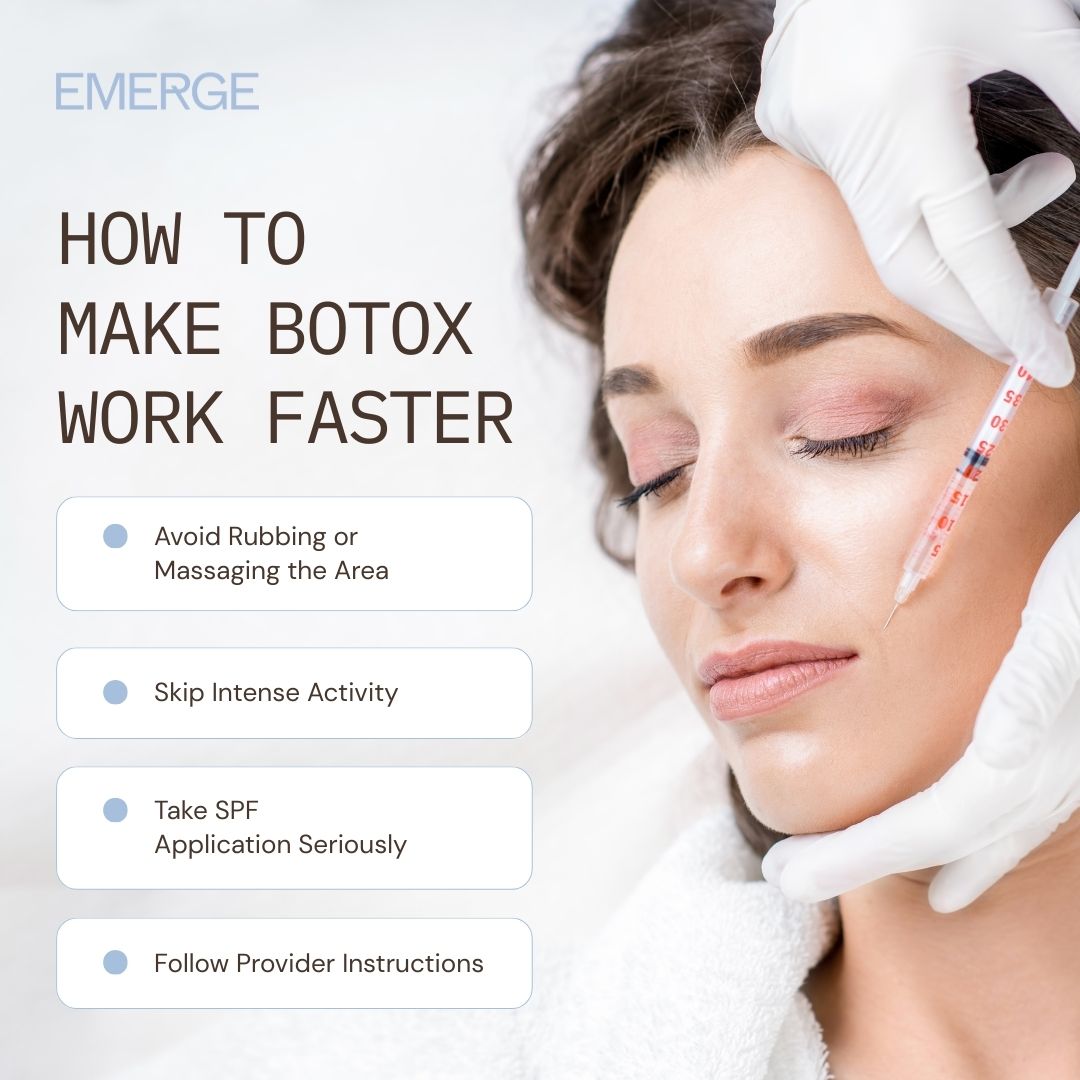
How to Make Botox Work Faster
Technically, you can’t make Botox kick in instantly—the physiology requires time to properly bind. You can, however, follow actionable, expert-led tips to optimize results and support sustainable rejuvenation.
Avoid Rubbing or Massaging the Area
After injections, do not rub or massage the treated area for at LEAST 24 hours, ideally 72. Doing so can cause toxins to migrate, leading to uneven, undesirable results. What you can do is gently move the muscles where the Botox was injected.
For example, if you got Botox for forehead lines, raise your eyebrows for 3 sets of 40. Same for smile lines or frown lines. Keep movements gentle—you don’t have to strain your muscles to boost results.
Also, follow the 4-hour rule! Don’t lie down, nap, or bend over for at least 4 hours post-procedure. This ensures the toxin remains where it belongs—in the targeted muscle.
Skip Intense Activity
As with avoiding rubbing or massaging the treatment area, you also want to avoid strenuous activity for at least 24–48 hours. This includes heavy lifting and intense cardio. Whenever you increase your blood pressure or heart rate, you increase blood flow to the injection site.
This then causes Botox to spread beyond the target muscle, increasing the risk of unwanted effects. You can enjoy slow, light walking and gentle activities—just save the moderate and intense workouts for later.
Take SPF Application Seriously
Consider heat and Botox sworn enemies—they do NOT get along. Just like when you work out, heat can increase blood circulation and dilate blood vessels. And what happens then? The toxin spreads to other, untargeted muscles. We’re sure you see the trend here.
That said, avoid saunas, hot showers, and intense sun for 24–48 hours. If you weren’t using broad-spectrum SPF before, now’s definitely the time to start. This protects post-procedure skin from UV-induced inflammation, a factor that can break down Botox, cause it to wear off faster, and lead to additional swelling.
At Emerge, we highly recommend Alastin Hydratint Pro Mineral Broad Spectrum Sunscreen. With SPF 36 and powerful antioxidants, this formula provides UVA/UVB sun protection and offers long-lasting hydration. Listen to Dr. Kling talk about the benefits of tinted SPF here!
Follow Provider Instructions
Following provider instructions is by far the most important post-procedure tip for enhancing Botox results. Not only will your clinician discuss the points we’ve provided, but they’ll also offer tailored advice depending on your specific treatment. They know the dosage, treatment areas, and goals—and they can give you a structured post-procedure plan.
Related: Is Dysport Better Than Botox?
FAQs on How Long Does Botox Take to Work
Is Botox immediate or gradual?
Botox is a gradual process; results don’t kick in immediately. While the procedure itself takes only about 10–20 minutes, results begin appearing 3–5 days later.
Can I see results in 3 days?
Some patients do begin to slowly see initial improvements from Botox injections within 3 days. However, they’ll be very subtle—like gentle softening and faded swelling. Results peak around the 7–14 day mark.
How long does Botox last after it kicks in?
Botox typically lasts 3–4 months after the procedure. However, this depends on individual anatomy, biology, and metabolism. Some patients’ results last longer, some shorter. Consistency is key.
Why didn’t my Botox work after one week?
One week is still well within the normal window of developing results. Peak Botox results can take up to 2 weeks.
When should I schedule Botox before an event?
We recommend booking your treatment at least 2–3 weeks before an event. This allows full results to settle. We talk more about when to get Botox for an event on our Instagram!
Botox is a safe, effective, FDA-approved non-invasive treatment perfect for preventing visible signs of aging.
Preventative treatments, like Botox, don’t alter your features, freeze your face, or reshape your complexion. Instead, they balance, rejuvenate, and revitalize. When you prioritize a strategic treatment plan, you can stay ahead of aging rather than play catch-up later. And when you understand how Botox works, you can set realistic goals and achieve better outcomes. Wondering if Botox helps acne? Read this guide to learn more.
Don’t forget: neurotoxin injectables are one aspect of a multimodal anti-aging approach. At Emerge, Dr. Kling addresses every layer of the aging process: the skin, structure, and cellular function. Schedule an appointment or contact the Emerge team to learn about the treatment plan that’s right for you, your aesthetic goals, and your anatomy.
Until then, don’t forget to visit the Emerge Aesthetics blog! Here, you can find comprehensive guides on everything from medical-grade skincare to post-procedure routines. Medical aesthetics isn’t guesswork—it’s knowledge, education, and expert-led precision.