
When it comes to skincare, active ingredients matter. A lot. These are the “doers” of the routine—the compounds that directly improve skin concerns at the cellular level. Among the most talked-about active ingredients, especially for anti-aging, are retinoids and retinoids.
You’ve seen them everywhere. Dermatologist-approved. Gold standard. Anti-aging must-haves. However, they’re not the same thing. Sure, they’re both used to promote smoother, healthier, more resilient skin, but they don’t produce the same results.
Skincare is the foundation of everything we do at Emerge. In fact, medical aesthetics relies on a strong, medical-grade skincare routine. And when you’re investing time, money, and consistency into your routine, you should understand what you’re putting on your face—and why it matters.
So today, we’re breaking down the differences clearly and honestly. We’ll talk about how retinol and retinoids work, how they differ, and which one helps achieve long-term change.
Retinol Vs. Retinoid: Which Is Best for Your Skin?
By 25, you lose up to 1%-1.5% of collagen a year. Then comes the sagging, volume loss, and hollowness—all the signs of aging you probably aren’t noticing yet—but will later on. There are plenty of non-invasive treatments that offer powerful preventive benefits, like fractional CO2 laser treatments, and micro-needling with or without PRP or exosomes.
However, a good skincare routine is what allows these treatments to work better, last longer, and support long-term skin health.
A lot of people know that by the time they reach their 20s, some form of anti-aging product needs to make its way into their routine. But here’s where most fall short: they invest in inconsistent, over-the-counter quality that doesn’t truly do anything.
Investing in the right products begins with knowing what to look for—or what to avoid. So in this post, we’ll provide a comprehensive overview of the differences between retinols and retinoids. We’ll talk about how they work, how long they take to deliver results, and who benefits most from each option.
Are Retinoid and Retinol the Same?
Short answer? No.
Longer answer: retinol and retinoids are related, but they’re not interchangeable. Both products fall under the umbrella of vitamin A-derived compounds, working by converting into retinoic acid (the active form your skin cells respond to).
They also both target anti-aging. Think: boosting collagen production, producing a more even skin tone, and minimizing the appearance of fine lines and wrinkles.
However, the difference lies in strength, speed, and the amount of conversion your skin has to do.
What Is the Difference Between Retinol and Retinoid?
The differences come down to potency and conversion. Retinoids are stronger, more direct, and work faster. They convert to retinoic acid more quickly, leading to faster results. Retinols, on the other hand, are gentler, work more slowly, and require more steps before they become “active” on the skin.
It’s not like one is “good” and one is “bad.” They simply serve different purposes depending on your goals.
What Is Retinoid?
A retinoid is a prescription-strength vitamin A derivative that directly influences cellular behavior in the skin. These won’t be over-the-counter products—they’re medical-grade formulas that require a prescription and are designed to create controlled, measurable changes. They will outperform every “miracle cream” on the shelves.
Tretinoin and tazarotene are the gold standard in anti-aging. They don’t just sit on the skin; they work deep within the surface to transform from within. They’re evidence-based, dermatologist-approved, and holy grails in skincare. And while anti-aging is the general benefit, they also provide a radiant, even, and stronger complexion.
Think of it this way: retinols require a two-step conversion to become active. Tazarotene requires a one-step conversion; tretinoin requires zero. The closer a retinoid is to retinoic acid, the quicker it works to provide noticeable results.
And know that side effects—like dryness, peeling, and sun sensitivity—are normal. They’re actually a sign that the product is working. However, because they’re so strong, always start slowly and gradually increase use over time. Not only will this reduce the “skin uglies,” but it’ll also allow the skin to adjust, build tolerance, and maintain a healthy barrier.
Learn more about how you can receive either type of retinoid through the Emerge RX club!
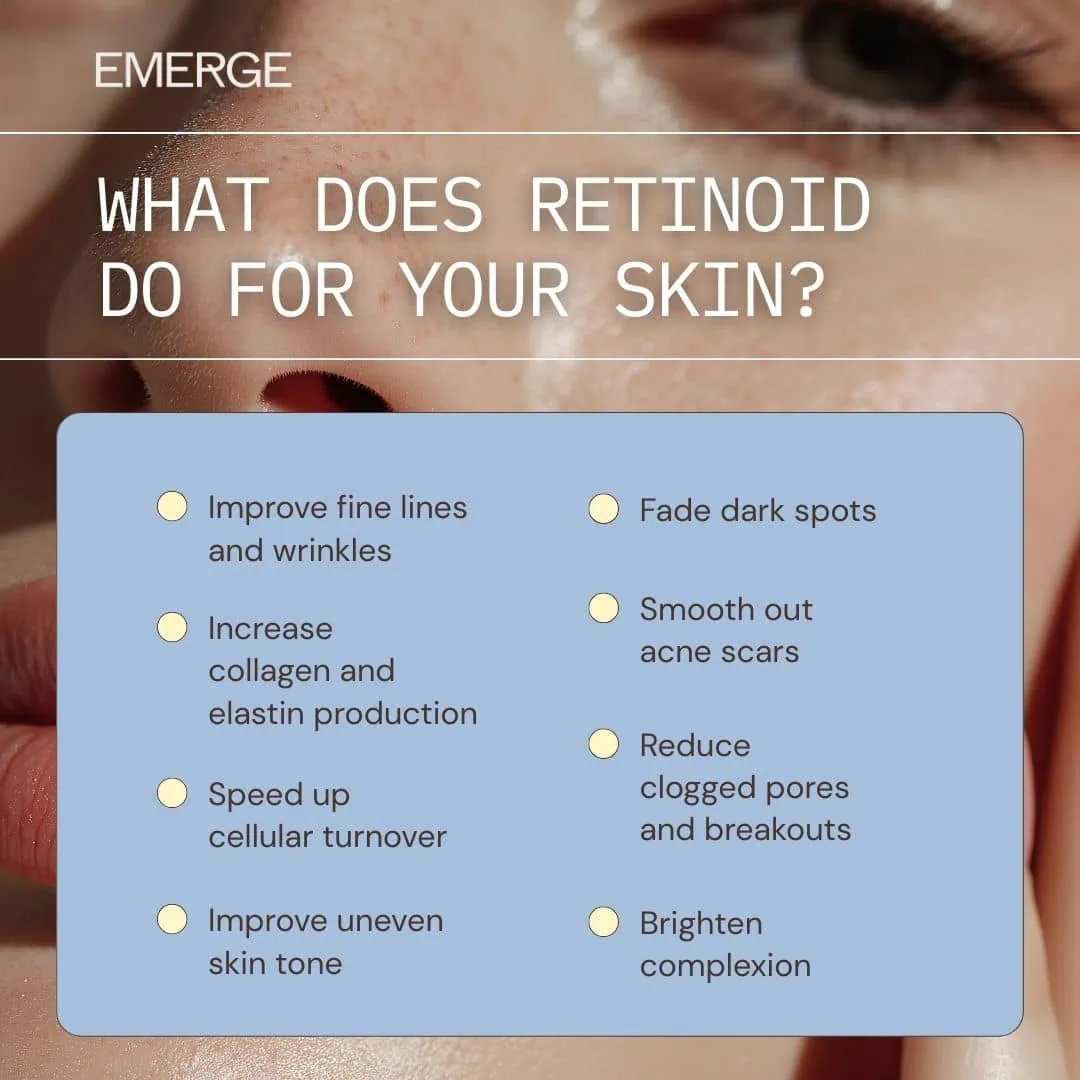
What Does Retinoid Do for Your Skin?
As the preferred option in medical-grade treatment plans, retinoids allow for more precise, physician-guided results. Benefits include:
- Improve fine lines and wrinkles
- Increase collagen and elastin production
- Speed up cellular turnover
- Improve uneven skin tone
- Fade dark spots
- Smooth out acne scars
- Reduce clogged pores and breakouts
- Brighten complexion
How Does Retinoid Work?
Boosts Cell Turnover
Retinoids accelerate how quickly skin cells regenerate. Without retinoid, skin cell regeneration generally takes about 28-40 days, but continues to slow down with age. Retinoids cut this process in half, reducing the skin regeneration cycle to about 14 days.
So, what does this mean, exactly? The skin can naturally begin to accumulate old, damaged cells. This is what leads to dull appearances, rough textures, and uneven skin tone. Boosted cell turnover sheds those cells faster, making room for healthier, fresher cells. This gives you that smoother, brighter, more radiant complexion.
Stimulates Collagen Production
Remember when we said that collagen production slows after age 25? That means retinoids aren’t for later—they’re for now. This is what transforms your skin as you age—keeping you from playing catch-up before it’s too late.
Retinoids interact with fibroblasts (collagen-producing cells) in the dermis, encouraging collagen synthesis. As a result, skin becomes more elastic, easier to hydrate, and more youthful-looking. It also blocks inflammatory pathways and lowers the levels of enzymes that degrade collagen.
Normalizes Pigment Production
There are plenty of causes for dark spots—like sun exposure, hormonal changes, inflammation, genetics, and deep acne scars. This is where retinoid shines. As we mentioned earlier, this ingredient speeds up cell regeneration—a key step in naturally replacing pigment-filled cells.
In combination with this, retinoids help regulate melanocyte activity and reduce abnormal melanosome transfer. Essentially, they limit excess pigment deposition in the epidermis, meaning those spots don’t transfer to deeper, harder-to-reach layers.
And if dark spots do reach the epidermis, a multimodal approach—like pairing retinoids with medical aesthetics—helps meet skincare in the middle, supporting a more holistic, regenerative outcome.
Regulates Gene Expression at Cellular Level
This is where retinoids truly separate themselves from retinol. Prescription retinoids bind directly to retinoic acid receptors (RARs) in the skin cells. Once bound, they directly influence gene expression. Think of this as the blueprint for your skin health.
A retinoid goes in and tells cells what to do—how they should divide, how quickly, how much collagen to produce, and how to organize themselves. This is like total preprogramming for your skin, creating long-term structural change.
This is why the effects are stronger and faster, and why they come with a higher likelihood of side effects. It’s not simple cosmetic exfoliation—it’s cellular medicine.
When to Use Retinoid
Retinoids are sun-sensitive. When applied during the day, the UV light destabilizes them, reducing their effects and potency. With this, they also make the skin more vulnerable to sun damage. It’s better just to skip the guesswork and apply them at night.
Plus, the skin’s regenerative cycle naturally peaks overnight. When you pair your retinoid routine with your skin’s natural repair and renewal process, you maximize cellular turnover, collagen signaling, and treatment effectiveness.
Because of their strength, always prioritize a medical-grade sun protection and a medical-grade moisturizer. Alastin Ultra-Nourishing Moisturizer calms and hydrates skin while supporting the production of new, healthy elastin. Pair this with Alastin Hydratint Pro Mineral Broad Spectrum Sunscreen. This product provides SPF 36, evens and brightens skin, and offers long-last hydration.
How Long Does It Take for a Retinoid to Work?
Retinoids, while faster-acting, still take time to work—the skin has to “warm up” to this new product. In general, initial changes may appear within 4–12 weeks, but meaningful structural changes take about 3–6 months. Remember, this is medicine—not instant gratification.
What Is Retinol?
Retinol is a derivative of vitamin A, a skincare ingredient used to improve texture, tone, and signs of aging. These are your over-the-counter products—ones that don’t require a prescription and can be found at almost any beauty retail store.
While your retinol product may still be effective, it’s a much weaker form of vitamin A. Because of this, it requires multiple conversion steps to become active retinoic acid. This means milder sensitivity, fewer side effects, and, naturally, slower and more gradual results. Many people opt for retinol because it’s easily accessible, milder, and considered effective for sensitive skin.
However, formulas can be inconsistent, results may vary, and benefits take much longer to appear. That said, including retinol before introducing stronger retinoids that perform better can be effective for building tolerance, supporting early prevention, and preparing the skin for more targeted treatment.
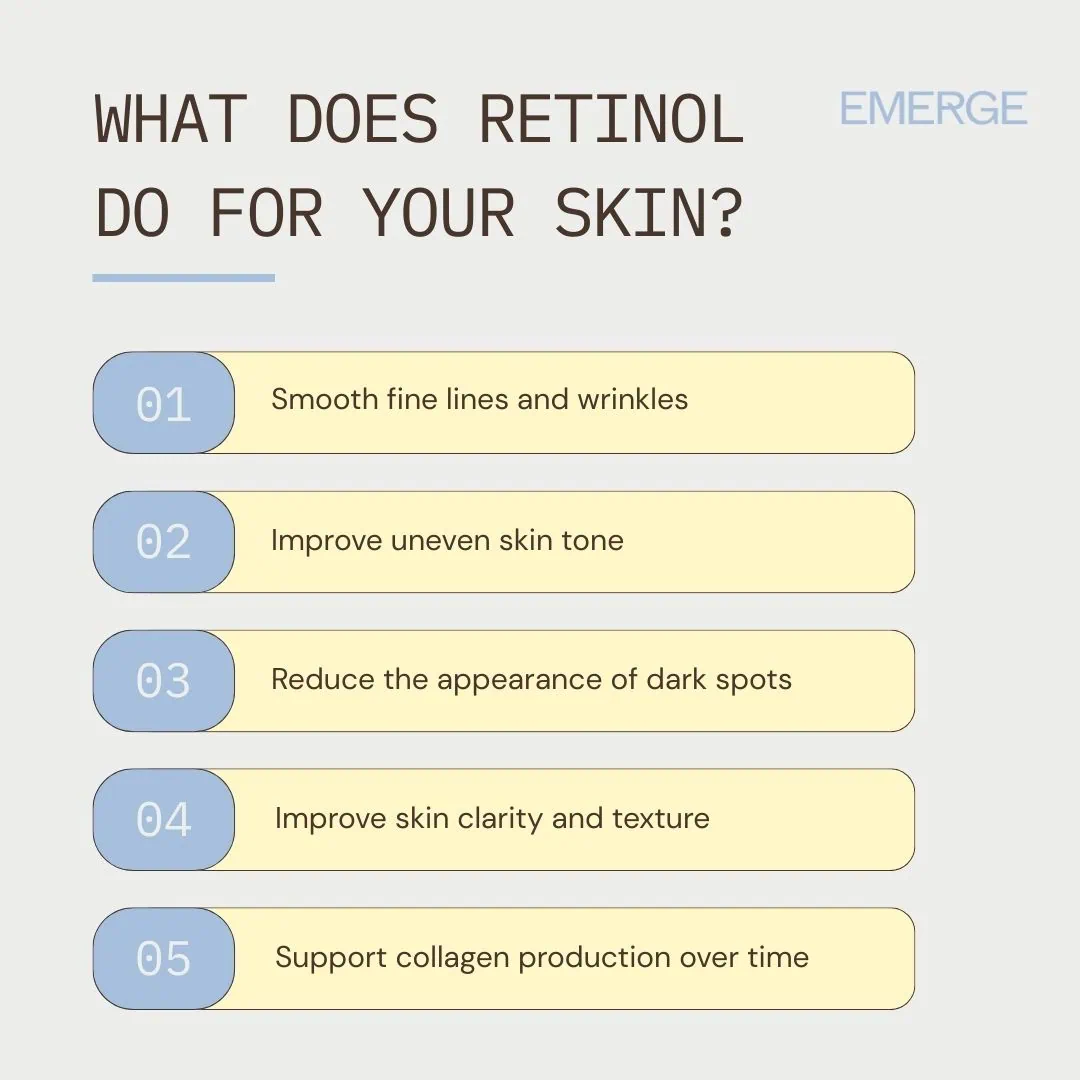
What Does Retinol Do for Your Skin?
Retinols are like the weaker, less direct cousin of retinoids. They can be helpful for early prevention or maintenance. However, they don’t deliver the same level of consistent, cellular change as prescription retinols. Benefits include:
- Smooth fine lines and wrinkles
- Improve uneven skin tone
- Reduce the appearance of dark spots
- Improve skin clarity and texture
- Support collagen production over time
How Does Retinol Work?
Requires Multi-Step Conversion
Retinol works through conversion, regulation, and repetition. This is where it differs from a lot of prescription retinoids—and why people tend to get confused. After it’s absorbed, the skin has to convert it into retinaldehyde and then into retinoic acid—the active form your skin cells respond to.
That extra processing and conversion happen slowly by design. Only a small percentage of the retinol actually becomes active retinoic acid. This is also why it’s seemingly better tolerated by sensitive skin. It’s essentially like a slow-release system; retinoids are direct delivery.
Encourages Gradual Cell Turnover
Retinol encourages skin cells to turn over in a controlled, regulated way. It doesn’t strip the skin or force exfoliation. Instead, it improves how efficiently the skin sheds old cells and reproduces new ones.
Over time, this improves uneven skin tone, helps fade dark spots, and reduces congestion without overwhelming the barrier. But because the process is generally slower, irritation is minimized—and so are results and speed.
Indirectly Supports Collagen Production
Because retinol is slower-acting, it eventually does stimulate collagen production. However, this is a much more indirect process compared to when you use a retinoid. Remember, it takes a handful of additional steps to convert into retinoic acid.
This means that its signal to fibroblasts (the cells that make collagen) is weaker and slower. It also means results are subtle and depend heavily on consistency, formulation, and how efficiently an individual’s skin converts retinol into retinoic acid.
Modulates Cellular Behavior Over Time
Just like retinoids, retinols do interact with the receptors in skin cells. In other words, they can still impact cellular behavior—it’s just a slower, much more gradual process. Rather than seeing immediate, noticeable changes, it essentially nudges cellular behavior in the right direction.
Over time, you can expect a smoother texture, softened fine lines and wrinkles, and improved skin elasticity. However, it won’t rebuild collagen loss entirely on its own. This is where retinoids—and regenerative treatments—fill in the gaps.
When to Use Retinol
Just as with retinoids, retinol should also be applied at night. Even though it’s slower acting, it’s still just as susceptible to UV damage—and so is your skin. Make sure to follow up the day after using a retinol with a rich, hydrating moisturizer to enhance results.
Want Dr. Kling’s secret weapon? Triple Paste Diaper Rash Cream. Yes, it also belongs on the face! With zinc oxide and protective beeswax, the formula heals, nourishes, and hydrates.
How Long Does It Take for Retinol to Work?
You know from earlier that retinoids work relatively quickly—especially after the skin adjusts to them. Retinols, on the other hand, require 3–6 months to be effectively converted and to reveal results. In this case, consistency is what will provide visible improvement.
Is Retinoid Better Than Retinol?
Think of it like this: retinoids are like autofill for passwords. They have the right credentials and work immediately. Retinols are like typing in one of the many passwords you have, hoping you picked the right one.
For some patients, like those just beginning their routine, retinol can seem like the ideal option. And sometimes, depending on medical history and skin sensitivity, it can be. However, there are three pillars of skincare: retinoids, vitamin C, and SPF.
As far as retinoids are concerned, there truly isn’t anything more effective for long-term collagen, texture, and clarity. It seems appealing to buy trendy OTC retinols for the hype, packaging, or favorite influencers promoting it. But by using a medical-grade retinoid, you’re basically skipping to the front of the line.
You save time, money, and yourself from fine lines by focusing on what actually works—on evidence-based treatments that produce long-term change.
Remember, though: you’ll always get the best results from a multimodal approach. Without proper skincare, your routine is like building a house on sand. It may look nice on the surface, but as far as the structure goes? Not as promising. Skincare supports treatments; treatments amplify skincare.
Retinoids are the gold standard in skincare, boosting collagen, accelerating cell turnover, and producing radiant, youthful results.
Ultimately, it’s not about whether retinoid or retinol is “stronger” or “better.” It’s about using the right skincare tool at the right time, on the right skin, for the right reasons. Healthy, radiant results aren’t luck—they’re a result of science, strategy, and consistency.
If you want guidance on choosing the right products, schedule a consultation with Dr. Kling! As a double-board-certified Emergency Medicine physician, Dr. Kling is committed to delivering high-quality care with expert precision. At Emerge, we address every step of rejuvenation through personalized multimodal approaches.
Results don’t come from trends, they come from what works for your skin—and what doesn’t. For more recommendations, make sure to check out Dr. Kling’s recommended skincare! Also, don’t forget to join the Emerge RX Club for customized formulations, professional guidance, and a progressive approach.