
Damaged hair doesn’t happen overnight. It happens slowly—ponytails start looking thinner, hairlines begin receding, and once glossy strands appear dull and tired. The truth is: almost everyone will experience damaged hair at some point. Men, women, treated hair, untreated hair—we’re all “at risk.”
There are numerous factors that affect hair health. Heat styling, hormone fluctuations, environmental exposures, age, genetics, sleep. However, the earlier you act, the easier it is to keep the hair you have resilient and revitalized.
At Emerge, we don’t focus on quick fixes, miracle oils, and trend-driven hacks. Instead, we emphasize the importance of expert-backed tips, innovative, non-surgical procedures, and the guidance of a double board-certified aesthetic medicine physician.
So today, we’re breaking down how to safely and effectively fix damaged hair. We’ll discuss the signs of deeper scalp or follicle issues, helpful protective outer-layer treatments, and when it’s time to visit an advanced restoration specialist.
How to Restore Damaged Hair: Treatments for Healthier Strands
When people think of medical aesthetics, they often think of reducing fine lines, filling hollow areas, and restoring volume. However, hair restoration is a large part of what we do. And the good news? Strategy is the first step to real, long-lasting results.
This guide will walk you through what damaged hair actually looks (and feels) like, what causes it, what you can do at home, and when it’s time to explore regenerative, medical-grade treatments. Like with every other approach in aesthetics, consistency will always win. The best results start with a plan—not panicked decisions.
What Does Damaged Hair Look Like?
There’s a significant difference between dry hair and damaged hair.
Healthy hair has a smooth, uniform, and closed cuticle. It reflects light, it feels strong, and the hair cuticle itself is resilient. It also generally lies flat, regardless of hair type, acting as a protective shield for the hair cortex (also known as the hair shaft).
Damaged hair, on the other hand, looks and behaves very differently. The cuticle is rough, open, and uneven. Hair will feel extremely brittle or straw-like, split ends will travel upwards, frizz won’t be humidity-related, and there’s little to no light reflection.
This is the distinguishing difference: dry hair is dehydrated; damaged hair is structurally dilapidated.
In addition to this, dihydrotestosterone (DHT) is a major contributor to hair health. This is a hormone that literally shrinks follicles over time. As Dr. Kling says in this video, it’s like a slow suffocation for your hair.
We all produce some level of DHT. However, when you have existing damage, it essentially lays the foundation for DHT’s hair-shrinking effects. Think of it this way: a good roof keeps out the rain—unless it’s already cracked. Existing hair damage is the crack, and DHT is the rain that makes problems worse. If you don’t treat the underlying cause of hair loss and damage, new growth is just as vulnerable.
Healthy hair can become dry due to external factors. However, dryness isn’t considered permanent structural damage—like excessive breakage or poor elasticity. Damaged hair requires a deliberate approach with a non-negotiable level of maintenance.
What Causes Damaged Hair?
There are numerous factors that contribute to hair health. And if you’re suffering from extreme damage, here are the most common culprits:
- Repeated heat styling
- Frequent hair color or chemical treatments
- Using heat without heat protection
- Harsh brushing—particularly on wet hair
- Tight hairstyles
- Harsh shampoo and conditioner
- Over-washing routines
- Environmental stressors (UV, pollution, climate, hard water, salt water/chlorine)
- Nutritional deficiencies or chronic stress
- Aging
Here’s what surprises most people: your scalp ages the same way your skin does. Follicles shrink, collagen breaks down, circulation slows, and hormones shift. Not only does hair become thinner, but growth slows and shedding increases.
This is why restoration extends far beyond product aisles—it’s an integral part of medical aesthetics. When the concern lives at the follicular level, hair masks alone won’t fix it.
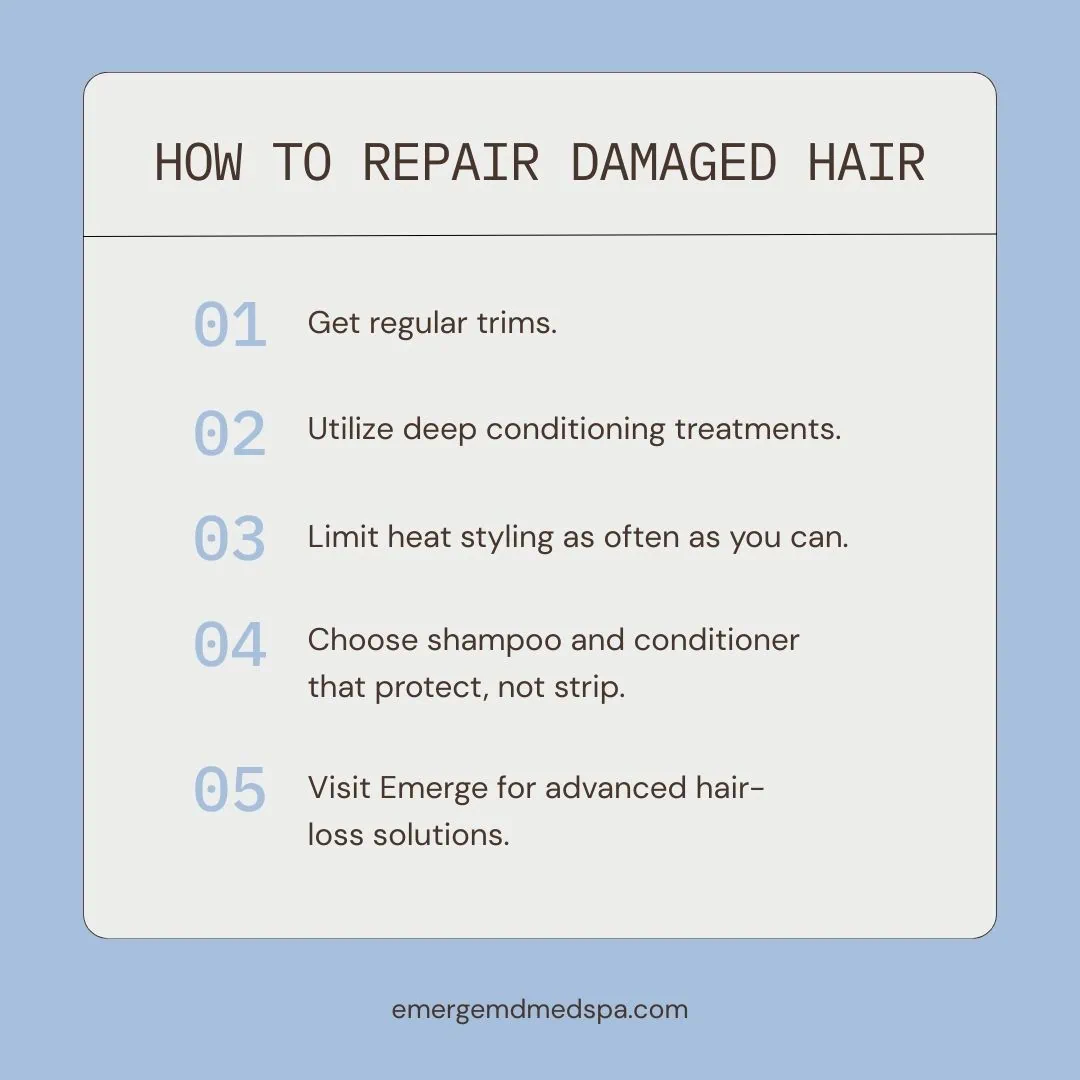
How to Repair Damaged Hair
Get regular trims.
When you’re trying to grow your hair, regular trims seem counterintuitive. However, ignoring split ends allows them to travel upwards towards the shaft. The longer you ignore that breakage, the more likely it is that the cycle will continue.
A light trim every 10-12 weeks creates a firm “stop break” point. It maintains the hair’s overall integrity, preventing fraying and promoting hair health. Think of it as clearing out damage to make room for new, healthier hair growth.
Utilize deep conditioning treatments.
There is an abundance of hair care products lining the shelves that guarantee healthier, stronger, more manageable strands. Some of them work; many of them overpromise and underdeliver. And for most, instructions require direct application onto the scalp and an even, combed-through application down to the ends.
Emphasis on “direct application onto the scalp.”
The skin on your head acts similarly to that on your face. However, the scalp undergoes faster cell turnover, higher oil production, and, at times, increased vulnerability. And because this is where hair grows, the area is naturally warmer, more humid, and darker. This affects microbes and makes it harder to effectively cleanse.
It’s essential to focus on science-backed ingredients that promote hair health and a healthy scalp. Look for conditioning treatments with niacinamide, glycerin, aloe vera, peptides, ceramines, squalane, and omega-3s. These are essential in rebuilding the scalp barrier, supporting follicle health, and stimulating circulation.
Limit heat styling as often as you can.
Your hair remembers heat the way your skin remembers UV. You may not see the effects immediately, but over time, they’ll definitely make themselves known.
Straighteners, curling irons, and blow dryers don’t just dry strands out—they rapidly weaken the hair cuticle. They also strip moisture, weaken keratin protein, alter lipids, and cause protein denaturation. When a client experiences this, the hair shaft becomes significantly more fragile and less able to retain strength.
This process is often compared to boiling an egg. You can cool, season, or restructure the egg, but you can’t “un-boil” it. Apply heat to your hair, and the proteins unfold. No matter how much moisture you add back in later on, the protein structure itself has changed.
Will this happen after a few times of heat styling? Not necessarily. However, consistent use, especially without heat protectants, can permanently damage hair health and growth. Embrace overnight braids, “sock bun” curls, claw clip hairstyles, and an air-dry routine as much as possible.
Choose shampoo and conditioner that protect, not strip.
As we mentioned with deep conditioning treatments, healthy hair begins at the scalp. And shower routines, especially when it comes to shampoos, directly impact hair growth and health. A cosmetic product won’t magically re-grow the hair. It will, however, maintain strand integrity, cleanse pores, and, most importantly, create an environment that encourages new growth.
Many shampoos contain harsh, pore-blocking ingredients—like silicones and heavy oils. Naturally, this inhibits hair growth, creates inflammation, and disrupts the nutrient supply.
Choose something designed for your scalp—not something that smells nice and looks pretty.
82S Hair Science Formula, for example, is an excellent option for those dealing with both hair loss and extensive damage. This professional-grade, clinically backed DHT-blocking formula helps restore visibly fuller, thicker, and healthier hair. Additionally, it’s made from 10 essential amino acids proven to reduce breakage up to 25%.
When you want to protect your hair, side with science.
Visit Emerge for advanced hair-loss solutions.
At-home care improves the hair you can touch. Medical-grade treatments support the hair you want to grow. When the concern revolves around thinning, shedding, or changes in density, regenerative medicine steps in.
At Emerge, Dr. Kling uses strategic, non-surgical, evidence-based procedures to activate hair follicles and enhance long-term hair health—without surgery or a list full of side effects. Here are some of the options we offer:
Prescription-Strength Topical Treatments:
- Formula 82M: This is a powerful, non-greasy minoxidil-based formula. It contains tretinoin to enhance absorption and effectiveness.
- Formula 82F “Finoxidil”: A combination of finasteride and minoxidil, this treatment targets DHT-driven hair loss. We primarily recommend it for male pattern hair loss and post-menopausal women.
- Prescription Shampoos: These specially compounded formulas stimulate the scalp, reduce shedding, and promote healthier growth.
Advanced In-Office Treatments:
- Micro-needling with PRP: Using platelet-rich plasma derived from your own blood, PRP stimulates growth factors, improves blood flow, and enhances long-term hair health. Check out this video to see how we used PRP to boost one client’s growth.
- GlowPin Infusion Therapy: This treatment combines micro-injury with targeted infusion—similar to our GlowPin Facial Treatment. This will improve scalp hydration, enhance follicle function, and lay the groundwork for better regrowth.
- SmartXide PRO CO₂ Laser: Our fractional CO₂ laser, typically known for skin rejuvenation, is also designed for hair health. This treatment improves scalp circulation, stimulates collagen production, and creates a regenerative environment that supports hair growth. Learn more about it on our post, “The Gold Standard of Renewal: The Fractional CO2 Laser Treatment for Skin Transformation.”
As with skincare, treatment plans for damaged hair work best as part of a multimodal approach. This method will be gradual, strategic, and designed around each client’s individual biology.
When to See a Hair Restoration Specialist
There comes a time when it’s essential to stop relying on hair masks, trims, and conditioning treatments. But how do you know if this is the case for you?
It’s time to consider a physician-led treatment if:
- You notice excessive hair shedding. Think: clumps in the shower, balls on your pillow after you sleep, and brushes full of lost strands.
- You’re experiencing a widening hair part, thinning at the crown, or noticeable bald patches.
- Even with over-the-counter treatments, your hair is still prone to breakage, feels elastic, and remains extremely porous.
- You have a strong family history of hair loss—especially early on. Genetics plays a major role in when you can first experience hair loss or damage..
- The skin on the scalp begins to shift dramatically. Signs may include itching, burning, redness, or flaking.
Can you wait on professional-grade treatment and just “see what happens?” Sure, but prevention is always easier than correction. Dr. Kling can formulate a personalized approach to intervene before problems progress.
A strategic approach to damaged hair can make all the difference in reversing fragility, restoring health, and supporting long-term results.
Damaged hair doesn’t have to be a life sentence. However, healing and health do require intention. Whether you’re dealing with overuse of heat styling, consistent chemical treatments, or baldness due to genetics, a plan restores resilience. At-home strategies can protect your hair, medical strategic help to transform it.
At Emerge Aesthetics, hair care isn’t about trend-chasing—it’s about biology, strategy, and science-backed solutions. Dr. Kling, a double board-certified Emergency Medicine physician, is thoroughly committed to delivering high-quality care through consistency and expert-level precision. If you’re ready to explore treatments that may be right for you, schedule your consultation at Emerge today!
Your hair deserves the same level of care as your face—and we’re here to help you love what you see in the mirror.