
Fine lines and wrinkles are the most common signs of skin aging—and one of the first things people notice when they look in the mirror. This isn’t a flaw; it’s simple biology. Aging is a privilege. However, more than ever, people are using regenerative medical aesthetics, like Dysport and Botox, to treat early signs of skin aging.
As you age, collagen production naturally slows down (up to 1.5% a year, actually!). Skin becomes thinner, facial expression lines deepen, and shadows form in areas that once reflected light smoothly. And rather than trying out trendy “skincare hacks” and questionable DIY routines (looking at you, at-home microneedling), people are relying on FDA-approved injectable treatments.
So, we’re here to answer the question everyone’s been Googling: Is Dysport better than Botox? We’ll discuss what Dysport is, what areas it treats, and how it’s used in non-surgical aesthetic procedures. Afterwards, we’ll explore the differences between Dysport and Botox and tell you which one may be more suitable for your goal.
Because non-surgical innovation isn’t marketing, it’s medicine. And the best results always come from strategy.

Is Dysport Better Than Botox?
If you’re trying to decide between Dysport and Botox, you’re not alone. These are two of the leading neuromodulators for natural-looking results and visible reduction in signs of aging.
Both are FDA-approved. Both are botulinum toxin type A treatments. And both work by temporarily blocking nerve signals to facial muscles. Generally, they’re interchangeable in terms of efficacy. However, they’re not identical, and they behave differently in the skin depending on:
- Your anatomy
- The injection site
- The treated areas
- Your facial expressions
- The results you’re hoping to achieve
So, if you’re looking for subtle enhancements that refresh your appearance without making it look frozen or overdone, is Dysport or Botox the better choice? That’s what we’re here to help you decide. We’ll walk you through how Dysport works, how this treatment compares to Botox, and how to choose the best option.
What Is Dysport?
Dysport is an FDA-approved injectable neurotoxin made from botulinum toxin type A, used to temporarily improve the appearance of fine lines and wrinkles. Like Botox, Dysport relaxes facial muscles that contribute to dynamic wrinkles—the lines formed by repetitive facial expressions.
Know this: Dysport injections do not add volume. Collagen biostimulators, like Sculptra and Radiesse, focus on volume restoration. Instead, injectable neurotoxins reduce muscle activity beneath the skin, helping your complexion look smoother and more refreshed.
Nonetheless, the best results come from multimodal treatment plans that address every layer of the aging process: skin, structure, and cellular function. This means pairing neurotoxin injectables with cosmetic procedures, like microneedling, laser resurfacing, and fillers. And this is what a comprehensive anti-aging plan looks like.
If you’re interested in volume restoration, read our guide: “What Is Sculptra and How It’s Different from HA Filler.” You can also visit “The Gold Standard of Renewal: The Fractional CO2 Laser Treatment for Skin Transformation” to learn more.
What Is Dysport Used For?
Dysport is often used to treat glabellar lines, also known as frown lines, which are those deeper wrinkles that develop between the eyebrows from repeated contraction of facial muscles.
Still unsure? Face the mirror and frown, squint, concentrate, or look angry. You’ll notice those “11-shaped” wrinkles right between your eyebrows—that’s what Dysport targets. However, you can also use Dysport for:
- Forehead lines and crow’s feet
- Bunny lines (sides of the nose)
- Non-surgical neck lifts
- Enhancing lip shape
- Refining facial expressions
- Lifting the brows
- Defining the jaw
When you meet with Dr. Kling at Emerge, she creates a personalized treatment plan tailored to your unique facial structure and goals.
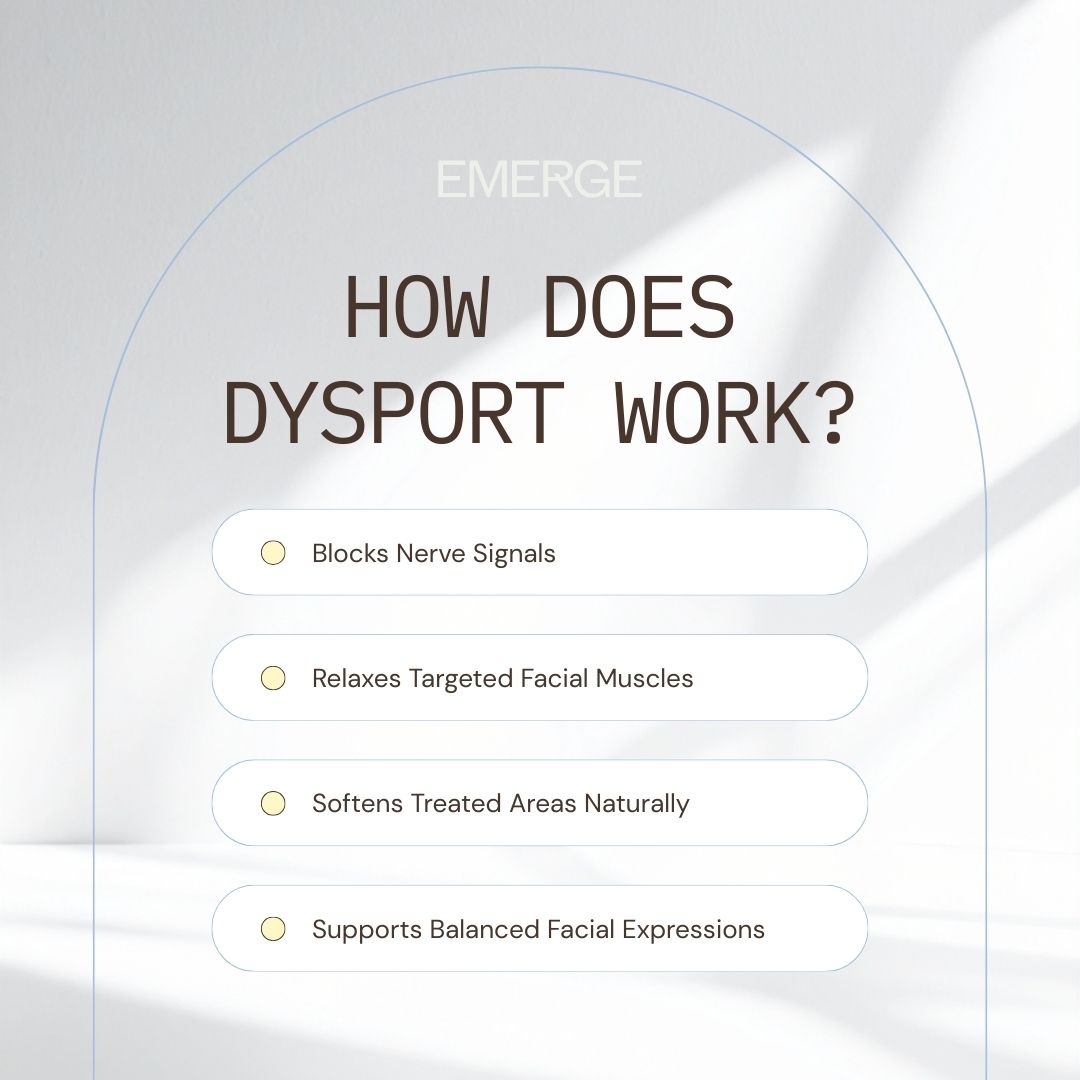
How Does Dysport Work?
Blocks Nerve Signals
Dysport injections use a neurotoxin (abobotulinumtoxinA) to temporarily block nerve signals to the muscles where it’s injected. You can still move your face, raise your eyebrows, and smile normally—injections don’t get rid of natural, functional movement. They simply weaken the underlying muscles that create fine lines and wrinkles.
Relaxes Targeted Facial Muscles
Neuromodulators work by reducing the muscle’s ability to contract. Again, these injections relax, not paralyze. When you go to smile, laugh, squint, or raise your eyebrows, you still get that natural movement. The muscles just don’t contract fully, making the skin look smoother, tighter, firmer, and more youthful.
Softens Treated Areas Naturally
Dysport has a much broader distribution than other neurotoxins, such as Botox. Don’t worry, we’ll explain this more below! However, because of this, Dysport relaxes the muscles surrounding the injection site. This results in a smoother, blended, more naturally “softened” look rather than a frozen or expressionless one.
Supports Balanced Facial Expressions
When people consider regenerative medical aesthetics, they have a few common goals in mind: balance, symmetry, and harmony. The goal isn’t to erase or restructure the face; it’s to restore balance and smooth contours without disrupting expression. Dysport supports this by gently spreading to surrounding areas and relaxing dynamic facial wrinkles.

What Is the Difference Between Botox and Dysport?
Dysport and Botox are both botulinum toxin type A treatments. However, they differ in speed, results, dosing, and precision. Let’s talk a little more comprehensively about the difference between Dysport injections and Botox injections:
Diffusion and Treated Areas
One of the most significant differences between neurotoxin injections is the extent of diffusion and the ideal treatment areas.
To start, Dysport contains smaller molecules compared to Botox, allowing it to diffuse more easily and spread 1–3 cm from the injection site. This is why it’s excellent at treating larger areas, like the forehead. Fewer injections treat broad muscle groups with an even, smooth coverage.
Botox molecules are much larger than Dysport’s. Because of this, it’s often an ideal treatment for precise, targeted areas. Sounds a little ironic, we know. However, think of it this way: Botox has a higher molecular weight—heavier things don’t move around as easily.
CAN Botox spread? Sure, but it generally shouldn’t with expert technique and precision. This is why many people prefer Botox for vertical lines and crow’s feet, or even lip lines.
Bottom line: Dysport works well for large, broad areas due to its wider diffusion. Botox is a top candidate for localized treatment in delicate, precise areas.
Onset of Results
Both Dysport and Botox provide relatively quick visible improvements—especially compared to other regenerative treatments. However, one works slightly faster than the other.
Dysport injections offer a faster onset, with results showing in as little as 2–3 days. This is because Dysport begins relaxing the targeted facial muscles and disperses efficiently within the muscle tissue.
Botox injections tend to have a more gradual onset, with results typically becoming noticeable within 5–7 days. Because the molecules are larger, though, the full effects take about 7–14 days to become fully visible. You can read more in this post, “How Long Does Botox Take to Work?“
Dosing Differences
While results may be similar, units aren’t interchangeable. Remember earlier how we mentioned that many people prefer Dysport for dynamic forehead wrinkles because it requires fewer injections. This doesn’t mean Dysport is stronger than Botox; it’s just measured differently.
More specifically, using a clinical 2.5:1 dosage ratio, 25 units of Dysport equals approximately 10 units of Botox. The takeaway? Don’t focus on the number of units—focus on the strategy and expertise behind the treatment plan.
Precision vs. Soft Blending
Some clients appreciate Dysport for its soft, blended look. Others prefer Botox for its precision targeting. Ultimately, this demonstrates why personalization and tailored treatment plans matter so much. What works for one client may not work for another.
This is also why consultations are an essential aspect of treatment. Your physician can discuss your anatomy, understand your goals, and determine what works best for long-term rejuvenation.
Is Dysport or Botox Better?
So… Is Dysport or Botox better? The answer is: there is no answer. Dysport and Botox aren’t competitive treatments, and neither is universally superior. Let’s break it down:
Dysport may be the ideal option if you want quicker results, a softer, more blended look, and slightly more movement. It’s also a fantastic injectable for reducing moderate to severe frown lines (glabellar lines) and horizontal forehead wrinkles. Plus, results typically last 3–4 months depending on treatment areas, lifestyle factors, and individual anatomy.
Botox may be the ideal option if you want gradual results, precision treatment, and a more concentrated result. It also works exceptionally well for treating crow’s feet, subtle facial wrinkle patterns, and lip shape enhancement. Injections are effective at treating existing wrinkles and preventing new ones from forming, with results lasting 3–4 months.
However, at Emerge Aesthetics, we pride ourselves on helping clients prioritize long-term skin health, physician-led advice, and expert guidance. With this in mind, it’s only fair to remind you that the best results come from a good skincare regimen, a multimodal approach, and consistency.
Neurotoxins are one tool—not the whole plan.
FAQ: Dysport vs Botox
Does Dysport Last Longer Than Botox?
Patients generally experience similar longevity when using Dysport and Botox, both lasting 3–4 months. However, results vary based on anatomy, biology, and lifestyle factors.
Is Dysport Cheaper Than Botox?
Dysport is often cheaper than Botox per unit. In a general sense, Dysport typically costs $4-$6 per unit compared to Botox, which costs $10-$25 per unit. However, prices vary depending on the provider, practice, treatment area, and the number of units distributed.
At Emerge, Dr. Kling provides a precise cost breakdown during each consultation.
Is Dysport Safer Than Botox?
Dysport and Botox are both safe, FDA-approved neurotoxins with comparable side effects, such as swelling, bruising, and redness. Neither treatment is considered “safer” or “less safe” than the other.
How Long Does Dysport Take to Kick In?
Dysport often begins taking effect within 2–3 days, with full results visible at 10–14 days.
When Does Dysport Peak?
Peak results of Dysport typically occur around 10–14 days after treatment. Many start noticing visible improvements within 48-72 hours post-treatment and maximum results within 2 weeks of injection.
Can I Get Dysport the Same Day as My Consultation?
Yes! In many cases, you can receive Dysport treatment the same day as your consultation. However, this can vary depending on where you go to receive treatment.
Can I Combine Dysport with Other Non-Surgical Procedures?
You absolutely can combine Dysport with other non-surgical procedures. And, honestly, you should. Treatments like microneedling, Sculptra, and fractionated CO2 lasers are excellent complements to Dysport for a comprehensive anti-aging plan.
You may also want to read this post, “Is Daxxify Better Than Botox?” for another option to consider.
Dysport is a leading injectable treatment that softens lines, reduces wrinkles, and refines facial expressions.
Achieving firm, youthful, and smooth skin isn’t magic—it’s medicine. And it’s entirely attainable when you prioritize a treatment plan that’s consistent, strategic, and expertly precise. Remember: injectables are one piece of the anti-aging puzzle. The best results require a multimodal approach that addresses every layer of aging—which is what we prioritize at Emerge Aesthetics.
Dr. Kling is a double-board-certified Emergency Medicine physician and understands the unique challenges of maintaining beauty and a busy life. With a multifaceted approach to skin rejuvenation, she uses a layered approach to deliver tailored, subtle, and natural results for every patient.
We’re not changing how you look. We’re enhancing it. Schedule a consultation with Dr. Kling today! And if you want to learn more about skin integrity and treatment options, visit the Emerge blog. Our patient-focused guides take the confusion out of care.