
If you’re wondering how to stimulate collagen in the face, you’re not alone. Collagen is the scaffolding of your skin—the quiet structural protein that works behind the scenes to keep skin firm, smooth, and resilient. But by 25, we lose up to 1%-1.5% of collagen a year—and your complexion shows it.
Fine lines and wrinkles appear deeper. The skin begins to sag. Shadows form in places where light typically reflects. This is skin aging in real time—and it’s normal. It’s biological. However, there are plenty of intentional lifestyle changes and non-surgical regenerative treatments designed to restore your complexion and enhance your skin.
Stimulating collagen production in the face is one of the most effective, practical, and natural ways to improve skin health, reduce signs of aging, and restore that youthful glow—no plastic surgery necessary. However, there’s never one magic treatment. The best results come from an intentional multimodal approach that targets every layer of the skin.
So today, we’re breaking down exactly how to stimulate and increase collagen levels in the skin. We’ll discuss the role collagen plays in your complexion and what declining levels truly mean. Afterwards, we’ll tell you what builds collagen and what restores it.
How to Stimulate Collagen in Face for Firmer, Smoother Skin
When stimulating or restoring collagen, people generally take two common approaches. Some opt for natural lifestyle changes and new skincare routines that support collagen and elastin production. Others invest in medical aesthetics that promote structural changes at the cellular level.
Both matter. You should prioritize both.
At Emerge, Dr. Kling uses a layered approach to anti-aging and beauty, meaning multimodal treatment plans are the foundation of all we do. That’s why we’ll be telling you why you should implement skincare and regenerative medicine to promote collagen levels in the skin. And we’ll also tell you how.
Remember: the goal isn’t to look “different” or “done.” It’s to enhance your features, restore your glow, and highlight your natural beauty.
What Does Collagen Do for Your Face?
Collagen is the most important building block for youthful skin.
Think of it as a building’s foundation—it keeps everything lifted and in place. As a building ages, the roof suddenly sags, the exterior cracks, and the surface looks dull and uneven. This is essentially what happens to your face as collagen levels begin to decrease.
More specifically, here’s a quick overview of everything collagen does for the face:
- Improves skin firmness by strengthening the dermal structure
- Supports skin elasticity and “bounciness”
- Helps reduce the appearance of fine lines and wrinkles
- Maintains smooth, contoured, and soft facial volume
- Enhances skin tone and texture
- Promotes wound healing and tissue regeneration
- Keeps skin plump and hydrated
- Creates light reflection to help skin look radiant
As contradictory as it may seem, a youthful appearance isn’t always defined by age. Sometimes, it’s defined by how it reflects light, how uniform the tone is, and how easily it can bounce back. This is why improving skin quality matters more than chasing trends and quick fixes.
What Causes Collagen Loss in Face?
Collagen decline is inevitable. UV rays impact skin health. What you eat affects collagen production. Genetics plays a role in the rate of collagen decline. Common causes of collagen loss include:
- Natural aging
- Sun exposure and UV damage
- Smoking and alcohol
- Chronic inflammation and stress
- Environmental pollution
- Poor nutrition and low protein intake
- Overuse of harsh skincare products
- Rapid weight loss
- Hormonal changes
- Skipping preventive treatments until “later”
There should never be a stigmatization around aging—it’s a privilege, not a burden. However, that doesn’t mean you can’t WANT to restore collagen, improve skin elasticity, and enhance your complexion. Consistent care early on reduces challenges later. It’s always easier to prevent and maintain than it is to undo and correct.
Can You Rebuild Collagen in Your Face?
Yes, you can absolutely rebuild collagen in the face. But let’s break down what exactly that means.
You cannot use one “miracle cream” to replace age-related collagen loss. It’s just not realistic or possible. You also won’t fix age-related concerns with one singular treatment. This is why it’s so important to use medical-grade skincare products and to trust in physicians who prioritize science and physiology and not instant fixes and overdone results.
When done correctly, collagen production happens slowly over time. Treatments and products will stimulate fibroblasts to produce collagen proteins, repairing the skin’s structure and regenerative pathways. Generally, depending on the treatment method you use, this process takes place over months.
However, this is how you achieve sustainable, long-term change. No damaged skin barrier, no scarring due to over-stimulation, and no chronic inflammation.
This is also why physician-guided treatments, such as CO2 laser resurfacing, Sculptra, and microneedling are so effective. They don’t just “fill” collagen loss; they rebuild it. And that’s how patients end up receiving results that fit their face and their goals.
At Emerge, Dr. Kling doesn’t treat symptoms—she treats underlying causes. She also doesn’t simply chase fine lines and wrinkles. Instead, Dr. Kling prioritizes facial balancing, long-term rejuvenation, and overall skin health. This moves the needle when boosting collagen production.
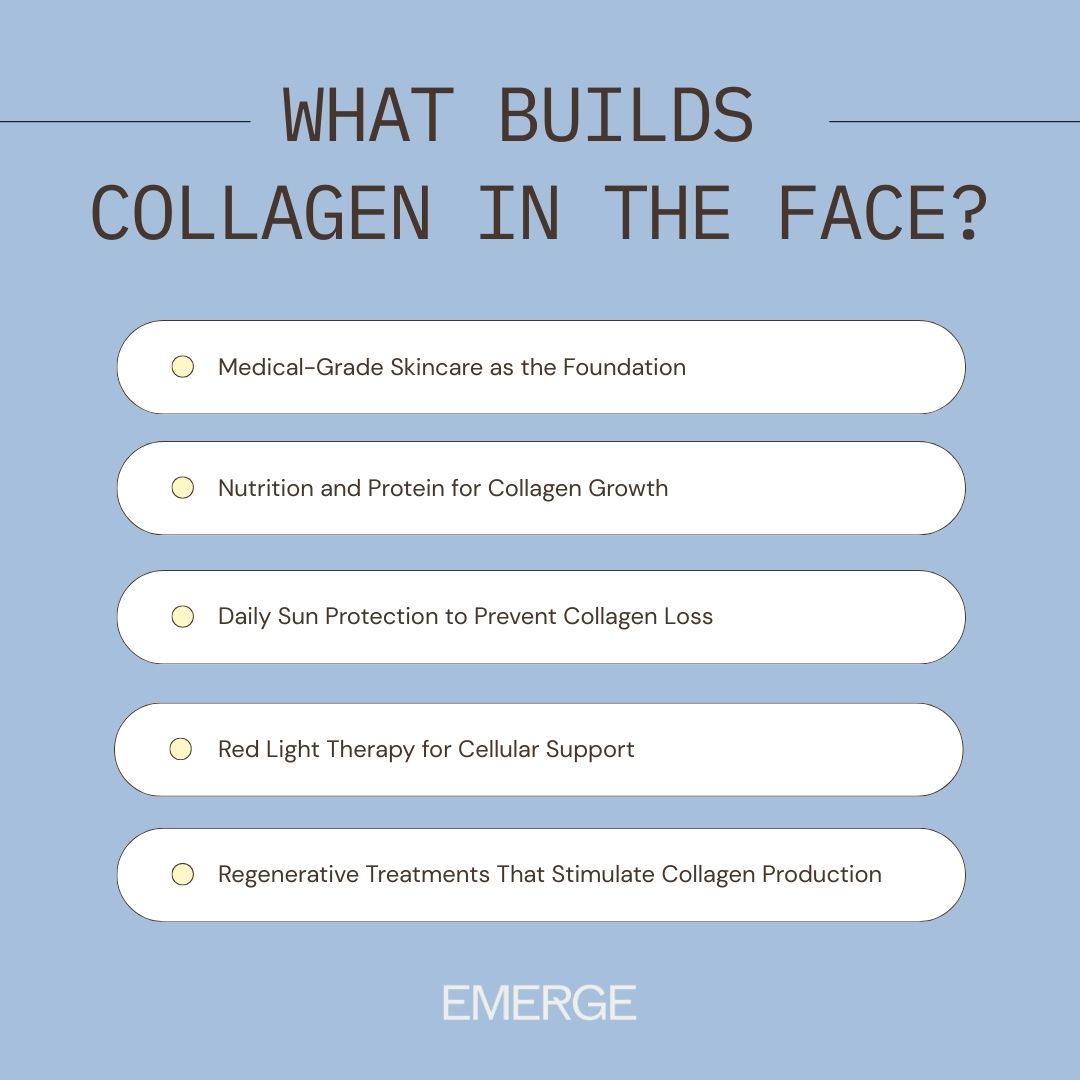
What Builds Collagen in the Face?
Let’s start with foundational strategies. These won’t replace in-office visits and procedures, but they will support collagen levels in the skin.
Medical-Grade Skincare as the Foundation
Skincare is the foundation of everything we do at Emerge. Without improving skin quality, the treatments you do invest in can’t perform as well. But here’s why this gets tricky: we’re surrounded by a sea of brands promising routines that sound great in theory.
Miracle serums. One-quick-fix face cleansers. Anti-aging moisturizers that reduce wrinkles and fine lines in as little as days. If it were this easy, everyone would have great skin!
All you truly need is Dr. Kling’s three pillars of skincare: Retinoid, vitamin C, and a high-quality SPF. These are the main medical-grade skincare ingredients that protect, rebuild, and support collagen. And it isn’t guesswork; it’s scientifically proven and research-backed—which we discuss in our post, “How to Choose Skincare Products.”
Retinoid boosts collagen by stimulating fibroblast cells and inhibiting enzymes that break down existing collagen. At the same time, vitamin C stabilizes collagen’s structure and increases gene expression. Together, this powerful duo repairs, rebuilds, and refines skin quality.
Learn more in our post, “Retinols vs. Retinoids: Which Is Best for Your Skin?” And if you want to see what’s in Dr. Kling’s skincare bag? Check out this video on our Instagram.
Nutrition and Protein for Collagen Growth
Rebuilding collagen isn’t just about what you put on your face—it’s how you nourish from within, too. We’ve said it before, and we’ll say it again—and again and again: you should be eating your skincare. Metaphorically, of course! There are so many ingredients out there that can reduce hyperpigmentation and the appearance of wrinkles while increasing collagen production and elasticity.
What you eat goes hand in hand with moving your body, because strength is the ultimate anti-aging strategy. Again, this isn’t guesswork—it’s science. Research shows that regular exercise can both improve collagen production and enhance skin elasticity through reducing cortisol (the stress hormone) and stimulating blood flow.
Skin health is an inside-out process. What you put in for fuel and nourishment shows on the outside—always.
Daily Sun Protection to Prevent Collagen Loss
UV exposure is one of the main causes of collagen loss. Days spent in the sun, while it may take a while to appear, do negatively affect skin health in numerous ways. UV exposure directly affects collagen by breaking down existing fibers and inhibiting the production of new ones. This is known as photoaging.
And what comes from that? Skin aging, hyperpigmentation, sun spots, and an uneven texture. (There’s a reason Dr. Kling is so serious about her hat!) Ultimately, broad-spectrum sunscreen is non-negotiable. No matter the weather, the time of year, or if you applied it already in the morning.
However, just like with all other skincare products, what you use matters just as much as how you use it. For optimal protection, make Alastin Hydratint Pro Mineral Broad Spectrum Sunscreen a regular part of your routine. A tinted SPF offers better defense against visible light, provides long-lasting hydration, and acts as a lightweight foundation for a no-makeup makeup look.
You can hear Dr. Kling talk about the benefits of tinted SPF here!
Red Light Therapy for Cellular Support
Red light therapy (RLT) is one of those “trendy” skincare products techniques right now but does it work as people claim?
Actually, yes. Red light therapy can stimulate collagen production at the cellular level. Is it as impressive as medical aesthetics? No—the effects of RLT are much more subtle. However, consistent use combined with facial massages and medical-grade skincare can make a noticeable difference.
Red light therapy uses specific wavelengths to stimulate fibroblasts, the cells responsible for collagen and elastin, to reduce wrinkles and support skin structure. According to research, this treatment actually increases hyaluronic acid synthase and elastin gene expression.
Unlike at-home microneedling (which you should never, ever do), it is generally safe and effective. However, always consult your physician before adding it to your routine.
Regenerative Treatments That Stimulate Collagen Production
Your skincare routine matters—but topical products will only take you so far. Think of it as building a sand castle. Unsurprisingly, you can’t build the castle without a solid foundation to work on. But if the goal is real structural change, you need more than surface-level support. You need collagen stimulation deeper in the skin.
Enter options such as microneedling, CO2 laser resurfacing, PRP/PRF, and biostimulatory injectables. They’re not magic treatments—they’re layers of a multimodal approach that rebuild collagen gradually, strategically, and naturally over time.
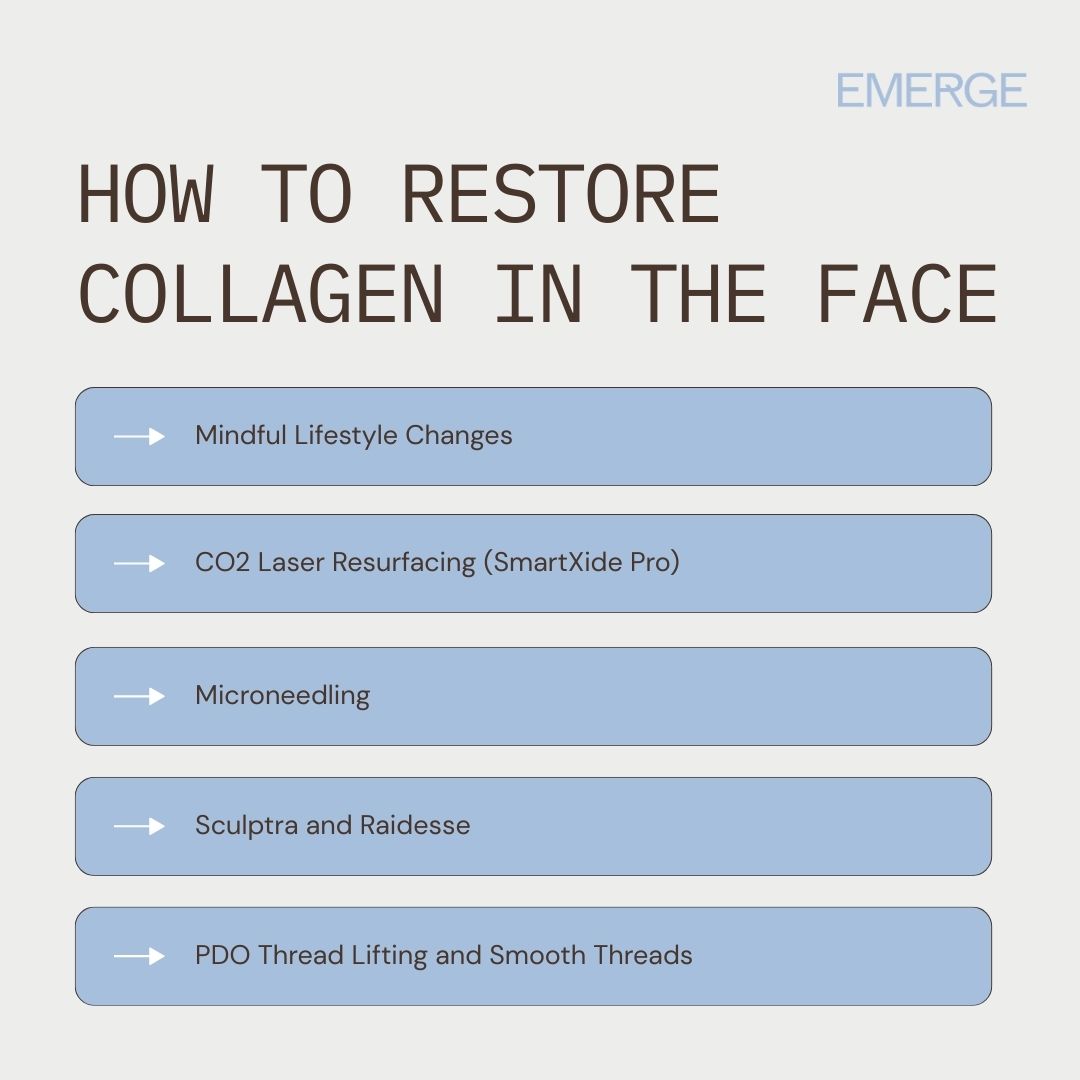
How to Restore Collagen in the Face
Mindful Lifestyle Changes
We can’t emphasize this enough: to support non-surgical medical aesthetics, you have to also take care of your skin. Your skin is an organ, and non-skincare habits matter more than you think. Here are a few things to keep in mind before and after receiving regenerative procedures:
- Build muscle. Better metabolic health means better circulation, better hormone balance, and better collagen support. When you lose muscle, you lose collagen and youthful, radiant skin.
- Get good sleep. Every time you sleep, your skin enters R&R mode. It produces collagen, increases growth hormones, lowers cortisol levels, and enhances blood flow. If you’re not sleeping well, cortisol levels rise, inflammation increases, and skin weakens.
- Eat protein. Protein is everything for skin quality and health. Our skin is built from protein. This doesn’t mean restricting yourself, limiting your options, or going on fad diets. It means eating enough protein to support the production of collagen, elastin, and keratin.
- Control blood sugar. Too many glucose spikes lead to glycation—a process where sugar bonds to proteins and causes structural damage. When this happens, it damages collagen and prematurely ages the skin.
- Stay social. This isn’t talked about nearly enough. The lonelier you are, the more you raise inflammation—whether you know it or not. And ultimately, your nervous system affects your skin more than your serum ever will.
Your topical products matter—but so does your lifestyle. The right approach can protect and restore collagen, especially when paired with non-surgical cosmetic treatments.
CO2 Laser Resurfacing (SmartXide Pro)
Fractional ablative CO2 laser treatments are one of the most powerful tools we have in regenerative aesthetics. This skin resurfacing treatment uses a gas mixture to produce focused light energy, removing microscopic layers of damaged skin. This triggers the natural wound-healing process, stimulating the production of fresh, healthier collagen and elastin.
The result? Softened wrinkles, reduced sun damage, and minimized stubborn fine lines and wrinkles. Most importantly, these precise light beams remodel collagen, tighten skin laxity, and transform overall skin texture. You can see a CO2 procedure in action on our Instagram!
And for a more comprehensive guide, visit “The Gold Standard of Renewal: The Fractional CO2 Laser Treatment for Skin Transformation.”
Microneedling
Microneedling is a regenerative treatment that uses precise needles to create controlled micro-injuries in the skin. As these injuries stimulate the body’s natural healing response, they simultaneously stimulate collagen and elastin production. You can actually hear Dr. Kling talk about microneedling on our Instagram!
These micromechanical injuries aren’t just excellent for collagen production. It also helps even skin texture, tighten and firm loose skin, and improve the absorption of skincare products. Even if you’re unsure about needles, it’s a minimally invasive treatment with little pain and significant results.
Learn more about post-treatment additions, like PRP and PRF, over on our Instagram! You can also hear Dr. Kling explain the difference between exosomes and PRP treatments—and why they work so well to facilitate the healing process and stimulate collagen production.
Sculptra and Raidesse
Sculptra is a collagen bio-stimulator made from poly-L-lactic acid (PLLA) that stimulates collagen production deep within the dermis. It doesn’t “fill” hollow areas; it rebuilds them. Studies even show a 66% increase in collagen production, making it one of the most effective ways to reverse signs of aging.
Sculptra doesn’t offer an overnight change. Instead, it stimulates your own collagen to gradually restore support and structure from within. You can learn more about it in our post “What Is Sculptra and How It’s Different from HA Filler.”
Raidesse is another bio-stimulator that uses calcium hydroxylapatite (CaHA) to provide collagen stimulation. Unlike Sculptra, it offers a quicker, more instantaneous lift and improvement. Many clients choose to go this route for immediate structural support rather than gradual improvement.
Ultimately, the question isn’t “Which dermal filler works best?” Instead, it’s “Which of these bio-stimulators supports my biology, anatomy, and long-term goals?”
PDO Thread Lifting and Smooth Threads
A thread lift is a minimally invasive procedure that uses temporary, dissolvable threads to lift and tighten skin underneath the surface. As the threads dissolve, they stimulate collagen production, resulting in firmer, more elastic skin.
This is an immediate rejuvenation procedure that simultaneously lifts sagging skin and triggers the body’s natural healing process. So clients will get that instant boost of structure from the thread insertion and a long-term boost from collagen stimulation during gradual absorption.
Smooth threads, particularly made from polydioxanone (PDO), are a minimally invasive solution to aging and reduced collagen production. After being inserted into the skin, the smooth PDO threads trigger a mild inflammatory response that stimulates the body’s natural healing process. It’s safe, known for its biocompatibility, and has been used in regenerative aesthetics for years.
To learn more about both procedures, visit our treatment page: Thread Lift: Advanced Collagen Stimulation and Non-Surgical Facelift.
The best way to stimulate collagen production in the face is through a multimodal approach using medical-grade skincare and regenerative aesthetics.
Youthful, radiant, firm skin isn’t luck. People aren’t naturally aging backwards due to miracle creams or serums. Yes, topical products like retinoids, vitamin C, SPF, and certain active ingredients do play a significant role. However, the best results come when you address every layer of aging—skin, structure, and cellular function.
Which is exactly what we do at Emerge Aesthetics. We don’t aim for quick fixes, temporary relief, and overcorrective treatments. Dr. Kling, a double-board-certified Emergency Medicine physician, approaches every treatment plan with science, precision, and research-backed approaches. Bringing a surgical level of expertise to non-surgical aesthetics, you can trust her to restore collagen, improve skin elasticity, and help you look like the more refreshed version of yourself.
Schedule a consultation with Dr. Kling for real guidance, real results, and real transformation.
For additional information about skin health, regenerative aesthetics, and treatment approaches, visit the Emerge blog. We take the guesswork out of skin health and skin quality. Also, make sure you visit Dr. Kling’s medical-grade skincare and targeted skincare solution recommendations to start protecting your own collagen production today!