
Aging is a privilege—but that doesn’t stop us from noticing the physical changes that come with it. Over time, we lose fat in the face, especially in the temples, cheeks, and around the nasolabial folds. And what do we see when we look in the mirror? Sagging skin, tons of shadows, and a hollowed appearance.
Good news: You can’t stop aging, but you can definitely control how you age. At Emerge, patients come in all the time asking how to get plumper, more lifted, more radiant skin. Fortunately, today’s regenerative treatments give us options—including collagen stimulators like Sculptra and HA Fillers.
Both are among the most popular treatments in the country, but they work in entirely different ways. And because Sculptra is a bit newer, clients want a bit more clarity. So today, we’ll discuss what Sculptra is, what HA fillers are, and how they take a different targeted approach.
What Is Sculptra and How It’s Different from HA Filler
It’s not uncommon to keep anti-aging routines strictly to serums, creams, and balms. However, topical products will only take you so far. The real magic happens below the surface—and this is evidence-based, not trend-based.
But before you choose an injectable, it’s important to understand what each product does, targets, and offers. It’s also important to understand why one may be more appropriate than the other depending on your anatomy, concerns, and desired outcomes.
In this post, you’ll learn about what HA fillers do, what Sculptra does, and how Dr. Kling combines them into strategic multimodal anti-aging plans. By the end, you’ll know exactly what to expect when it’s time to schedule a consultation.
What Is HA Filler?
Hyaluronic acid (HA) dermal fillers are gel-based injectables used to restore volume, enhance symmetry, and soften fine lines and wrinkles. HA is naturally found in the skin, so fillers blend seamlessly when placed by a trained, board-certified physician. This treatment is ideal for…
- Immediate results
- Sculpting specific features (cheeks, chin, jawline)
- Filling superficial lines
- Enhancing facial balance and contour
Because HA fillers provide instant volume, they’re often chosen for clients who enjoy seeing quick, immediate improvement.
However, as Dr. Kling likes to remind clients, HA fillers don’t lead to overdone, overfilled results. Instead, she takes a strategic approach, providing natural-looking enhancements that come from expertise, restraint, and a deep understanding of anatomy.
What Is Sculptra Treatment?
Sculptra is a collagen bio-stimulator made from poly-L-lactic acid (PLLA)—a biocompatible substance that’s been used in medical aesthetics for decades. Unlike dermal fillers, Sculptra stimulates collagen production deep within the dermis. It doesn’t fill; it rebuilds.
Essentially, it’s the closest thing we have to turning the clock back biologically. To prove it, studies show that Sculptra generally shows a 66% increase in collagen production thanks to that PLLA-SCA. Consider it a long-term investment in your skin’s structure. However, it’s not changing the architecture of your face overnight. Instead, it’s gradually rebuilding the framework that supports smoother contours and healthier, more resilient skin.
Sculptra is ideal for…
- Significant age-related volume loss
- Hollow cheeks or temples
- Face laxity
- A dull, thin, or crepey appearance
- Patients who want natural, progressive treatment
Dr. Kling uses Sculptra in a multimodal approach because achieving good results requires addressing every layer of aging—skin, structure, and cellular function. See more about the 5 5 5 rule for Sculptra here!
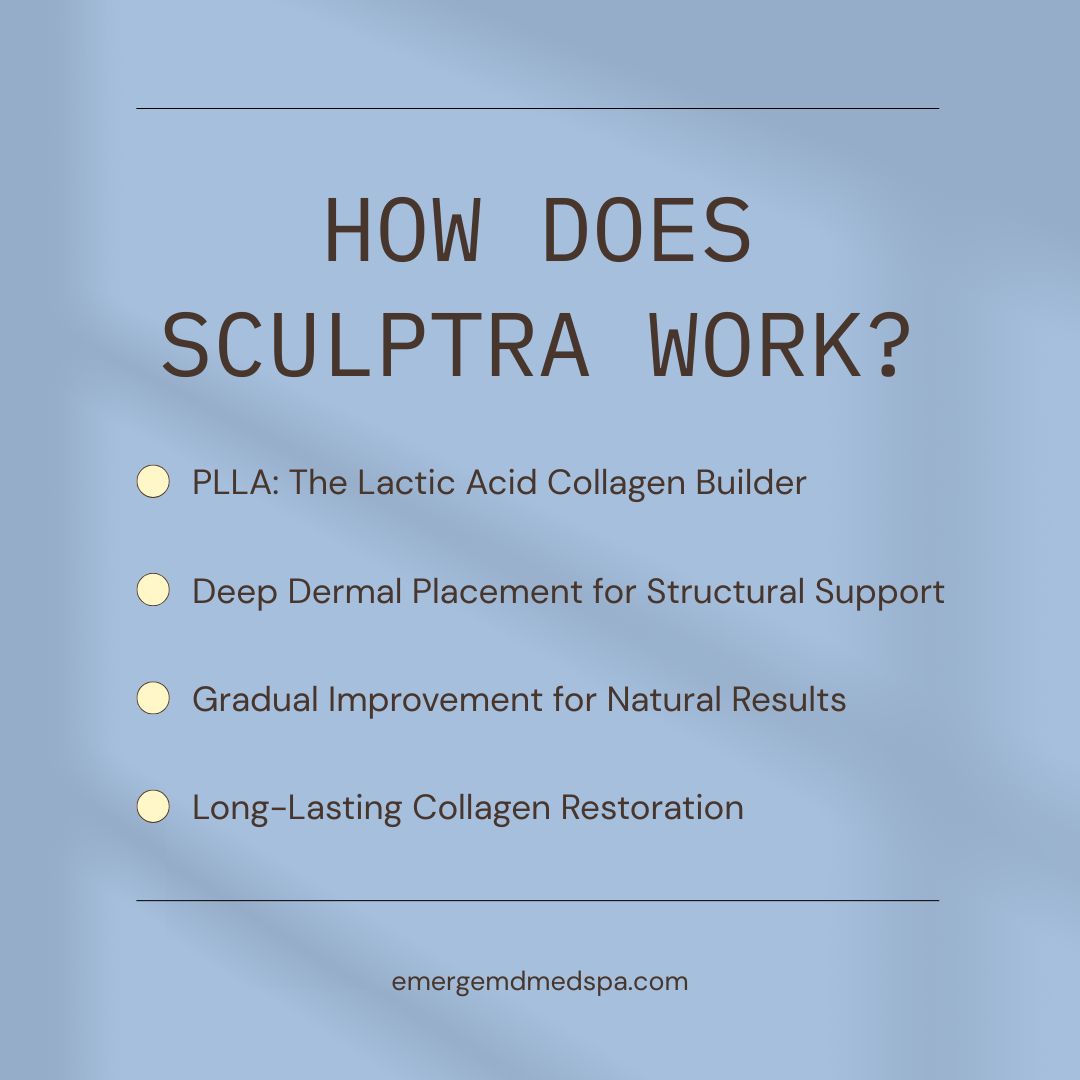
How Does Sculptra Work?
PLLA: The Lactic Acid Collagen Builder
Poly-L-lactic acid is Sculptra’s primary ingredient. It’s injected deep into the skin’s dermal layer, attracting cells like macrophages and fibroblasts. And what do those two inflammatory response cells do? Stimulate collagen production—your OWN collagen, actually. You don’t look “done,” you look refreshed.
Deep Dermal Placement for Structural Support
After Sculptra injections, the PLLA acts as a scaffold. More specifically, it’s placed in particular anatomic places—typically over the bone—to lift areas affected by sagging and shadowing. As collagen develops, it gradually provides volume, firmness, and strength.
Gradual Improvement for Natural Results
Sculptra does not produce instant, noticeable results. Instead, it improves the production of collagen over several months. We even shared a Sculptra timeline on our Instagram! Because of the slower process, clients can enjoy subtle, more natural-looking results.
Remember: dramatic results happen gradually, and only when you follow a treatment plan.
Long-Lasting Collagen Restoration
We don’t have a one-size-fits-all answer to Sculptra’s longevity. Studies show that results can last up to two years, but we have to consider the aging process. Meaning, we build collagen and we lose collagen. (You can hear Dr. Kling explain this here!)
So, you can’t expect indefinite results from one single session. But continual, minimally invasive treatments can maintain and enhance results over time.
Related: How Does Body Contouring Work?
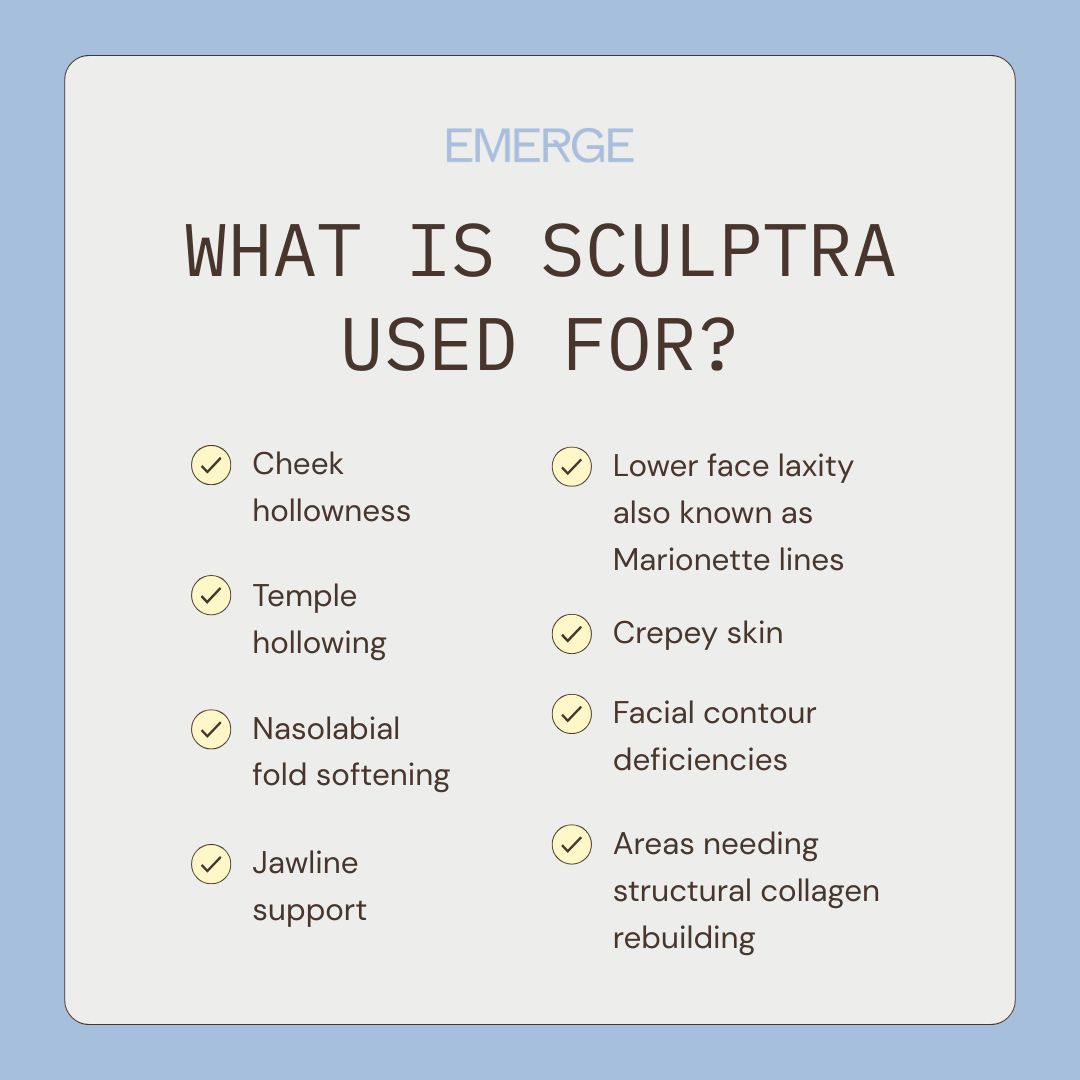
What Is Sculptra Used For?
Sculptra provides true rejuvenation: subtle, strategic, and natural-looking results. It’s designed to enhance your own beauty without changing who you are. Consider scheduling a consultation with Dr. Kling if you deal with…
- Cheek hollowness
- Temple hollowing
- Nasolabial fold softening
- Jawline support
- Lower-face laxity (also known as Marionette lines)
- Crepey skin
- Facial contour deficiencies
- Areas needing structural collagen rebuilding
To learn more, we have a few resources over on our Instagram. You can hear Dr. Kling discuss pain management and what to expect after Sculptra injections. Also, check out what one session of Sculptra looks like.
Sculptra vs HA Filler: Which is Better
Truthfully? Neither is “better”—they simply do different things. HA filler provides instant lifting, shaping, and contouring. Sculptra, on the other hand, rebuilds collagen from within to promote long-term structural changes.
For global volume loss, early sagging skin, loss of facial radiance, or hollowing that creates shadows, opt for Sculptra. That said, Dr. Kling may recommend HA fillers when a precise contour change is necessary. Think chin projection, jawline definition, or targeted fold softening.
In MOST cases, the best results come from a strategic combination of treatments. This is why Emerge emphasizes gradual, multimodal approaches. No single treatment will fix everything—not laser, not filler, not threads. When you address every stage of the aging process, results last longer, feel better, and look more natural.
Both treatments have (minimal) side effects, both require expert placement, and both should be administered by a board-certified physician. More importantly, the physician should understand anatomy, tissue regeneration, and the science of medical aesthetics.
Prevention is always easier than reversal!
With a targeted, multimodal approach, the right treatment plan can give you stronger, radiant, and more resilient skin.
Whether you choose Sculptra, HA fillers, or a combination of both, the goal isn’t to look different. Instead, it’s to look like you again—restored, radiant, and balanced. And remember: you can’t prevent aging, but you can prevent the physical changes that accompany it.
If you’re ready to explore what facial rejuvenation can do for your skin, the next step is simple! Schedule a consultation with Dr. Kling and receive a personalized, physician-led treatment plan. One that’s designed for long-term, natural-looking results that work for you. In the meantime, you can also elevate your beauty routine with Dr. Kling’s recommended skincare.